Temple Epoxy Flooring installs epoxy flooring in Woodway, and after more than 20 years of coating concrete across Central Texas we have learned not to bring the same assumptions to every slab in the region. This city is a genuine exception to the one warning most flooring contractors here recite by reflex, and pretending otherwise would mean selling a detail nobody needs.
We check what a slab actually sits on before we quote it. Roughly a third of the ground we work over across this region is true shrink-swell clay and about half of it is not, and those two conditions deserve different conversations. Reading the soil for a given address takes minutes and it changes the crack detail, sometimes the product, and occasionally the price.
What we will not do is tell you a coating can do something it cannot. It is a film. It bonds to the slab and it follows the slab, and no resin system stops ground movement, bridges a working joint or makes a bad substrate into a good one. Everything below is written around that honest limit.
The clay warning that does not apply here
What the soil survey maps under this city
The soil survey at the Woodway city centroid maps the Eddy-Urban land complex on 3 to 15 percent slopes, with Eddy at about 50 percent of the map unit and urban land at 40 percent. Eddy is a loamy-skeletal, carbonatic, thermic, shallow Typic Ustorthent sitting over chalk, and it is well drained.
The properties that matter to a coating are the ones at the bottom of the sheet. Maximum horizon clay content is 30 percent, the plasticity index is 16, and linear extensibility is 1.5 percent. Those are low shrink-swell numbers, roughly a fifth of the seasonal movement measured on the reactive Vertisol map units found at other points in the same county.
What 1.5 percent actually means for a floor
On highly reactive ground, a resin coating spends its life fighting a slab that swells with water and shrinks as it dries, and the honest specification there is built around that motion. At 1.5 percent linear extensibility, that seasonal cycle is a much smaller force, and the coating is being asked to do a simpler job than a blanket regional warning would suggest.
We say that out loud because the alternative is charging for a problem that is not present. One point of caution belongs with it: a single survey point does not characterize all 6.58 square miles of the city, so we still read the map unit for the address rather than the city, and we still look at the slab before we commit to a detail.
Diagnosing a crack when movement is not the default answer
Where the ground barely moves, attributing every crack to seasonal heave leads straight to the wrong repair. Settlement, plastic shrinkage from the original pour, a control joint that was cut late or never cut at all, and point loading from a vehicle or a heavy cabinet run are all more likely explanations here, and each one calls for a different treatment.
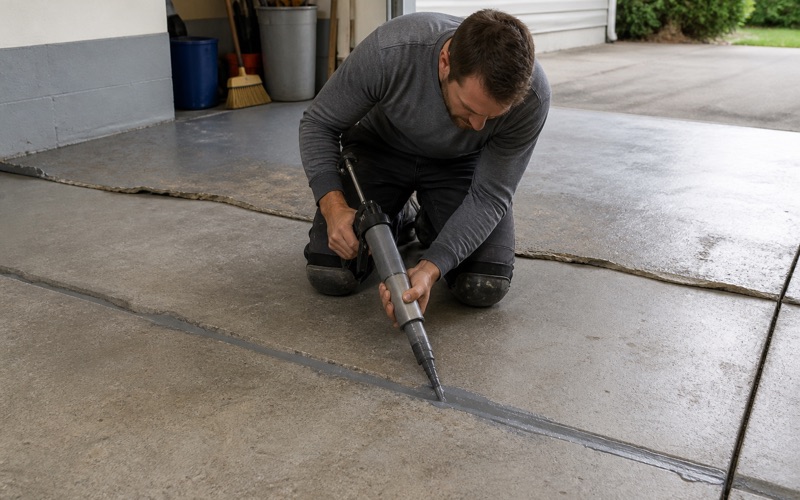
Where we do find a crack that is genuinely still working, we treat it as a live joint rather than filling it rigid and coating straight over it. That means a semi-rigid polyurea filler detailed to keep moving, and it means saying before the job that the line may show through again. A floor explained in advance never becomes an argument afterward.
Looking for epoxy flooring closer to Cameron? See Epoxy Flooring in Cameron.
Nothing in this city was poured before 1955
A housing record that begins at incorporation
Woodway incorporated on June 20, 1955, and its housing record starts there. Of 3,968 total housing units, the estimate records zero built in the 1940s and zero built in 1939 or earlier. There is no pre-war stock in this city, no historic review layer sitting over a garage project, and no century-old detached structure on a pad nobody can identify.
That is unusually clean ground for this trade. Every slab we grind here was poured under modern-era practice, so thickness conventions, reinforcement and finish quality are all more predictable than in an older town.
Two decades that built half the city
The 1960s and 1970s account for 25.7 percent and 25.8 percent of the housing stock respectively, so 51.5 percent of everything here went up inside twenty years. Working this city repeatedly means seeing the same narrow band of construction practice again and again: comparable slab conventions, comparable garage proportions, comparable drainage details, all aging on the same schedule.
The name fits that history. Woodway is a portmanteau of two existing local place names, Woodland West and the Village of Midway, stitched together for a city that covers 6.58 square miles at an elevation of 653 feet in McLennan County. A large cohort of its garage slabs is reaching the same age at the same time, which is why we see so much surface wear of the same character.
Conventionally reinforced concrete against post-tension
55.6 percent of the stock predates 1980, so the modal residential slab here is conventionally reinforced ground-supported concrete rather than tensioned. Post-tension became common in Texas construction after about 1980, and in this city it concentrates in the 14.2 percent built since 2010.
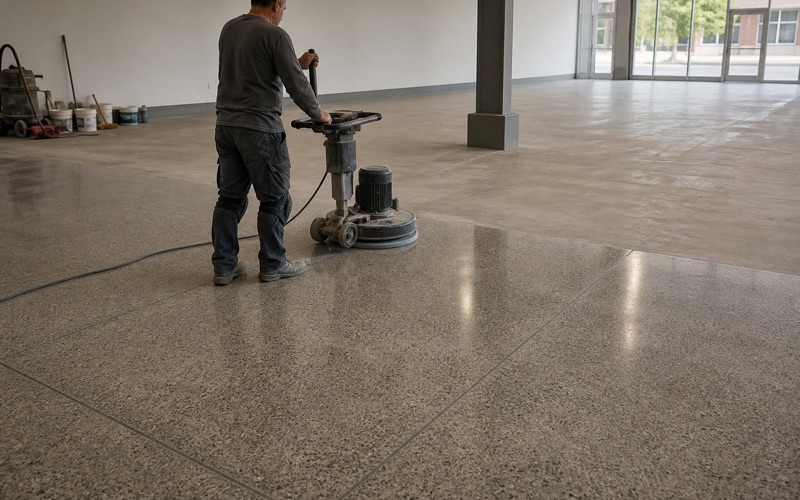
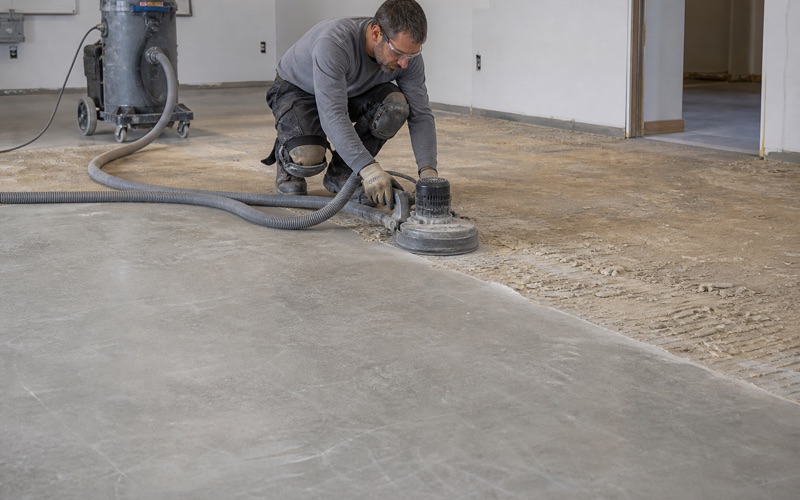
Knowing which one is underfoot has to happen before mechanical preparation is scheduled, not during it. Cutting, coring or setting an anchor into a post-tension slab risks a tendon. Diamond grinding and shot blasting open the surface to the ICRI CSP profile the system needs without going near a tendon, which is a large part of why we prepare every floor mechanically regardless of era. We never acid etch, and we never coat over somebody else’s sealer.
An owner-occupied market of freestanding houses
The person choosing the floor is the person standing on it
90.8 percent of households here own their home, and 3,339 of 3,719 occupied units are an owner living in a freestanding detached house. The estimate records no owner-occupied attached or multifamily units at all. Practically, every homeowner garage in this city belongs to a standalone house and the buyer is the eventual user.
That changes what the decision is about. Nobody is asking us how fast the floor can be handed to somebody else. They are asking how it will look in six years, how it cleans, whether it will yellow, and what happens where the bay meets the driveway. We answer those in the proposal, which names the product, the system build and the mil thickness so what was quoted can be checked against what was installed.
How the space actually gets used
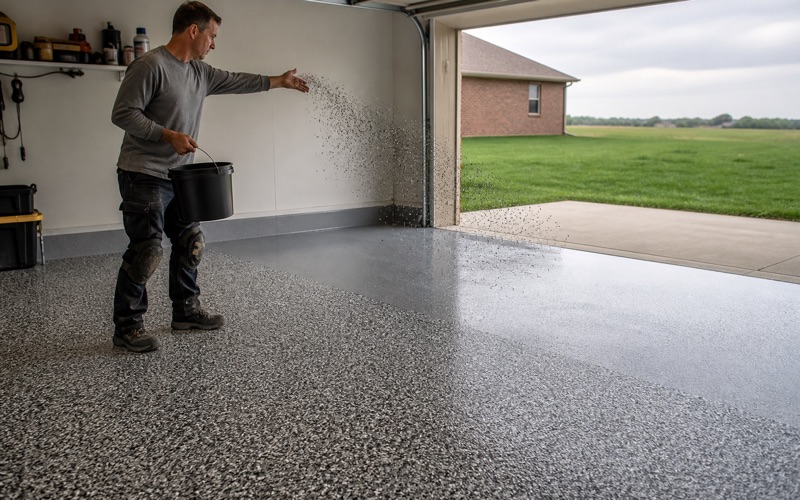
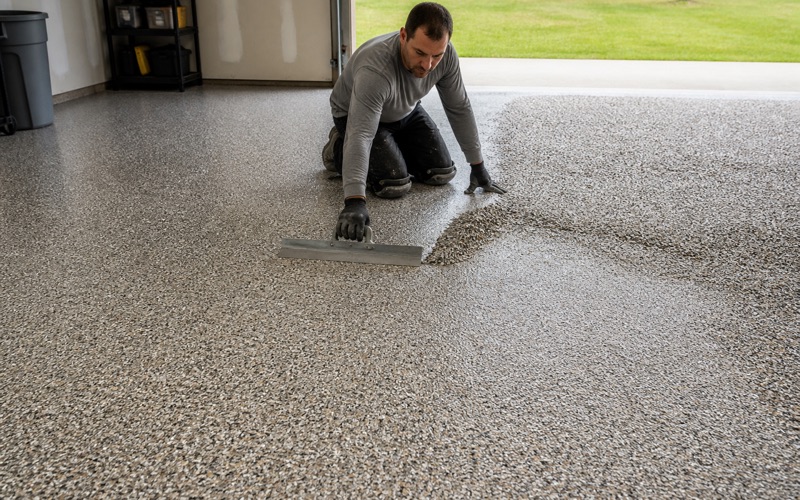
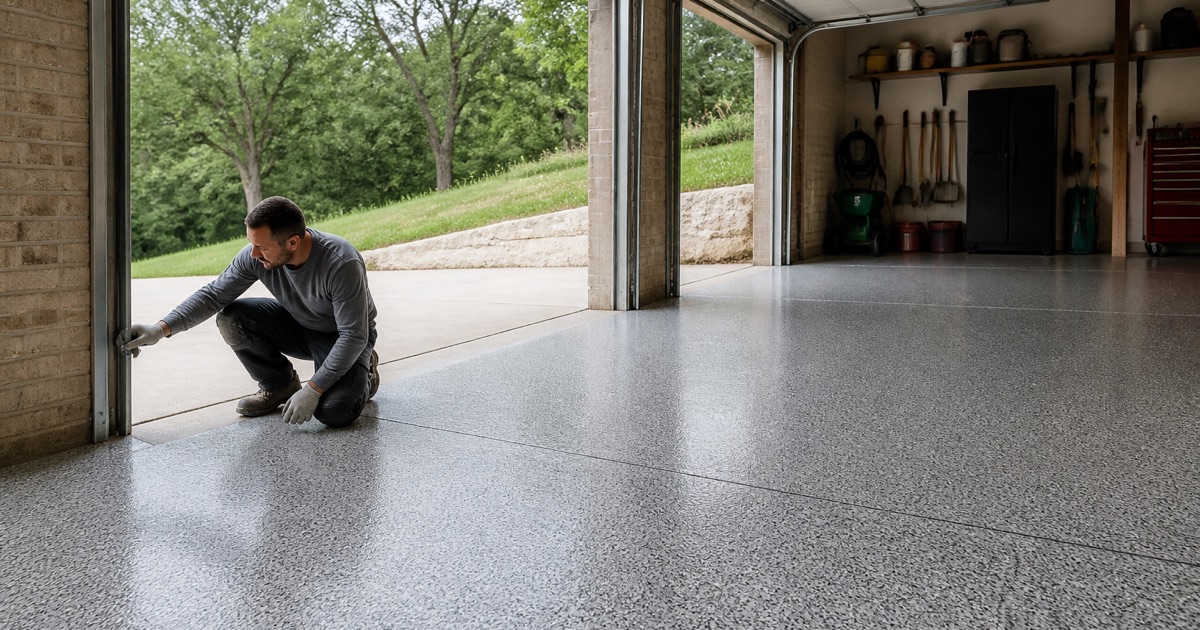
A garage in this city is frequently a workshop, a gym or a second living space rather than parking, and the finish should reflect what happens in it. A vinyl flake broadcast hides dust and chipping between cleans and gives a natural coefficient of friction underfoot; a quartz aggregate broadcast reads more industrial and takes heavier abuse; a pigmented system under a clear polyaspartic or polyurea topcoat holds color and resists yellowing best.
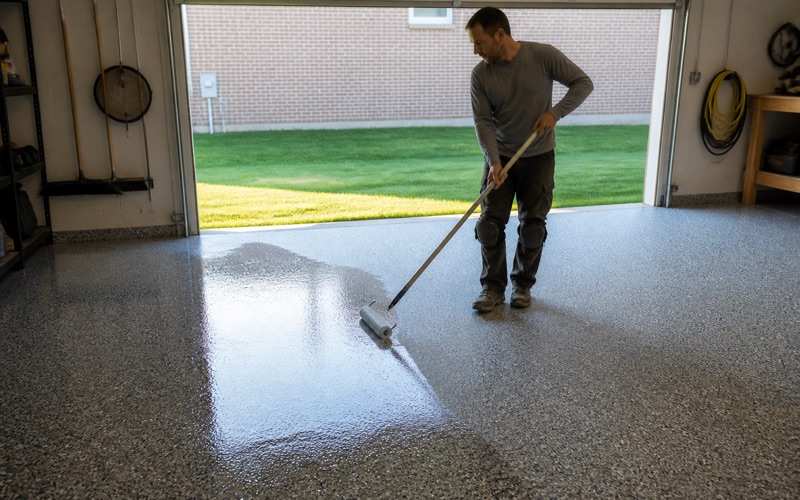
Mil build is the specification that decides service life, not the color chart. A 100 percent solids epoxy body laid at the specified spread rate and topped correctly resists hot tire pickup from a vehicle coming off a hot driveway; a thin single-day roll-on does not. Where a floor is staying bare concrete, a lithium silicate densifier is a different product with a different purpose, and we will say when that is the better answer.
The commercial floors that exist here, and the ones that do not
There is no industrial park inside this city limit, no rail function and no manufacturing base, so a pitch built around warehouse and plant work would be aimed at a market that is not present. The non-residential floor here is institutional, municipal and hospitality: school district buildings, public safety apparatus bays, recreation and event facilities, and hotel back-of-house.
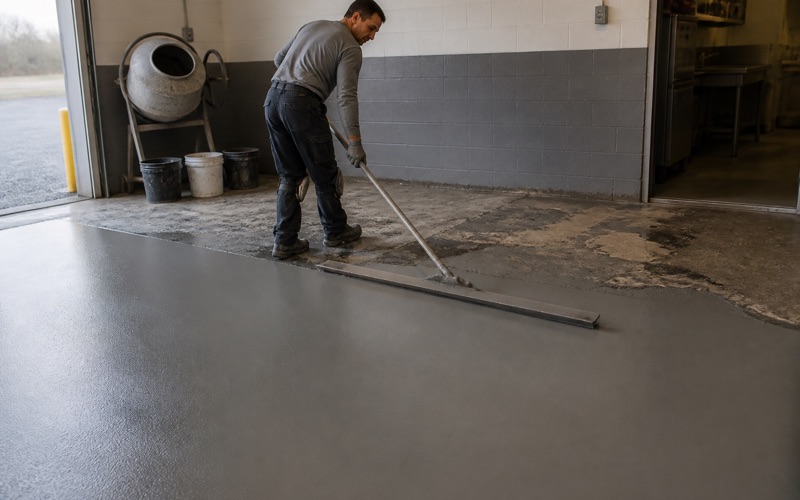
Those carry their own rules. A commercial kitchen in a hotel or an institutional building falls under the Texas Food Establishment Rules and the Food Code provisions on smooth, durable, easily cleanable surfaces, coved floor and wall junctures and the antislip exception, which usually points to urethane cement with an integral coved base rather than a standard epoxy. A business facility here also draws state-required fire safety inspection through the Woodway Fire Marshal’s office, which is part of the city’s combined Public Safety Department.
Working on sloping ground in Central Texas weather
Slope, drainage and the garage approach
Eddy soil is shallow over chalk on grades running 3 to 15 percent, so a lot of the residential work here is hillside work. Driveway approaches pitch harder, garage slabs are laid to drain toward the door on a real fall, and water arrives at a bay opening with more speed than it does on flat ground.
That matters at the edges of the floor. We detail the coating termination at the door line so runoff does not sit against the film, and we look at the low corner of the bay before quoting rather than after the first hard rain.
Dew point at the slab surface, not air temperature
We schedule against the dew point at the slab surface, not the air temperature, which is why summer work usually starts mid-morning rather than at dawn. A published requirement that surface temperature stay at least 5 degrees above the dew point rules out a cool slab on a humid morning, and ignoring it produces amine blush or a bond failure that only shows up later.
The margins here are narrower than a specification written for a dry climate assumes. A recent National Weather Service gridpoint forecast for this grid carried dew points from 58 to 74 degrees and relative humidity from 24 to 82 percent. At the top of that range there is no early-morning start worth taking, and we would rather move a day than force one.
Heat, freeze windows and what we can show you
Heat governs the working day from the other direction. The same forecast period ran from 75 to 103 degrees, and an uninsulated slab does not shed its heat overnight when the low is around 75. On one published product, pot life falls from roughly 60 minutes at 55 degrees to about 40 at 72 degrees and about 20 at 95 degrees, while the minimum recoat window collapses from 24 hours to about 6. A twenty-minute pot life changes crew size and batch size, not just the start time.
Winter is the opposite risk and the reference event is Winter Storm Uri, whose incident period ran February 11 to 21, 2021 and which brought Central Texas six to nine consecutive days of freezing temperatures. An unheated garage in a freeze sits below the minimum application temperature on every data sheet worth reading, so we flag the shutdown risk when a February date is booked.
Permits run through the city’s Inspections and Planning Division, and the intake schedule is narrow: the One-Stop Center meets one hour a week, on Thursday afternoons, as the primary intake and payment point for building permits. Accessory structures are stricter than most people expect, since storage buildings need approval before placement even with no permanent foundation. Texas licenses no flooring or coatings contractor, so instead of a number nobody issues we show general liability cover, workers’ compensation, a Texas sales and use tax permit and city contractor registration.
Moisture testing belongs in the scope from the start on an older slab rather than being sold after a floor blisters. That means ASTM F1869 calcium chloride vapor emission testing, ASTM F2170 in-situ relative humidity probes or an ASTM D4263 plastic sheet screen, read against the ASTM F710 thresholds, with a moisture-mitigation primer priced in advance if the numbers call for one. We also walk the warranty exclusions, moisture and substrate movement first, before anything is signed.
- 20+ Years in Central Texas
- Fully Insured
- Free Written Proposal