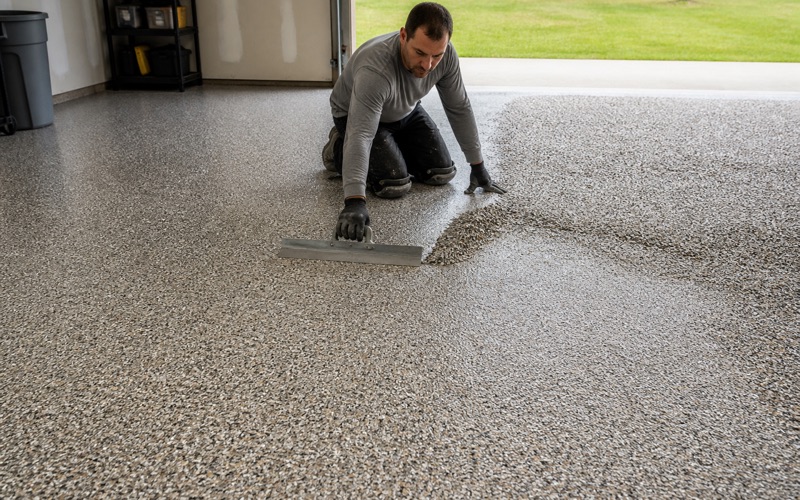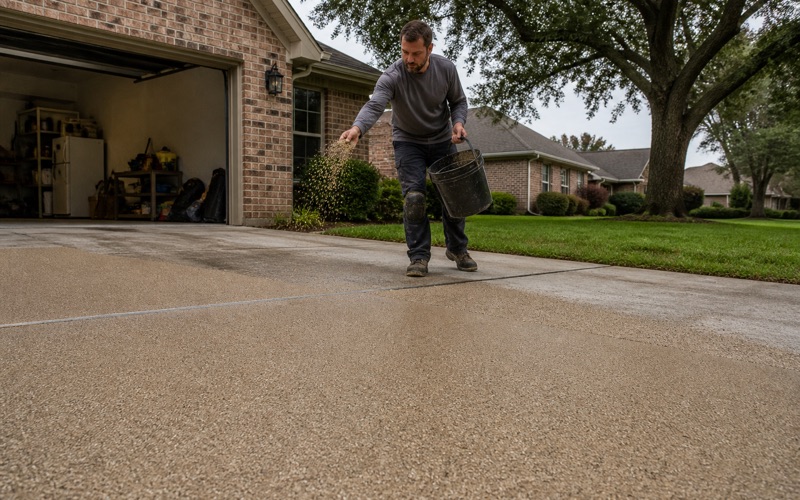
Temple Epoxy Flooring installs commercial epoxy flooring in Waco, and we have spent more than 20 years putting coatings on Central Texas concrete. Most of the work we are asked to price here is decided by someone who owns the building rather than by someone who stands on the floor, and that changes the conversation from the first call onward.
A coating is a film. It bonds to the slab, it follows the slab, and it will not stop or bridge ground that moves with the seasons. We say that plainly before a proposal goes out, because the alternative is explaining it after a crack has telegraphed through a finished floor.
So we start with the concrete and the site rather than with the color chart. What the slab sits on, roughly when it was poured, what has already been put on top of it and how much moisture is still moving through it all decide the system long before anyone picks a flake blend.
A city where renters are the majority
Waco is renter-majority, and only just: 27,258 renter-occupied units against 26,648 owner-occupied, 50.6 percent to 49.4 percent of 53,906 occupied units. Very few Texas cities this size read that way, and it shows up in nearly every job we quote inside the city limit.
The person deciding is rarely the person standing on it
When a landlord or a property manager signs off on a floor, the brief is different. The question is not whether the finish suits the room; it is how many years the coating survives being used hard by people who did not choose it.
It also matters that 7,073 single-family detached houses here are renter-occupied, roughly a quarter of all renter households in the city. A house-to-house rental portfolio is a repeatable specification, and we price it as one rather than treating each address as a fresh design exercise.
Durability and turnaround set the specification
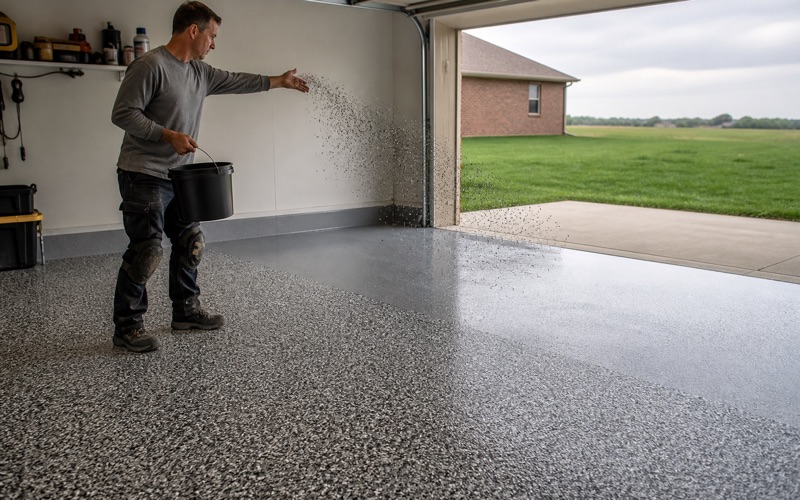
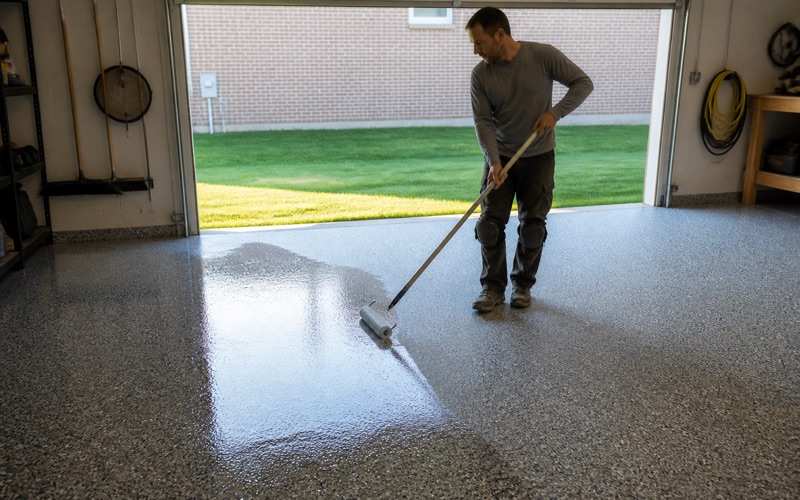
On a rental turnover we take the owner’s timeline as the governing constraint. Durability and how fast the floor can be handed back decide the build, and appearance is what is left over once those two are satisfied. A 100 percent solids epoxy body coat under a polyaspartic or polyurea topcoat usually wins that argument, because the topcoat is what shortens the return-to-service window.
Hot tire pickup is the failure a rental garage actually sees, and it is a bond and cure problem rather than a product problem. A properly ground profile and a genuine full cure before a vehicle rolls back in matter far more than which label was on the pail.
A proposal that can be checked against the install
Our proposals name the product, the system build and the mil thickness, so what was quoted can be compared against what was installed. Someone holding four addresses should be able to lay four documents side by side and read the same spread rate on each.
Texas does not license flooring contractors, so there is no license number for anyone to give you. Instead we show general liability cover, workers’ compensation and a Texas sales and use tax permit, and we walk through the warranty exclusions, substrate movement and moisture first among them, before the job is sold rather than after.
Looking for epoxy flooring closer to Belton? See Epoxy Flooring in Belton.
One compressed turnover window every year
Baylor University enrolled 20,626 students in fall 2024 and 64 percent of them live off campus, which puts roughly thirteen thousand people into a rental market of 27,258 units. Those leases turn on the academic calendar, so a large share of the city’s rental stock changes hands within the same few weeks.
Scheduling backward from a fixed date
A turnover window with a move-in date attached is not a deadline anyone can push. We book those jobs backward from the handover: full cure first, topcoat before that, body coat before that, and mechanical prep at the front, with the moisture result already in hand.
A market that turns over at random gives a contractor a steady trickle of single-unit work spread across twelve months. This one stacks into a peak instead, which is why we ask owners to commit to dates well ahead of the window rather than calling once the tenant has already gone.
Dew point at the slab surface, not the air temperature
We schedule against the dew point measured at the slab surface. A published application floor of 5 degrees Fahrenheit above the dew point is a hard limit, and in a humid subtropical summer the dew point here can sit in the low seventies while the slab is still holding overnight cool.
That is why we start mid-morning in summer instead of at dawn. A dawn start looks efficient and puts product onto a slab sitting below dew point, and amine blush or a quiet bond failure is what shows up weeks later.
Pot life shortens as the slab warms
Heat cuts working time sharply. On one published product, pot life runs roughly 60 minutes at 55 degrees Fahrenheit, about 40 minutes at 72 degrees Fahrenheit and about 20 minutes at 95 degrees Fahrenheit, while the recoat minimum collapses from 24 hours to 6 hours. Batch sizes and crew numbers get set from those figures rather than from habit.
The collapsing recoat minimum cuts both ways. It can pull a two-coat build into a single day, which is exactly what a fixed handover date needs, but it also means a coat left overnight in summer heat can pass out of its recoat window before the crew returns. We plan the day around the window rather than discovering where it closed.
Ground that changes within one city limit
The soil under this city is not one soil, and the spread across it is wider than the difference between many separate cities. That single fact is why we will not quote a coating system in Waco from a phone description of the room.
Eddy at the city centroid
At the city centroid the soil survey maps an Eddy-Urban land complex on 3 to 15 percent slopes. Eddy is a shallow, well-drained, loamy-skeletal carbonatic soil with a maximum horizon clay content of 30 percent, a plasticity index of 16 and linear extensibility of 1.5 percent. That is low shrink-swell ground.
On that kind of ground a slab is comparatively still, and the conversation about cracks becomes a conversation about the original pour and the loads it has carried rather than about the seasons. It is also shallow soil over chalk, so what shows up in the concrete tends to be there from the beginning instead of arriving later.
Fairlie, about three miles south
Roughly three miles south the same survey maps a Fairlie-Urban land complex on 1 to 3 percent slopes. Fairlie is a fine montmorillonitic Udic Haplustert, a true Vertisol, with 50 percent clay, a plasticity index of 41 and linear extensibility of 7.5 percent.
That is five times the seasonal movement of the ground at the centroid, inside one municipal boundary. Waco sits where the Blackland Prairie meets shallower limestone and chalk country and both are genuinely present here, so treating every address as deep expansive clay is wrong for one side of town, and treating none of it that way is wrong for the other.
Why we ask for the address before quoting
About a third of this city is true shrink-swell clay and about half of it is not, and the two need different conversations. We check what the slab actually sits on before pricing, because on the Vertisol side the seasonal movement is real and on the shallow carbonatic side it largely is not.
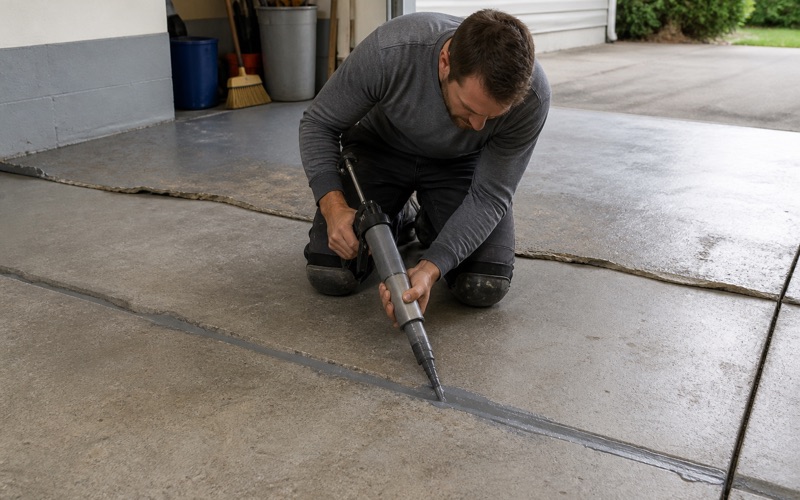
Where the ground moves, a crack is treated as a live joint and filled with a semi-rigid polyurea rather than packed rigid and coated over, and we tell you before the work starts that it may telegraph again. That is not a hedge, it is the honest description of what a film bonded to moving concrete does.
Preparing a Waco slab
Half the housing stock in this city, 50.9 percent, was built before 1980, and the 1950s alone account for 16.6 percent of all units, the largest single decade on record here. Commercial buildings follow a broadly similar spread, and the age of the pour changes what can be done to it.
Establishing what the slab is before any prep
Conventionally reinforced ground-supported concrete is the modal older slab. Post-tension construction became common in Texas after about 1980 and concentrates in the newer stock, and which one is underfoot decides what may be cut, cored or anchored. That gets settled before a grinder is scheduled, not during.
The oldest addresses raise a different question again, because pre-war construction in Texas is commonly pier-and-beam over a crawlspace rather than slab-on-grade. In those buildings there may be no interior slab to coat at all, and whatever concrete does exist is often a separate and much later pour with its own history. On that stock the substrate is a site question, not something an address alone answers.
Moisture testing written into the scope
On an older slab, moisture testing goes into the scope from the start rather than being sold as an add-on after a floor blisters. Depending on the substrate we run ASTM F1869 calcium chloride vapor emission testing, ASTM F2170 in-situ relative humidity probes or an ASTM D4263 plastic sheet test, and read the numbers against ASTM F710 thresholds.
Slabs poured before vapor retarders were standard practice often have nothing under them at all. Where the readings come back high, a moisture-mitigation primer goes into the build and into the price, in writing, before anyone has committed to a finish.
Preparation is mechanical, every time
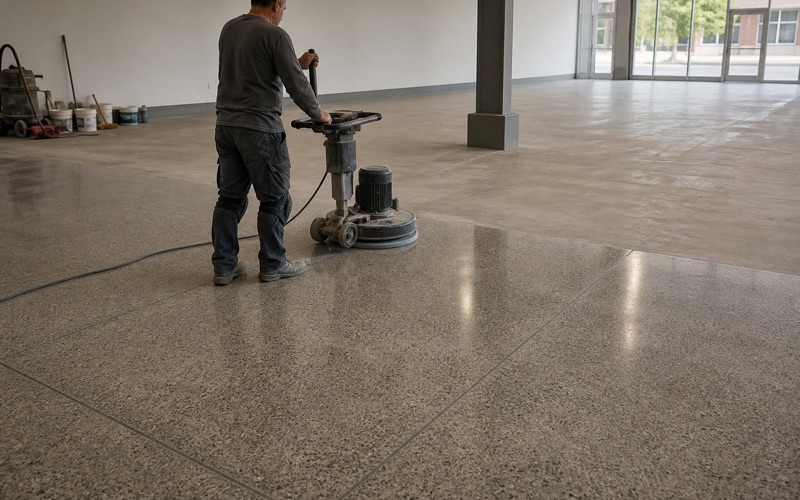
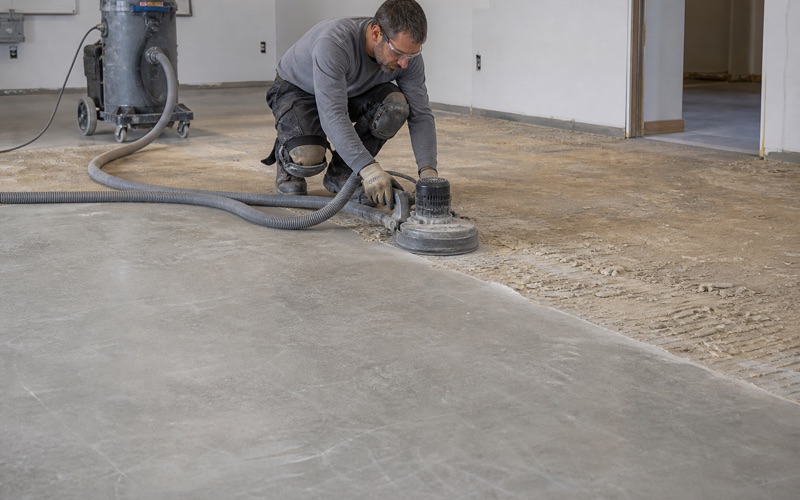
Every slab is diamond ground or shot blasted to an ICRI CSP profile suited to the system going down. We do not acid etch and we do not coat over an existing sealer; an old sealer comes off with PCD tooling first, and the diamond segment bond hardness is matched to the concrete rather than to whatever happens to be on the truck.
Commercial floors with harder service
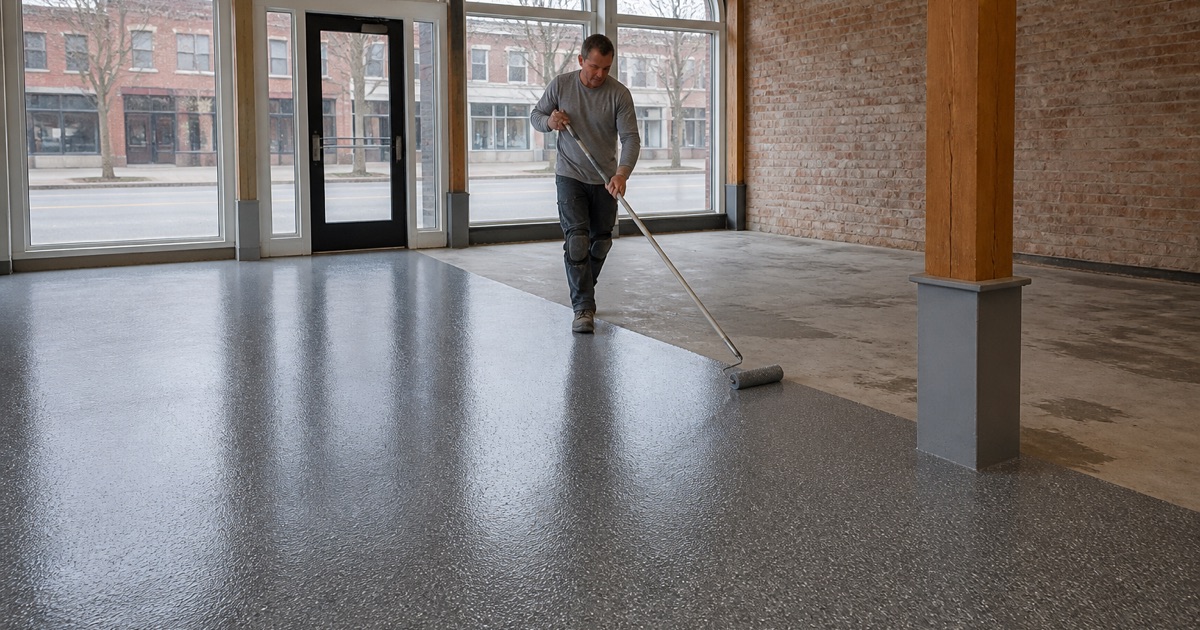
Downtown’s reuse of old industrial buildings puts a particular kind of slab in front of us. Former plant and warehouse floors arriving into retail, restaurant and research use come with unknown prior coatings, unknown moisture history and no vapor retarder underneath, because nobody installed one when they were poured. We test and profile them as unknowns, because that is exactly what they are.
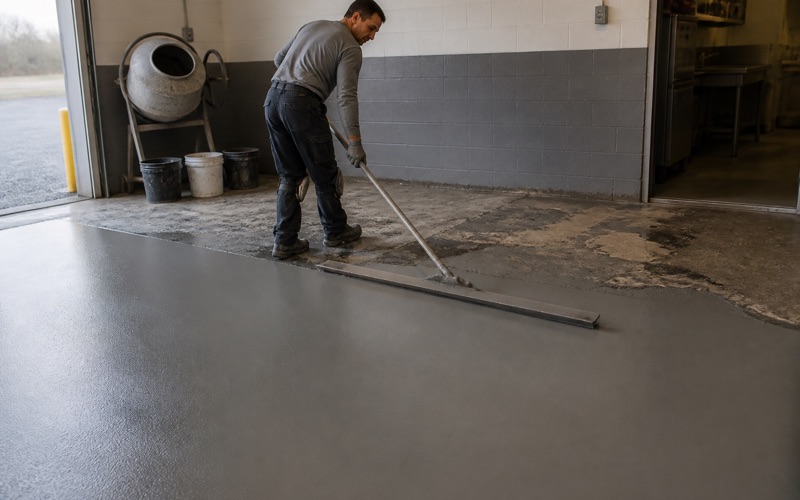
Where a floor faces continuous washdown, sanitation chemistry and thermal cycling, urethane cement rather than epoxy is usually the honest answer, with an integral coved base at the wall junctures and a quartz or vinyl flake broadcast set for slip resistance. Specifying an epoxy where a urethane cement belongs produces a cheaper quote and a shorter floor life.
- 20+ Years in Central Texas
- Fully Insured
- Free Written Proposal