Temple Epoxy Flooring installs epoxy flooring in Serenada, and after more than 20 years coating concrete across Central Texas we have learned that the first question here is not about the floor at all. It is about who actually governs the parcel, because the answer is not the one printed on the mail.
We check what a slab sits on before we quote, and on a job here we check who has authority over the property before we schedule. Both of those are unusual answers in this place, and both change how the work gets sequenced. Getting either one wrong turns a two-day garage floor into a three-week problem.
Once those are settled, the rest is straightforward and we write it down plainly. The proposal names the product, the system build and the mil thickness, so what was quoted can be checked against what was installed. Warranty exclusions get explained before the job is sold, with substrate movement and moisture named first rather than buried.
A mailing address that does not name the authority
Unincorporated land, governed by the county
Serenada is a census-designated place: unincorporated, with no city government, no mayor, no city council and no municipal building department. The CDP boundary is drawn by the Census Bureau for statistical purposes rather than by an act of incorporation. That is a finding, not a gap in our research, and it is the first thing worth knowing here.
Williamson County is the local government. The county runs Development Services and Drainage for land development regulations and floodplain management, Environmental Services for On-Site Sewage Facilities with defined roles for builders, designers, installers and property owners, and a Fire Marshal’s Office that issues construction permits and conducts annual inspections. What that list does not include is a municipal building inspection counter, and we confirm with the county what applies to a specific scope rather than assume it.
Annexation means the address settles nothing
Residents here hold Georgetown mailing addresses, and that is exactly the confusion that sends a contractor to the wrong permit counter. The City of Georgetown is not the authority over the CDP. An envelope tells you where the mail is sorted; it does not tell you who reviews work on the land.
It goes further than that. Part of the CDP was annexed to the City of Georgetown before 2010, cutting its area from 3.5 square miles to about 2.6, which means adjacent parcels on the same road can genuinely sit under different authorities today. Two neighbors with identical mailing addresses may not have identical paperwork, and we establish which side of that line a property falls on before quoting a start date.
Why this changes a garage floor job at all
For most residential coating work the scope is a surface treatment on an existing slab and the permitting question is narrow. But the moment a project touches drainage remediation, a structural alteration, an addition, or a shop building rather than an attached garage, the counterparty changes, and here that counterparty is a county department rather than a city one.
That is a scheduling fact, not a formality. County departments run their own calendars and their own submission routes, and the Fire Marshal’s Office is a more likely counterparty on a permitted job here than a building official would be. We would rather raise it during the estimate than discover it on the morning of mobilization.
Looking for commercial epoxy flooring closer to Waco? See Waco Commercial Epoxy Flooring.
What a slab here is actually bearing on
Georgetown stony clay loam, and the layer underneath
SSURGO at the CDP centroid maps Georgetown stony clay loam on 1 to 3 percent slopes, with Georgetown at 90 percent of the map unit — a very-fine, mixed, active, thermic Udic Paleustoll, well drained. The very-fine family designation means more than 60 percent clay in the control section, and the surface horizon is genuinely stony.
The horizon detail is what matters under concrete. The top 17 centimeters run 30 percent clay with a plasticity index of 23 and linear extensibility of 2.5 percent, which is mild. From 17 to 89 centimeters the profile jumps to 70 percent clay, a plasticity index of 48 and linear extensibility of 8.5 percent — high seasonal shrink-swell, and that is the layer a slab bears against.
Bedrock at roughly 35 inches and where the water goes
Below 89 centimeters the survey returns no clay content, no plasticity index and no linear extensibility, which is the signature of a bedrock contact at roughly 35 inches. The minor components in the same map unit confirm the picture instead of softening it: Tarpley and Eckrant are both Lithic, meaning shallow to rock, and all three named minors are smectitic, including a true Vertisol.
That combination creates a drainage condition worth naming. Water reaching the rock contact has nowhere to percolate to, so it moves laterally instead and concentrates moisture at slab depth. On this ground, moisture coming up through the concrete is a more likely reason for a coating to fail than a crack anyone can see.
Moisture gets measured, not assumed
So moisture testing is written into the scope on an older slab here rather than sold as an add-on after a floor blisters. We use calcium chloride vapor emission testing to ASTM F1869, in-situ relative humidity probes to ASTM F2170, and a plastic sheet test to ASTM D4263 as a fast screen, reading the results against ASTM F710 thresholds and the specific product’s own limits.
Where the numbers come back high, a moisture-mitigation primer goes into the specification and into the price before anything is installed. A dry-looking floor on a summer afternoon proves very little on a slab bearing against a 70 percent clay layer over rock, and we are not willing to guess with somebody’s garage.
A place built almost entirely in two decades
Nearly every garage the same age
Roughly 88.8 percent of the housing here went up in just two decades — about 48 percent in the 1980s and about 41 percent in the 1970s — with no units recorded before 1970 and none built in 2020 or later. This is a small place and the counts carry wide margins, so we treat the shares as reliable and the exact unit figures as approximate.
The practical consequence is unusual uniformity. Almost every garage in the CDP is the same age, which means broadly the same slab construction, the same service life and the same accumulated condition, and we can walk into an estimate here with a much better prior than we could in a place with a mixed build history.
Slab type is genuinely ambiguous, and we establish it
Post-tension slabs became common in Texas after about 1980. The 1970s half of this housing stock predates that transition and the 1980s half straddles it, which makes slab type here genuinely uncertain in a way it is not in an older or a newer place. We do not resolve that by assumption in either direction.
It matters because a post-tension slab cannot be cored, drilled or saw-cut without locating tendons first. Anchoring a threshold, doweling a transition or cutting a new control joint is a different operation with a different pre-step depending on the answer, and that gets established before any blade or bit goes into a floor.
Garage geometry from a transitional era
The two-car attached bay of the 1970s and 1980s is a shallower, narrower room than a modern three-car tract garage. Door openings, side clearances and the run from the overhead door to the back wall cannot be assumed from current plans, and equipment that fits comfortably in a newer bay sometimes does not fit here at all.
We measure the working space at the estimate for that reason, because it determines grinder size, dust extraction routing, how a shot blaster tracks and whether material can be staged inside or has to come in from the driveway. It is an unglamorous detail that decides whether a job runs one day or two.
Prep, systems and the working window
Every slab is ground or shot blasted
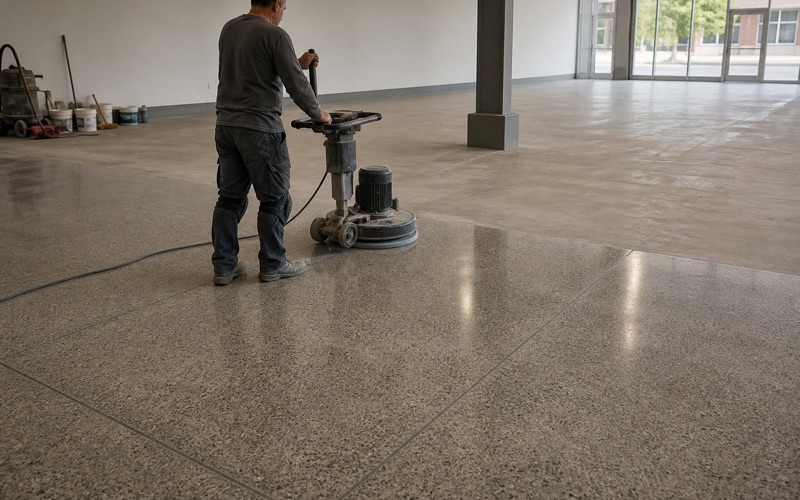
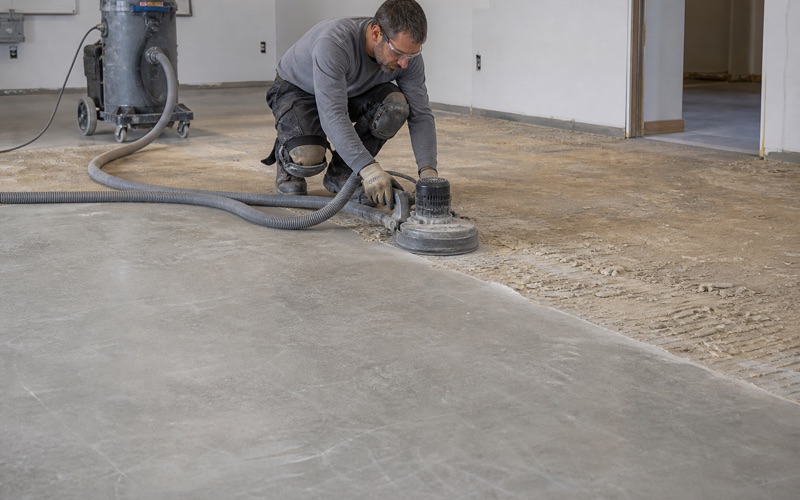
We do not acid etch and we do not coat over an existing sealer. Every slab is mechanically profiled with diamond grinding or shot blasting to an ICRI CSP surface profile matched to the system going down, with diamond segment bond hardness chosen for how the concrete actually cuts once we are into it.
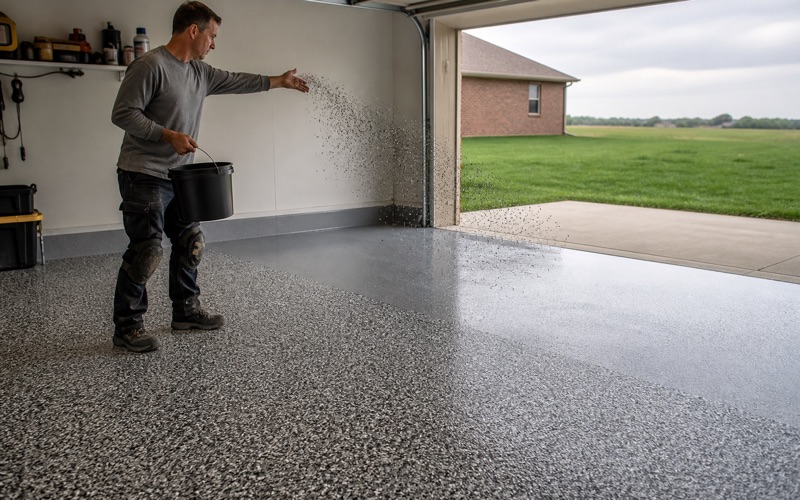
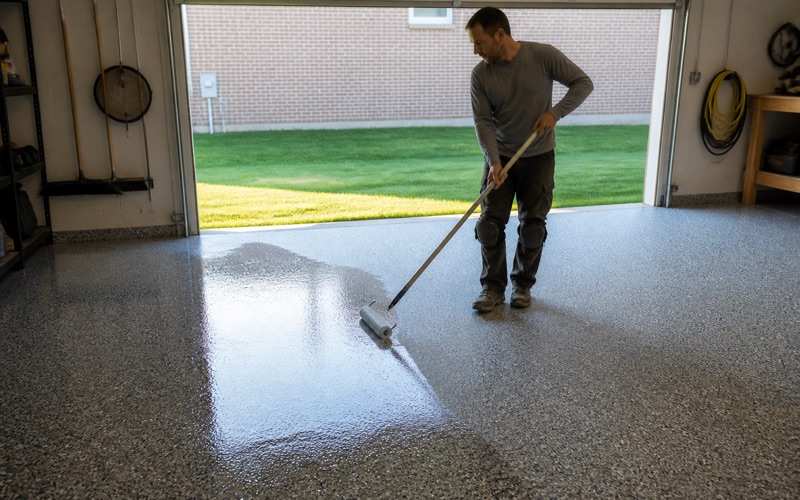
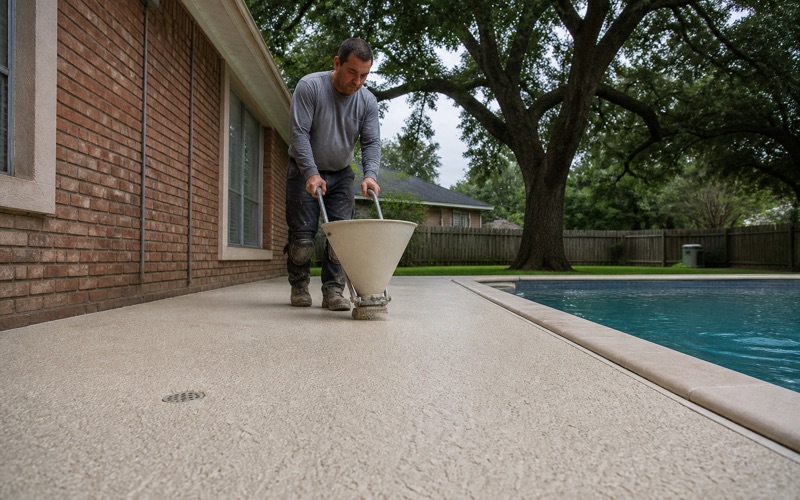
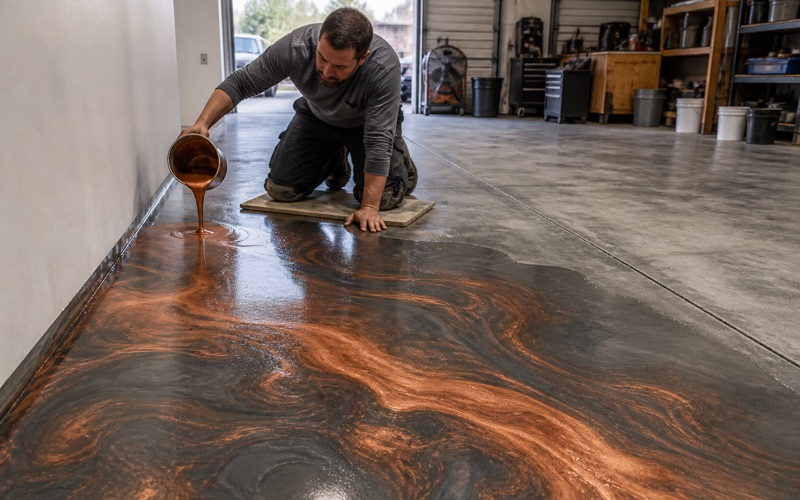
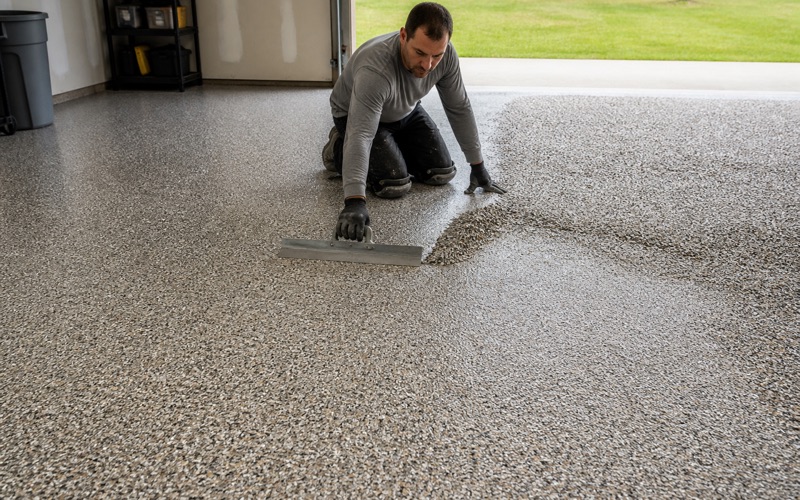
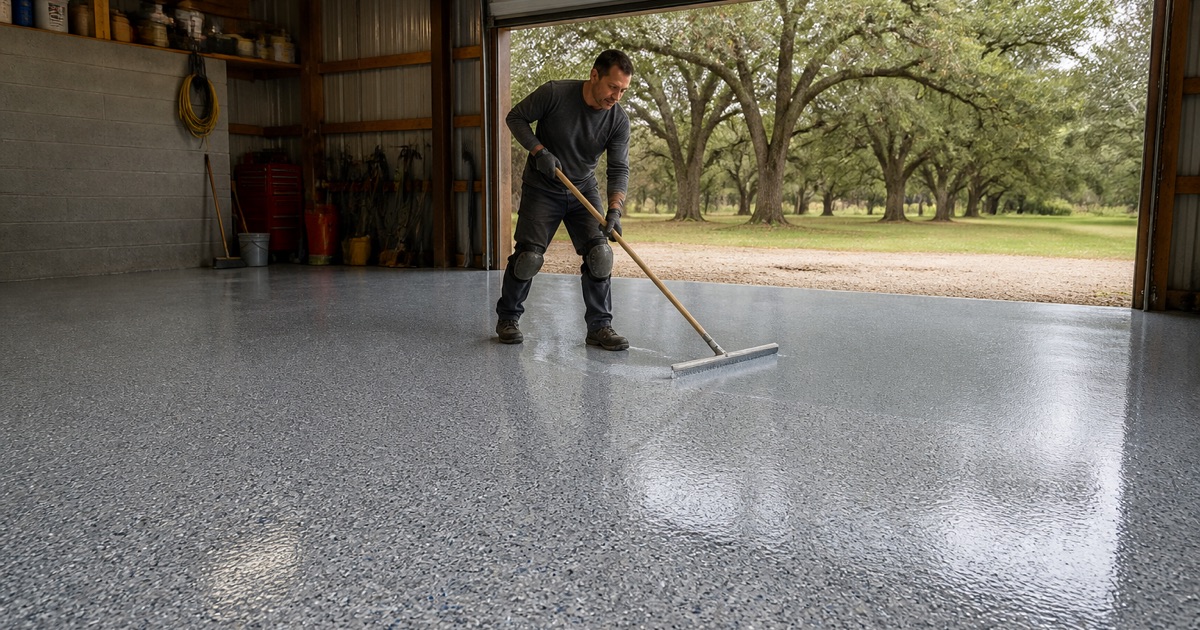
On a floor of this era there is often a curing compound, an old garage paint or a previous sealer to remove, and PCD tooling handles what a standard grinding segment would only smear and glaze. A 100 percent solids epoxy base with a polyaspartic or polyurea topcoat over a vinyl flake or quartz aggregate broadcast is the common build for a homeowner’s garage, and product choice also accounts for the architectural coatings rule at 40 CFR 59 Subpart D.
What the coating does, and what it will not do
An epoxy coating is a film. It bonds to the concrete and follows the concrete, which means it does not stop seasonal ground movement and will not bridge a crack that is still opening and closing on a slab bearing against high-shrink-swell clay. We say that before the job, not after.
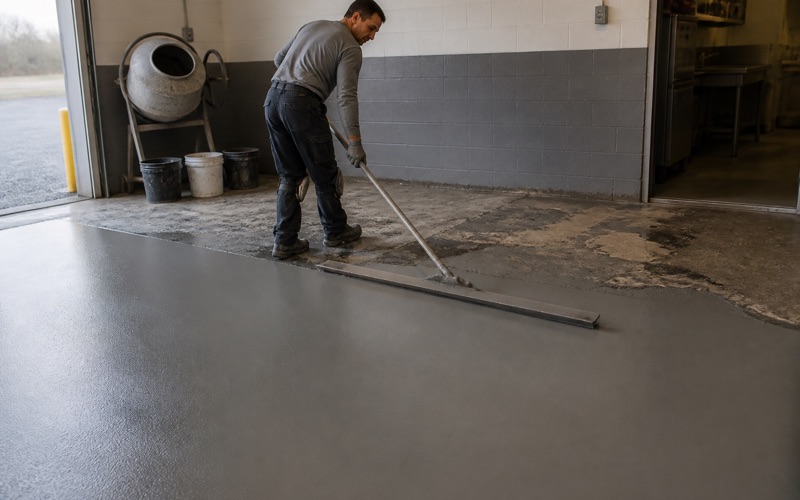
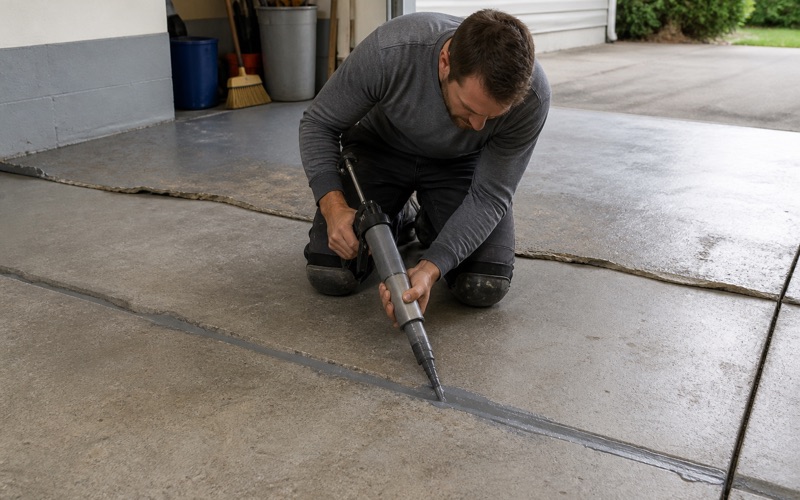
Where a crack sits over moving ground it is treated as a live joint — routed, filled with a flexible sealant such as a semi-rigid polyurea joint filler where the loading allows, and honored through the coating rather than filled rigid and skimmed. It may telegraph again, and an owner deserves to hear that in advance. What the system does deliver is a sealed, cleanable, chemically resistant and abrasion-resistant floor that shrugs off hot tire pickup, oil and dusting.
Dew point, heat and the February risk
We schedule against the dew point measured at the slab surface rather than the air temperature. Data sheets commonly require the surface to stay at least 5 degrees above the dew point through application and cure, and the NWS gridpoint forecast for this grid issued August 17, 2026 carried dew points from 58 to 74 degrees with relative humidity from 24 to 85 percent. At the top of that range an early start on a cool slab is off the table, which is why we begin mid-morning in summer.
The same forecast carried temperatures from 76 to 101 degrees. Pot life on a published product runs roughly 60 minutes at 55 degrees, about 40 minutes at 72 degrees and about 20 minutes at 95 degrees, the recoat minimum collapses from 24 hours to 6 hours, and an uninsulated slab can approach the 160 degrees maximum surface temperature a data sheet allows. Winter Storm Uri ran February 11 to 21, 2021 with six to nine consecutive freezing days in Central Texas, so a February booking in an unheated garage carries real shutdown risk. Texas does not license flooring contractors, so we show general liability cover, workers’ compensation and a Texas sales and use tax permit rather than a number that does not exist.
- 20+ Years in Central Texas
- Fully Insured
- Free Written Proposal