Temple Epoxy Flooring provides pool deck resurfacing across Temple, TX, serving surrounding cities including Belton, Harker Heights, Woodway, Killeen and Salado. We resurface worn, cracked and uncomfortably hot concrete surrounds with textured, slip-resistant finishes chosen for how they behave in a Central Texas summer rather than how they look in a catalog.
A pool deck is the hardest residential surface we work on, and not because of wear. It has to stay walkable barefoot, safe when wet, and tolerable in direct sun on days when the air is over a hundred degrees. It takes pool chemistry at the splash line and thermal cycling every day of the year, and it sits directly beside a structure that moves independently of it.
So the specification here is driven by temperature, traction and the joint detail at the coping. Color is a heat decision before it is an aesthetic one, texture is a safety decision with a comfort limit, and the edge where the deck meets the pool is where most failures start.
Surface Temperature
Why Color Is a Heat Decision
A dark surface absorbs far more solar energy than a light one and re-radiates it as heat you feel through your feet. On a deck people cross barefoot that turns a color choice into a comfort and safety question. We steer toward lighter tones and show samples outdoors in real sunlight, because a shade that looks right indoors can be genuinely unpleasant at midday.
Twenty Days a Year Over a Hundred
Temple sees around twenty days a year at or above a hundred degrees, and an unshaded slab runs considerably hotter than the air above it. That is the condition the deck has to be designed against, not the average summer day. A finish specified for mild conditions is the one people stop walking on in July.
Texture and Contact Area
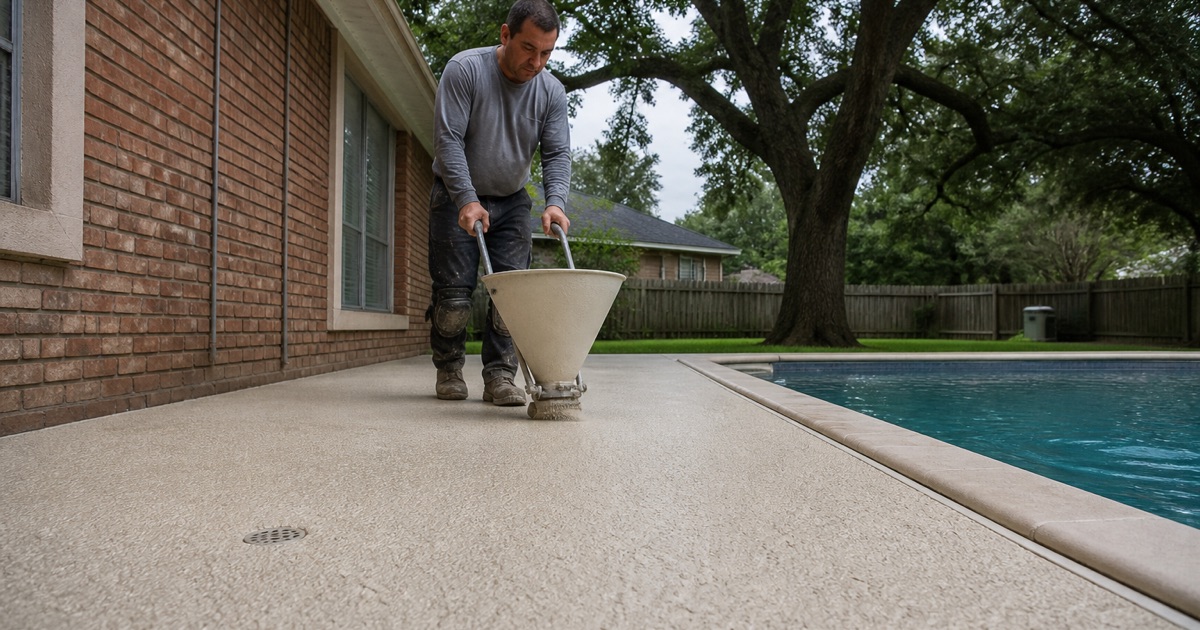
A profiled surface reduces how much material touches the sole of your foot at any moment, so a textured deck reads as cooler than a smooth one at the same temperature and color. Texture is doing two jobs at once here, which is part of why a knockdown or spray-applied finish suits a pool surround better than a smooth coating.
Shade, Layout and Realistic Expectations
We will tell you where the deck is going to be hot regardless of what we install, because a west-facing surface with no shade has a physical limit no product overcomes. Where that matters, the honest answer involves shade structures or planting as much as it involves the finish, and we would rather say so than let the coating take the blame.
Traction and Comfort
Specifying Grip
Slip resistance around water is a safety requirement, and it is set deliberately rather than left to whatever the product does by default. A knockdown texture, a spray-applied profile or a fine broadcast each give a different level of grip. We agree the finish from samples you can stand on, because the trade-off between traction and comfort is one people should feel rather than read about.
The Barefoot Limit
A pool deck cannot be as aggressive as an industrial floor, because the same texture that grips a wet foot abrades a dry one and makes a surface unpleasant to sit or kneel on. There is a genuine ceiling on how coarse a deck should be, and we work below it rather than maximizing grip and letting you discover the cost afterwards.
Wet Zones and Traffic Lines
The splash zone at the pool edge, the steps and the route to the door take more water and more traffic than the rest of the deck. We can vary the texture across the surface so the areas that get wet most often carry more grip while lounging areas stay comfortable, which is a better answer than treating the whole deck as one condition.
Chemistry, Water and the Edge
Pool Chemistry at the Splash Line
Chlorinated and salt-treated water attacks coatings, and salt systems are the harder of the two on a finish. The band nearest the water takes the most exposure and is usually where a poorly specified deck first shows chalking or color loss. We specify products rated for that exposure and detail the splash zone deliberately rather than treating it as ordinary deck.
Standing Water and Drainage
A deck that holds water in low spots will fail there first, whatever is on it. Where we find ponding we address the fall as part of the work rather than resurfacing over it, because a new finish in a puddle degrades the same way the old one did. Sometimes that means a self-leveling correction before any texture goes on.
The Coping Joint
The joint between the deck and the pool coping exists because the two structures move independently. It has to remain a working joint, filled with a flexible sealant rather than bridged with rigid material or coated across. Filling or coating over that line is one of the most common reasons a resurfaced deck cracks along the pool edge within its first year.
We rake the old sealant out, clean the joint faces properly and reinstall a backer rod at the right depth before the new sealant goes in. That depth matters more than it sounds: a sealant bead that is too deep bonds on three sides and tears itself apart as the joint works, which is why so many replacements fail as quickly as the material they replaced.
Expansion Joints Across the Deck
Existing expansion and control joints are carried through the new surface rather than covered. A resurfacing system bonded across a working joint concentrates all the movement into a line of its own choosing, which is invariably somewhere less tidy. Honoring the joints that are already there keeps the cracking where the original designer intended it.
Preparation and Repair
Assessing What Is There
We start by establishing what the deck is: broom-finished concrete, an old texture coating, pavers, or something that has already been resurfaced once. Each has different removal and bonding requirements. We also check for hollow areas where a previous surface has delaminated, since bonding new material to a layer that is already loose simply hides the problem.
Spall and Crack Repair
Spalled edges, pitted areas and dormant cracks are cut back to sound concrete and rebuilt with a repair mortar suited to exterior exposure. Around a pool this frequently includes the coping edge and the areas around handrails and ladders, where water gets in and freeze cycles have opened the concrete over the years.
Mechanical Preparation
The deck is ground or shot blasted to open the surface and remove old coatings, sealers and contamination. Outdoor slabs carry decades of sunscreen, oil and pool chemicals, all of which interfere with bond. Preparation matters more outdoors than in, because the finished surface has to survive conditions no interior floor ever sees.
Freeze Damage Around Water
Temple averages about thirty-three freezing nights a year, and water sitting in porous or already-damaged concrete around a pool is exactly where freeze damage does its work. Where we find that pattern we treat the cause as well as the surface, since a resurfaced deck over saturated, spalling concrete has a short and predictable life.
- 20+ Years in Central Texas
- Fully Insured
- Free Written Proposal