Temple Epoxy Flooring installs epoxy flooring in Nolanville, and we have been coating concrete across Central Texas for more than 20 years. Most of the garages we are asked to quote here are young, regularly built and genuinely straightforward to work in, which is not something we can say everywhere in this area.
A coating is a film. It bonds to the slab, it follows the slab, and it will not stop or bridge ground that moves with the seasons. We say that before the proposal goes out, because the ground here does move and the honest version of that has to come first.
What comes with the young slab is a different risk. A newer floor needs less recovery work than an old one, but it is far more likely to be post-tensioned, and that changes what anyone is allowed to do to it with a saw or a drill.
Ground that moves as one body
We check what a slab actually sits on before quoting it, because the answer changes across this region. Here the profile is unusually consistent, and that consistency is the interesting part.
Lewisville silty clay at the city centroid
The soil survey at the city centroid maps Lewisville silty clay on 1 to 3 percent slopes, with Lewisville at 85 percent of the map unit. It is a fine-silty, mixed, active Udic Calciustoll, well drained, carrying 46 percent clay with a plasticity index of 29 in the upper profile.
Linear extensibility runs 7.5 percent from the surface down, and it stays at 7.5 percent all the way through 175 centimeters. That is a moderate-to-high shrink-swell rating that does not soften with depth.
Uniform depth changes how a slab moves
A soil column with the same extensibility at every depth expands and contracts as a single body rather than in layers. Movement of that kind tends to lift and settle a slab more evenly than differential heave does, which is better news for a coating than the alternative.
It is still real seasonal movement. A crack that opens in a dry August is not a crack that has finished moving, so we read each one as live or dormant before deciding what goes into it.
Cracks treated as joints where the ground is working
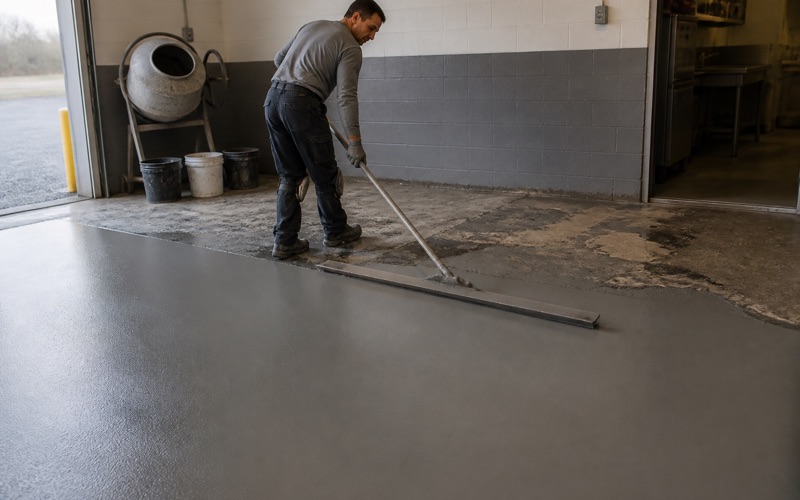
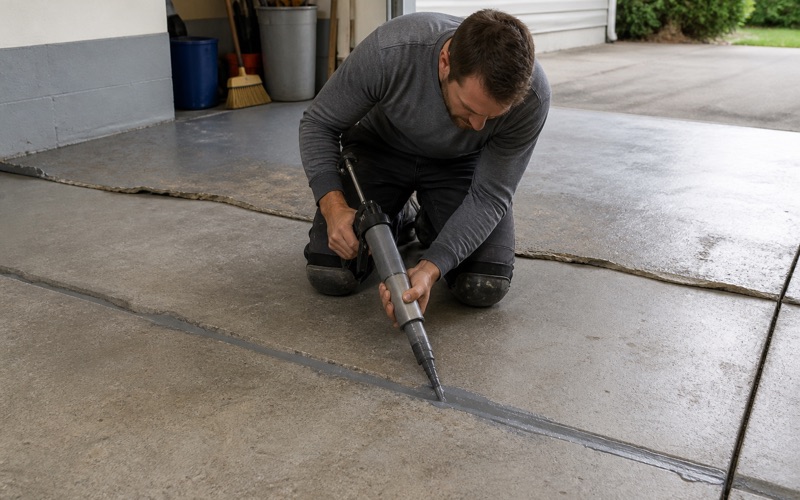
Where a crack is active, we treat it as a live joint with a semi-rigid polyurea filler rather than packing it rigid and coating straight over the top. We also say before the job starts that it may telegraph again.
That is written into the quote alongside the warranty exclusions, substrate movement and moisture first among them, because those are the two things most likely to end a coating early and they should be discussed before the sale rather than after the failure.
Slow drainage, so the slab gets tested
Saturated hydraulic conductivity on the Lewisville profile is 0.91 micrometers per second at every depth, which is slow. Water does not move down through this soil quickly, so it sits, and a slab can stay wet underneath long after the surface reads dry.
That is why we do not judge slab moisture by eye or by what the weather did last week. Depending on the substrate we run ASTM F1869 calcium chloride vapor emission testing, ASTM F2170 in-situ relative humidity probes or an ASTM D4263 plastic sheet test, read against ASTM F710 thresholds, and where the numbers come back high a moisture-mitigation primer goes into the build and into the price.
Looking for epoxy flooring closer to Harker Heights? See Harker Heights Epoxy Flooring.
What is actually addressable in this town
Household counts here overstate the market for this trade, and it is worth being straight about why rather than quoting a population figure and letting it stand. A meaningful share of the housing sits on a chassis rather than a slab, which takes it outside what a coatings contractor can do at all. Knowing that before a quote is written saves everybody a visit, and it changes which parts of town are worth talking to.
Roughly a quarter of the housing has no garage slab
Manufactured homes are 23.9 percent of all housing units here — 676 of 2,833 — and 594 of them are occupied, which is 22.0 percent of households. Those homes have no garage slab, and nothing we install applies to them.
They appear in every population figure and every demographic profile of this town, so anyone reading a household count as a market is counting more than one household in five that this trade cannot serve. We would rather subtract them out loud than quote work we cannot do.
The remainder is young and regular
What is left is unusually uniform. Some 73.8 percent of the housing was built in 2000 or later and 37.9 percent since 2010, with only 317 units predating 1980 and none at all built before 1950.
That produces a modal garage that is a post-2000 attached two-car bay off a short front driveway in a platted subdivision. Area, door width and driveway approach are all predictable, and preparation is removing ordinary use rather than fifty years of oil and old sealer.
Post-tension is the default assumption
With 88.8 percent of the stock built in 1980 or later, and post-tension construction having become common in Texas around that point, we treat a slab here as post-tensioned until it is shown otherwise. That is the reverse of how we approach older parts of the region.
It matters because cutting, coring or driving an anchor without knowing where the tendons run risks a cable, and on a slab this young that is the single easiest way to do expensive damage. Establishing which kind of slab is underfoot happens before any mechanical work is scheduled.
A move-up market rather than a turnover market
Who is buying the floor shapes how it should be specified, and the pattern here is not the one the wider area is known for. The published figures point clearly in one direction.
The movers are coming from within the county
A quarter of the population, 1,662 people, lived somewhere else a year earlier. Of those, 1,210 moved within the same county, 390 came from another county in Texas and 39 arrived from a different state.
That is a town being filled by households moving a short distance into new subdivisions. Armed Forces members are 5.6 percent of the labor force here, a real presence but a small one, and the data simply does not describe a market driven by arrivals from outside Texas.
Owners buying for a house they intend to keep
This is a majority-homeowner city at 64.3 percent owner-occupied, and only 278 detached houses in the whole town are rented out. The person choosing the floor is usually the person who will park on it for years.
That supports a different conversation from the one we have with a landlord. Appearance genuinely counts, the decision horizon is longer, and a customer who has just moved across the county into a new house is choosing a finish rather than buying a surface that has to survive a stranger and be handed back on a date.
What that means for the system we recommend
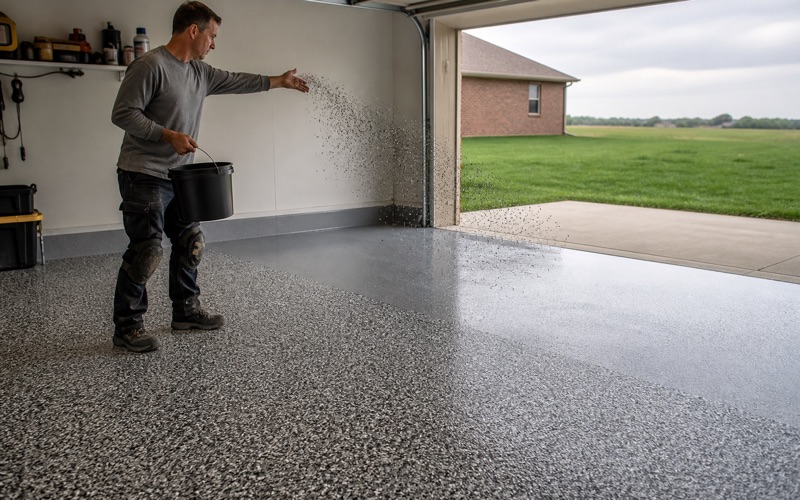
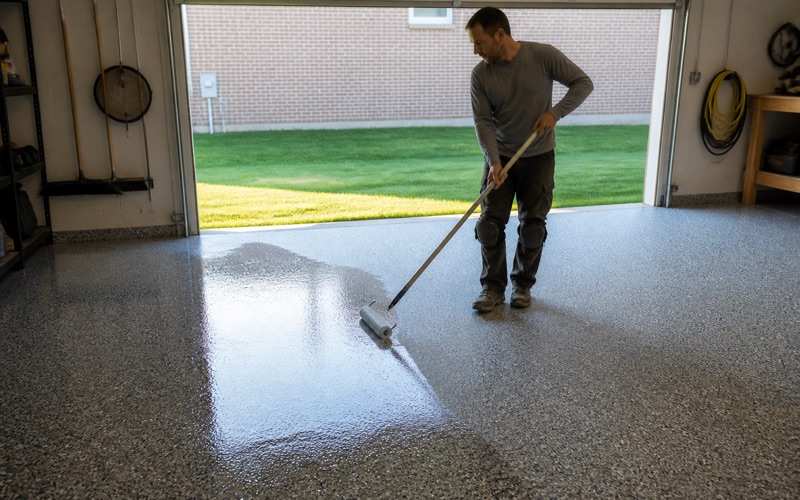
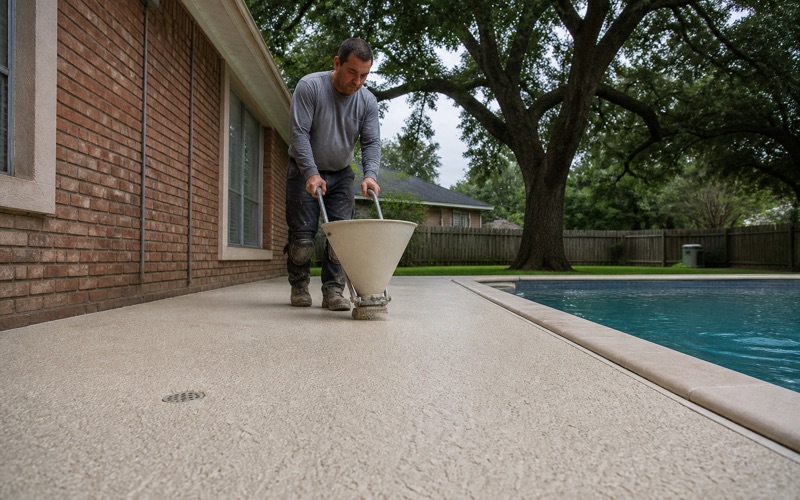
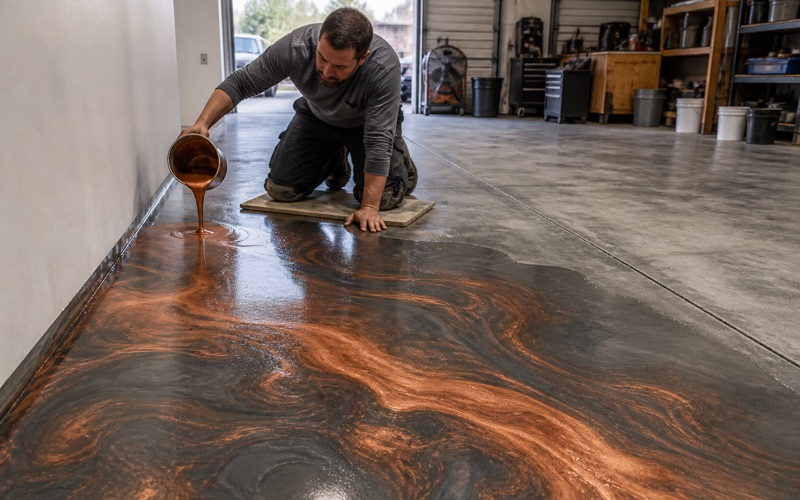
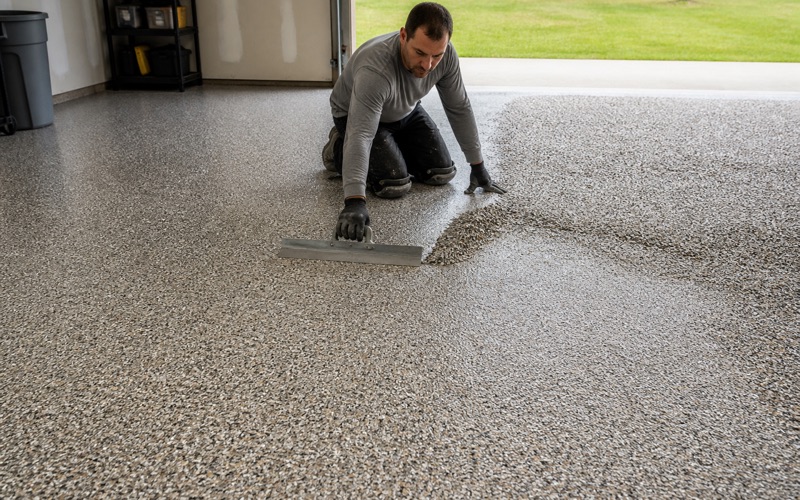
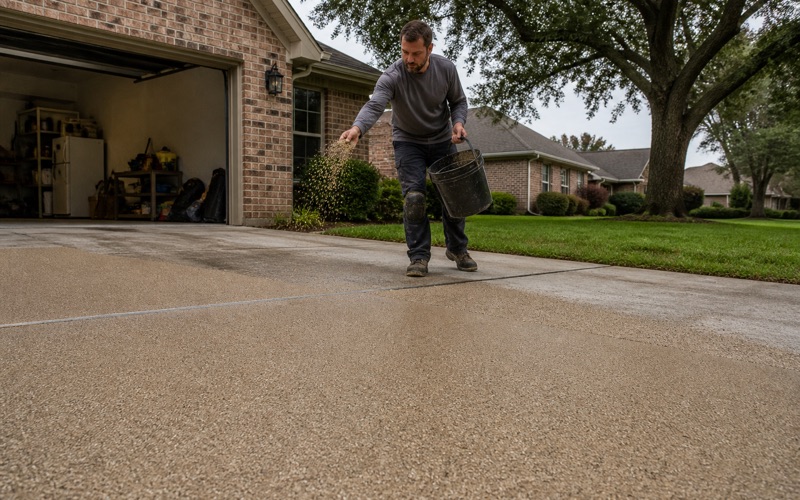
On an owner’s garage we usually build a 100 percent solids epoxy body coat under a polyaspartic or polyurea topcoat, with a vinyl flake broadcast where the customer wants depth and a floor that hides ordinary dust. Quartz aggregate goes in where slip resistance matters more than pattern.
Whichever way it goes, the proposal names the product, the system build and the mil thickness, so what was quoted can be checked against what was installed. A customer keeping the house for a decade should be able to look up in five years exactly what is on their floor.
Preparing the slab and timing the work
The two things most likely to cost a floor its life are how the concrete was prepared and what the weather was doing when the product went down. Neither is negotiable.
Mechanical preparation, every slab
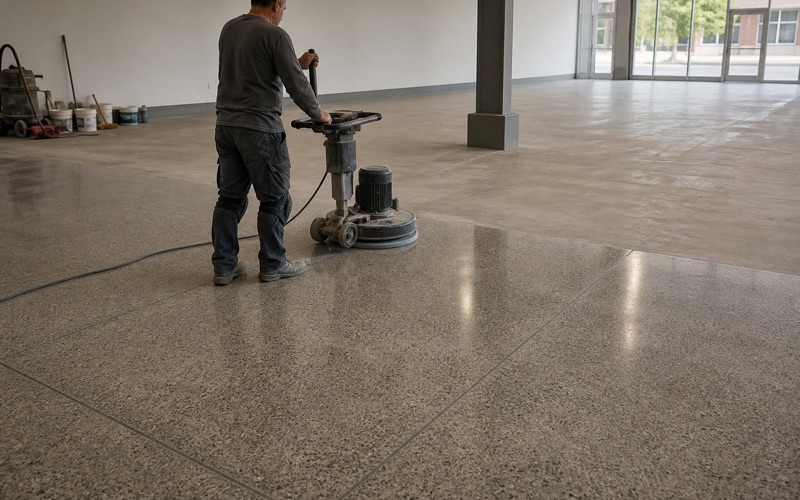
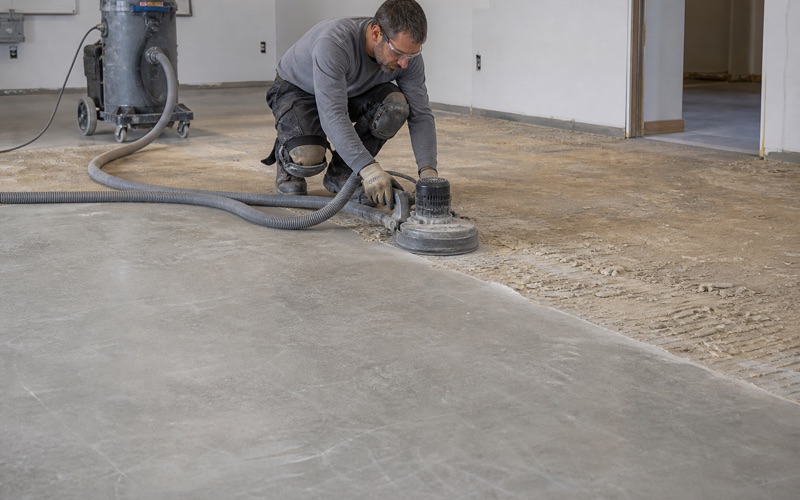
Every slab is diamond ground or shot blasted to an ICRI CSP profile matched to the system going down. We do not acid etch, and we do not coat over an existing sealer.
On a newer house the builder’s sealer is the usual obstacle rather than an old coating, and it comes off mechanically with the diamond segment bond hardness matched to the concrete. A young slab is often harder than people expect, which changes the tooling rather than the method.
Why the crew arrives later than you expect
Owners who live in the house through the work usually want an early start, and we almost always ask for a later one. The reason is a number rather than a preference: the published application floor is 5 degrees above the dew point, measured at the concrete rather than in the air, and the local forecast grid has carried dew points from 57 to 73 degrees with humidity between 25 and 85 percent.
At a 73 degree dew point a slab that has cooled overnight sits below the line, holding a film of condensation nobody can see on it. Coating over that buys a few hours in the morning and costs the bond, which surfaces as blush or patchy adhesion long after the crew has gone.
Heat shortens the working window
The same grid has carried temperatures from 74 to 102 degrees, with overnight lows around 74 meaning an uninsulated garage slab never fully sheds its heat between shifts. On one published product, pot life runs roughly 60 minutes at 55 degrees, about 40 minutes at 72 degrees and about 20 minutes at 95 degrees.
The recoat minimum moves the other way, collapsing from 24 hours to 6 hours as the slab warms. A twenty-minute pot life sets batch size and crew size, and the shorter recoat window is what sometimes lets a summer install finish two coats in a day.
Winter is the harder constraint
Cold works the other way and is easier to plan around. February 2021 is the event everyone here measures against, when all 254 Texas counties were affected and this part of the state ran six to nine consecutive days below freezing, the longest streak in its recorded history. Nothing that extreme is needed to stall a cure, which is why a winter date gets moved rather than gambled on.
An unheated garage during a freeze of that length sits below the minimum application temperature on every product data sheet worth reading. We move the date rather than cure a floor at a temperature the manufacturer does not support.
Permits are pulled at the city
The city has run its own planning and development function since becoming home rule at the 2011 charter election, and building permits and inspections are handled by the city rather than by the county. A garage coating that stays a finish normally is not a permit item.
An added circuit, panel work or mechanical ventilation put in for a coating crew is a different matter. This is a small department in a town whose housing stock has roughly tripled since 2000, so we call and ask rather than assume, and we can show general liability cover, workers’ compensation, a Texas sales and use tax permit and city contractor registration on request. Texas does not license flooring contractors, so there is no license number for anyone to produce.
- 20+ Years in Central Texas
- Fully Insured
- Free Written Proposal