Temple Epoxy Flooring installs metallic epoxy floor systems across Temple, TX, serving surrounding cities including Belton, Harker Heights, Killeen, Woodway and Waco. We pour marbled decorative floors for showrooms, retail units, offices, bars and residential feature rooms, and we have been working with resin systems in this region for more than twenty years.
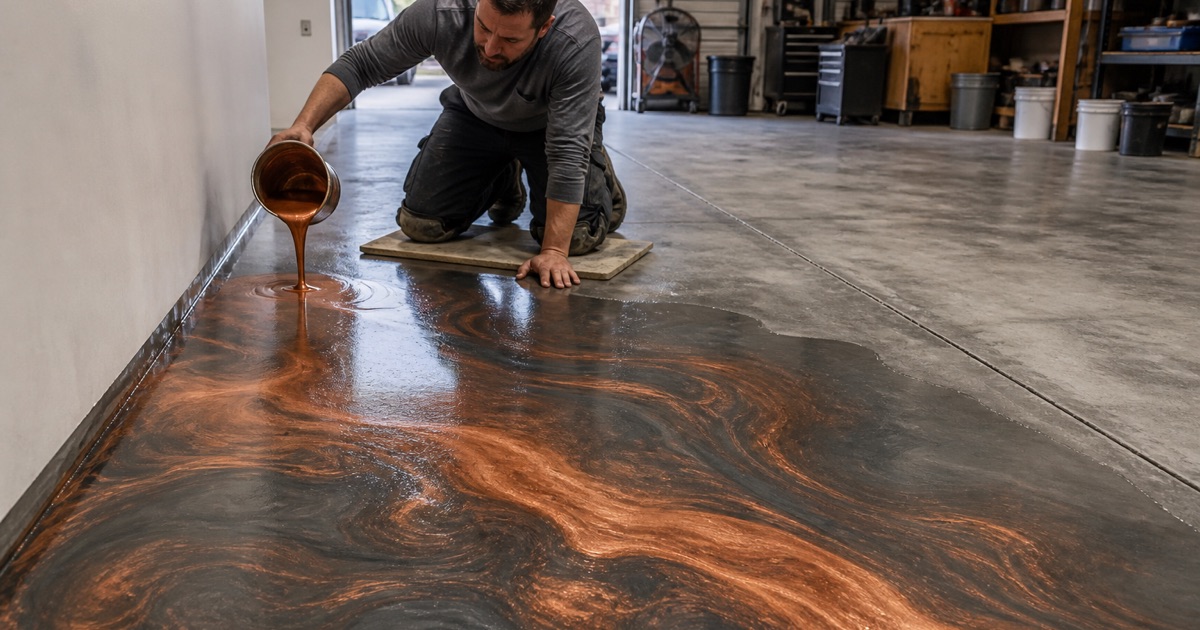
A metallic floor is the one system we install that is chosen almost entirely for appearance. The pigments are suspended in a clear resin and moved deliberately during the pour, so the finished surface has depth and figuring rather than a flat color. Done well it does not look like a coating at all.
It is also the least forgiving finish in our range. High gloss telegraphs everything underneath it, the pigment behaves differently every time, and the working window is short. Those are the honest constraints, and we would rather set them out before you choose than explain them afterwards.
How a Metallic Floor Is Built
The Base Coat
A pigmented epoxy base goes down first, usually in a color chosen to sit behind the metallic layer and give it depth. This coat also does the leveling work, filling minor surface variation so the decorative layer has a consistent plane to flow across. Skipping or thinning it is the most common reason a metallic floor looks patchy rather than deep.
The Metallic Layer
Metallic pigment is dispersed into a clear or tinted resin and poured over the base. The pigment particles move as the resin spreads, settles and releases air, and that movement is what creates the marbling. It is worked with squeegees, rollers, brushes or air to encourage the figuring, and the pattern develops over the following minutes rather than being placed.
The Topcoat
One or two clear coats go over the metallic layer, and they are what the floor actually wears on. A polyaspartic topcoat gives abrasion resistance and holds its clarity under sunlight far better than a clear epoxy, which ambers over time and dulls the color underneath. In a commercial space this layer is sacrificial and can be renewed later.
What You Can and Cannot Specify
Palette and Intensity
You choose the colors and roughly how dramatic the movement should be: a subtle single-tone shimmer, a two-color marble, or a high-contrast pour with strong veining. We work from physical samples and, on larger jobs, from a sample panel made with your actual colors, because metallic reads very differently at floor scale than on a small card.
What Nobody Can Promise
The exact pattern is not specifiable. Pigment movement responds to temperature, film thickness, how the resin gasses off and how the installer works it, so every pour is one-off. We are direct about this: if you need a repeatable, uniform appearance across a large area or across phases, metallic is the wrong system and a flake or solid color is the right one.
Seams and Phasing
A metallic floor wants to be poured as one continuous area, because a cold joint between two pours will usually be visible in a high-gloss finish. That constrains how a large space can be phased and how much floor we can open in one visit, and it is something we plan around at quoting stage rather than discovering on site.
Where It Suits and Where It Does Not
Showrooms and Retail
A metallic floor gives a retail unit or showroom a finished surface that reads as deliberate design rather than as flooring. It reflects light, which makes a space feel larger and brighter, and it takes ordinary foot traffic without difficulty when the topcoat is specified for it.
Offices, Bars and Salons
Commercial interiors where appearance carries weight and the floor stays dry are natural candidates. The seamless surface has no grout lines and cleans easily, which suits a bar or a salon where spills are routine and the floor still has to look good under direct lighting.
Residential Feature Rooms
In houses, metallic works in entry halls, living areas, home bars and occasionally a master bathroom. Homeowners sometimes ask for it in a garage, and we will install it there, but we point out first that a working bay puts a smooth high-gloss surface under vehicles, tools and grit, and a flake system usually serves that room better.
Wet and Working Areas
Smooth gloss and standing water are a poor combination, and a commercial kitchen or a wash bay needs texture and chemical resistance that a decorative metallic system is not built to provide. Where slip resistance is a genuine requirement we specify a broadcast or urethane cement floor instead and say plainly why.
Conditions at Installation
Temperature and Working Time
Metallic pours are sensitive to slab temperature because the resin’s viscosity and its working time both move with it. A hot slab shortens the window in which the pigment can be encouraged to move, and it can flash the surface before the figuring has fully developed. We schedule these pours to the slab rather than the calendar.
Moisture and Preparation
The slab is ground to an ICRI CSP profile and, where its age warrants it, tested to ASTM F1869 or ASTM F2170 against ASTM F710 thresholds before material is ordered. A high-gloss decorative floor makes any blister or adhesion failure conspicuous, so the underlying checks matter more here rather than less.
- 20+ Years in Central Texas
- Fully Insured
- Free Written Proposal