Temple Epoxy Flooring installs epoxy flooring in McGregor, and we have spent more than 20 years coating concrete across Central Texas. This is a small city with two very different kinds of floor in it, and a system that suits one of them is usually wrong for the other.
A coating is a film. It bonds to the slab, it follows the slab, and it will not stop or bridge ground that moves seasonally. We say that before a proposal goes out, because here the ground does move and pretending otherwise only postpones the conversation.
So the first thing we do is establish what the concrete is sitting on and what has already been done to it. Product selection is the easy part; the substrate is where the job is decided.
Expansive clay over shallow bedrock
We check what a slab actually sits on before quoting, and in this city the answer is unusual enough to be worth spelling out. Both halves of it change how a floor should be built.
Purves clay at the city centroid
The soil survey at the city centroid maps Purves clay on 1 to 3 percent slopes, with Purves making up 89 percent of the map unit and Aledo, Bolar, Crawford and Dugout as minor components. Purves is a clayey, smectitic Lithic Calciustoll, well drained, carrying up to 47.5 percent clay with a plasticity index of 33.
Its linear extensibility is 8.4 percent, which is a high shrink-swell rating. That is ground that genuinely breathes with the seasons, and any slab poured on it is subject to that movement.
Thin clay sitting on rock
The Lithic classification is the second half, and it means limestone bedrock within roughly 20 inches of the surface. The clay doing the swelling is a shallow layer over rock rather than a deep column of it.
That is a different movement regime, and it is also a different trenching and anchoring problem. Anything that has to be cut, cored or set into the ground around a slab here meets rock sooner than a crew used to deep clay would expect.
Reading a crack before filling it
With an 8.4 percent linear extensibility underneath, an existing crack has to be read as active or dormant before anything goes into it. A joint treatment chosen for a static slab fails on a moving one inside a season.
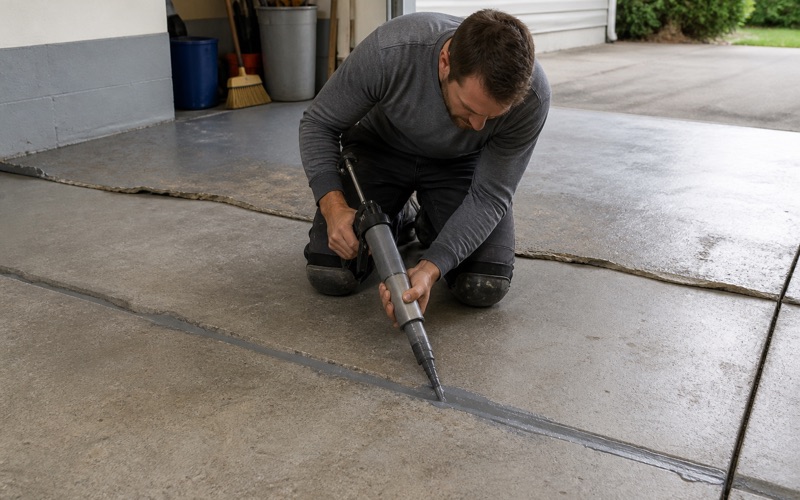
Where the crack is live, we treat it as a working joint with a semi-rigid polyurea rather than packing it rigid and coating over the top, and we say before the job starts that it may telegraph again. That warning is part of the quote, not a surprise afterward.
Looking for epoxy flooring closer to Fort Hood? See Fort Hood Epoxy Flooring.
A town that built a quarter of its houses in one decade
Most places spread their construction across several eras. This one did not, and the concentration shows up on almost every residential job we look at. When a large share of a town’s houses go up within a few years of each other, their slabs share an age, a specification and a set of construction practices. That makes the work unusually predictable, and it means a problem found on one floor is worth looking for on the next.
Six hundred houses from a single decade
Of 2,442 total housing units, 612 — 25.1 percent — were built in the 1950s, more than double the next largest decade. The 1940s account for thirteen units in the entire city.
The timing lines up with what happened at the old ordnance plant. The wartime plant ran from 1942 to 1945 without the town building housing for it, and Phillips Petroleum took the site over in 1952 to manufacture solid rocket propellants; the housing cohort follows that, whatever weight anyone wants to put on the connection.
What a 1950s garage actually is
That concentration is a geometry fact before it is a history fact. A 1950s Central Texas house was built for a one-car household, so the bay is narrower than a modern one, it is often a carport rather than an enclosed garage, and it is frequently detached and set at the back of a long driveway run.
That changes the labor before it changes the product. Material carry is longer, containment is harder in an open carport, and the garage slab is commonly a separate and thinner pour than the house slab with its own age, its own joints and its own moisture behavior.
The newer stock is a different problem
Against that, 564 units — 23.1 percent — were built in 2010 or later, and only 162 in the whole of the 2000s. Those newer houses carry attached two-car bays and, being post-1980 construction, are where post-tension slabs concentrate.
With 51.5 percent of stock predating 1980, the modal slab in town is conventionally reinforced ground-supported concrete. Which of the two is underfoot decides what may be cut, cored or anchored, and in a town where the two eras sit on adjacent blocks that is a site question rather than a neighborhood question.
Every owner-occupied home here is a detached house
All 1,401 owner-occupied units in this city are single-family detached. The estimate records no owner-occupied attached houses, no owner-occupied units in multifamily structures and no owner-occupied mobile homes at all.
For us that simplifies one thing and complicates another. There is no shared-structure access to negotiate and no association to satisfy, but the homeowner pool and the detached-house pool are the same set, spread across build eras that have almost nothing in common.
Preparing the slab and writing the specification
On an old garage slab the coating is rarely what fails. Preparation is, and so is a proposal vague enough that nobody can check it afterward.
Mechanical preparation on every slab
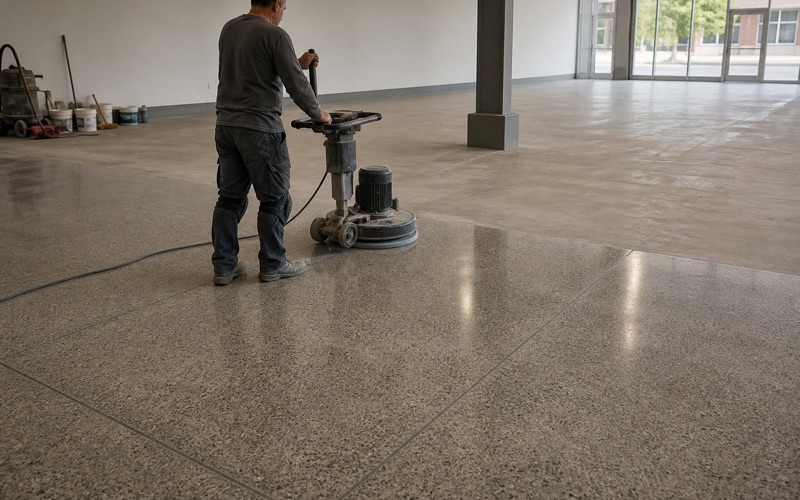
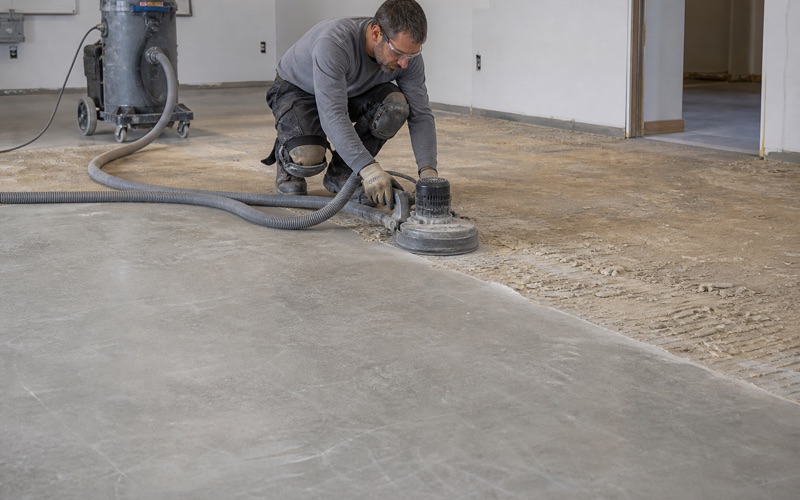
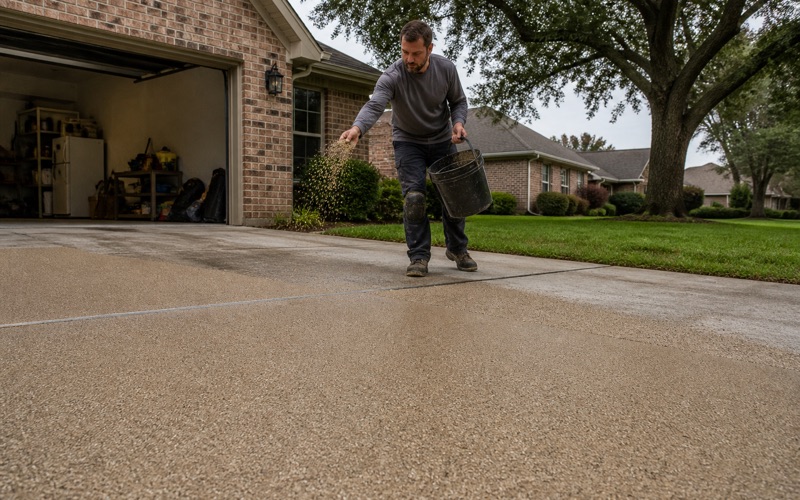
Every slab is diamond ground or shot blasted to an ICRI CSP profile matched to the system going down. We do not acid etch, and we do not coat over an existing sealer.
Where an old coating or sealer has to come off, it comes off with PCD tooling first, and the diamond segment bond hardness is chosen against the hardness of the concrete rather than against whatever tooling is already on the truck. On a seventy-year-old slab that decision is most of the labor in the job.
Moisture testing written into the scope
On an older slab, moisture testing goes into the scope from the start rather than being sold as an add-on after a floor blisters. Depending on the substrate that means ASTM F1869 calcium chloride vapor emission testing, ASTM F2170 in-situ relative humidity probes or an ASTM D4263 plastic sheet test, read against ASTM F710 thresholds.
Slabs poured before vapor retarders were standard often have nothing under them at all. Where readings come back high, a moisture-mitigation primer goes into the build and into the price before anyone commits to a color.
A proposal that can be checked
Our proposals name the product, the system build and the mil thickness, so what was quoted can be compared line by line against what was installed. Warranty exclusions are explained before the job is sold, substrate movement and moisture first among them.
Texas does not license flooring contractors, so there is no license number to hand over. What we show instead is general liability cover, workers’ compensation, a Texas sales and use tax permit and city contractor registration.
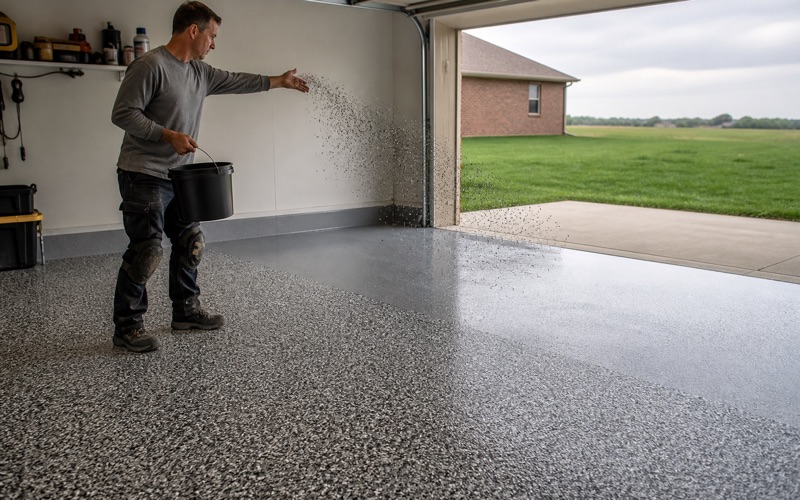
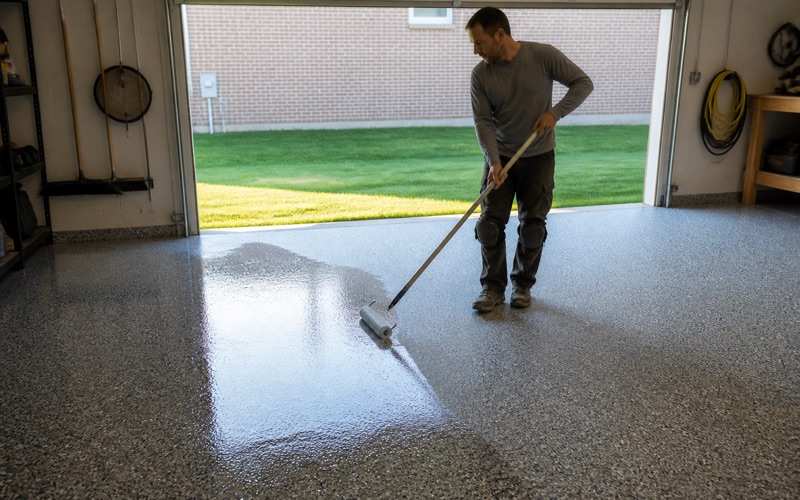
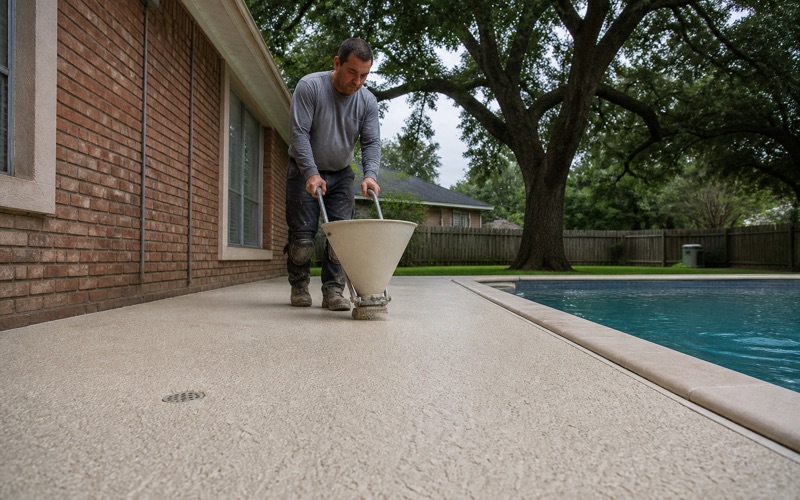
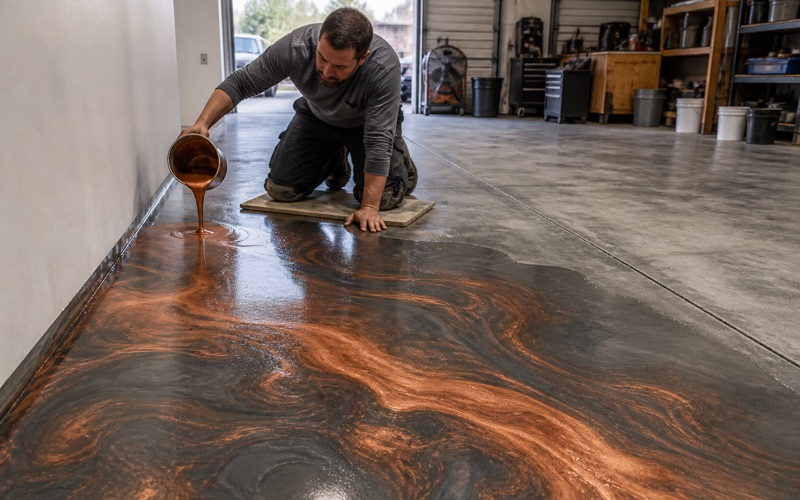
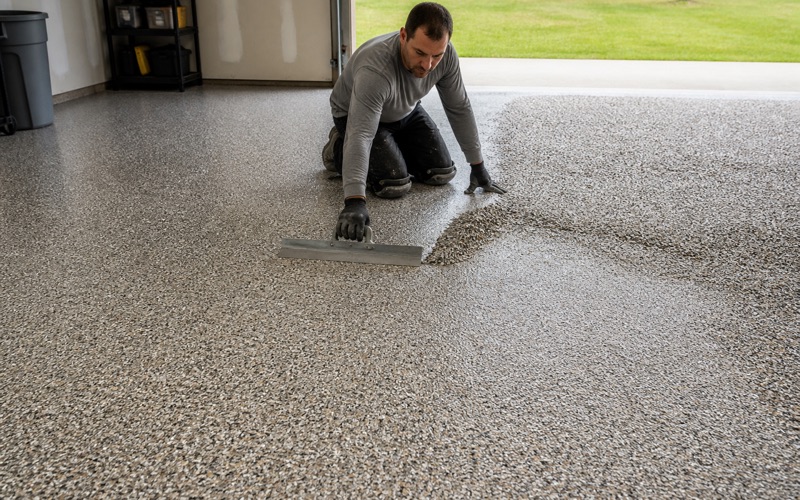
The finish itself is the last decision rather than the first. A 100 percent solids epoxy body coat under a polyaspartic or polyurea topcoat covers most residential bays, with a vinyl flake broadcast where a customer wants the joint lines and old patches to stop reading through, and the topcoat is what shortens the return-to-service window.
Industrial floors and small-city logistics
The industrial side of this city is large relative to its population, and it is not warehouse work. Those floors have requirements a residential system cannot meet.
Test stands and plant floors are not pallet traffic
The site west of town has been in continuous industrial use since 1942, running in succession through Phillips Petroleum, Astrodyne, Rocketdyne, Hercules and Beal Aerospace before SpaceX leased it in 2003 and expanded it to 4,000 acres by 2015. Every rocket engine and thruster the company builds passes through here for final testing.
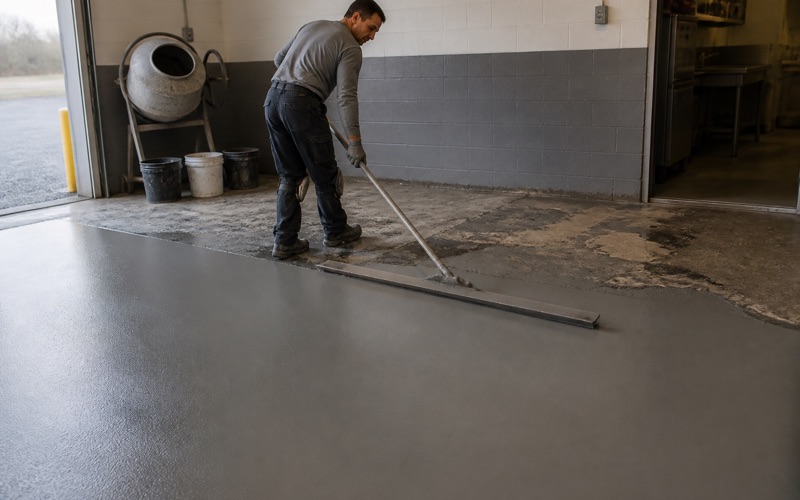
Floors in that kind of service take chemical exposure, thermal shock and heavy point loads rather than the rolling wear of a distribution center. Where washdown and thermal cycling are involved, urethane cement rather than epoxy is often the honest recommendation, with an integral coved base at the wall junctures and a quartz aggregate broadcast set for slip resistance.
A small-format commercial layer
The rest of the commercial work here is Main Street in scale, and it is worth saying so plainly rather than inventing volume. There is no hospital, no enclosed mall and no big-box concentration inside the city limit.
What there is instead is locally owned storefronts, a bank branch, municipal buildings, two school districts, a city-owned airport and an event center. Those are real floors with real service demands, just not the ones a metro specification assumes.
The permit path is short, and the fire department is volunteer
Community Development handles planning, zoning and building permits for the city, with the director and the permitting contact reachable on the same phone number and forms downloadable from the city site. On a job here a contractor talks to a person rather than joining a queue. The city also spans a county line, extending westward into Coryell County around the industrial park, so two jobs in different counties can pull the same city permit.
The fire authority is the McGregor Volunteer Fire Department. That is worth knowing before scheduling solvent-heavy work or anything involving hot work, and it is part of why we keep to high-solids materials and plan ventilation rather than improvising it.
Scheduling against the slab, not the forecast headline
We schedule against the dew point measured at the slab surface, not the air temperature. A published application floor of 5 degrees Fahrenheit above the dew point is a hard limit, and the local grid has carried dew points from 57 to 72 degrees Fahrenheit with humidity between 22 and 79 percent, which is why we start mid-morning in summer rather than at dawn.
Heat then governs the working day. On one published product, pot life runs roughly 60 minutes at 55 degrees Fahrenheit, about 40 minutes at 72 degrees Fahrenheit and about 20 minutes at 95 degrees Fahrenheit, while the recoat minimum collapses from 24 hours to 6 hours. With daytime highs near 103 degrees Fahrenheit and overnight lows only easing to about 75, an uninsulated slab never fully sheds its heat between shifts.
Winter is the other end of the same problem. Winter Storm Uri ran February 11 to 21, 2021 and affected all 254 Texas counties, with Central Texas seeing six to nine consecutive days of freezing temperatures, the longest such streak in the state’s recorded history. A cure scheduled into a February window here carries a real risk of a multi-day shutdown rather than a delayed morning.
- 20+ Years in Central Texas
- Fully Insured
- Free Written Proposal