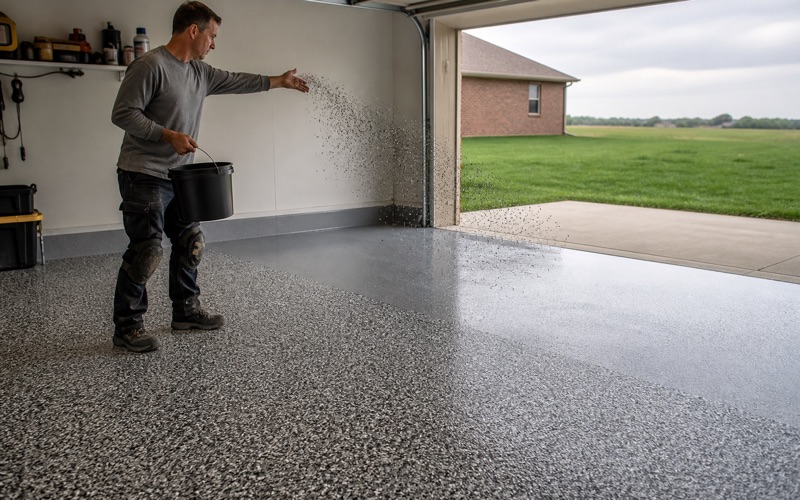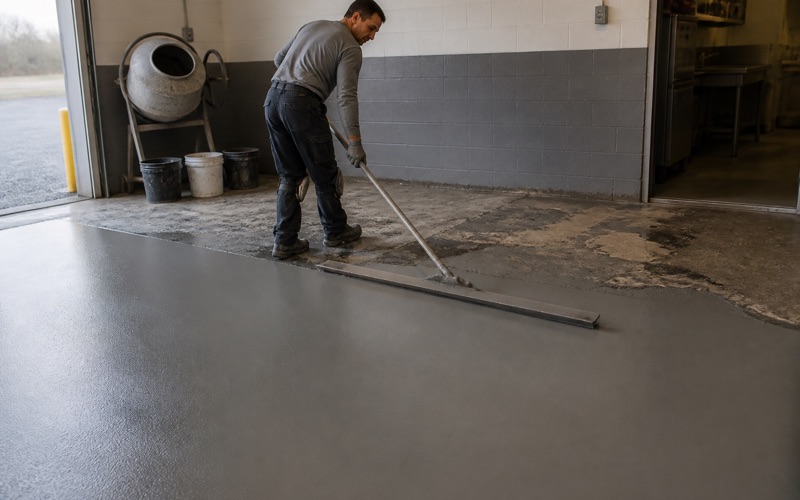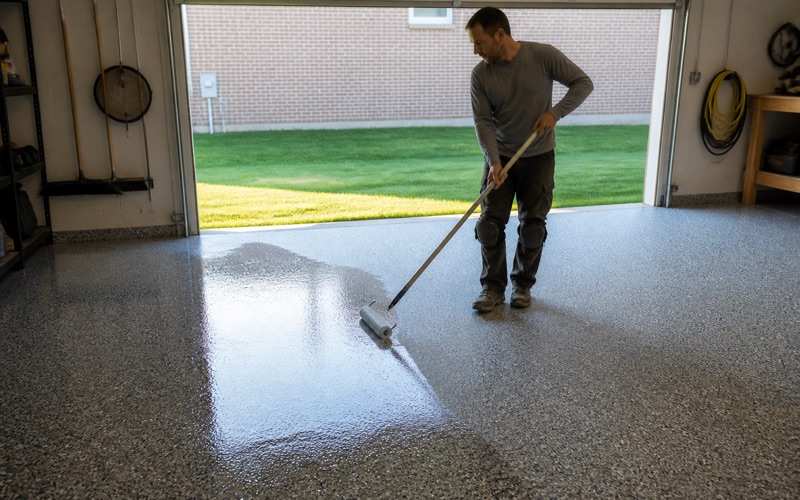
Temple Epoxy Flooring installs epoxy flooring in Marlin, and after more than 20 years coating concrete in this part of Central Texas we start every quote here the same way: by finding out what the slab is sitting on. In this city the answer is rarely reassuring, and pretending otherwise is how coatings fail.
We check the ground before we price the floor, because a third of our trade area is true shrink-swell clay and about half of it is not, and the two need completely different conversations. This city belongs firmly in the first group. That does not mean a coating is a bad idea here; it means the specification, the joint detailing and the warranty language all have to acknowledge a slab that moves with the seasons.
Everything we quote names the product, the system build and the mil thickness, so what was proposed can be checked against what was installed. Warranty exclusions get explained before the job is sold rather than discovered afterward, and substrate movement and moisture are the first two on that list every time.
The clay this region is named for
Houston Black at 54 percent clay, top to bottom
SSURGO on the north side of the city maps Houston Black clay on 0 to 1 percent slopes, with Houston Black at 85 percent of the map unit — a fine, smectitic, thermic Udic Haplustert. That is a true Vertisol and the archetype Blackland Prairie soil, the ground this whole prairie belt is named for. It is not a borderline case.
The numbers are severe and they never let up with depth. From the surface to 178 centimeters the profile runs 54 percent clay with a plasticity index of 44 and linear extensibility of 12.0 percent, and below that it reads 55 percent clay, plasticity index 45 and the same 12.0 percent. There is no calmer layer underneath the moving one to anchor a slab against.
Wilson loam at the city centroid is still Vertic
The centroid maps differently but not more gently. SSURGO there returns Wilson loam on 0 to 1 percent slopes at 100 percent of the map unit, a fine, smectitic, thermic Oxyaquic Vertic Haplustalf. The surface 15 centimeters is a comparatively mild 22.5 percent clay with a plasticity index of 16.
Below that the profile turns. From 15 to 99 centimeters it runs 42.5 percent clay, plasticity index 32 and linear extensibility of 7.5 percent, and from 99 to 203 centimeters, 47.5 percent clay with a plasticity index of 36 and the same 7.5 percent. Across this one city the slab-bearing horizons range from 7.5 to 12.0 percent extensibility, and no low-movement ground was sampled anywhere in it.
Flat ground that holds water rather than shedding it
Both dominant soils are described as moderately well drained on 0 to 1 percent slopes, and that pairing creates a second problem on top of the movement. Flat ground plus slow-draining smectitic clay means water sits against and under a slab instead of running off it, and standing moisture in the subgrade is the engine that drives vapor up through concrete.
That is why moisture testing is written into the scope on an older slab here rather than sold as an extra after a floor blisters. We measure with calcium chloride vapor emission testing to ASTM F1869, in-situ relative humidity probes to ASTM F2170 and a plastic sheet test to ASTM D4263 as a quick screen, reading the results against ASTM F710 thresholds and the product’s own limits.
Looking for epoxy flooring closer to Serenada? See Epoxy Flooring Services in Serenada.
What a coating honestly does on ground that moves this much
A film follows the slab, and we say so first
An epoxy coating is a film. It is thin, high in modulus and bonded tight to the concrete, which means it goes wherever the concrete goes. It does not stop seasonal ground movement, it does not stiffen a slab, and it will not bridge a crack that is still opening and closing through the year.
What it does deliver is real: a sealed, cleanable, chemically resistant and abrasion-resistant surface over the concrete that is actually there, which resists hot tire pickup, oil, brake fluid and the abrasion that grinds an untreated floor to dust. On this ground that is a maintenance decision, not a structural one, and we would rather sell it as what it is.
A moving crack gets treated as a joint, not filled and forgotten
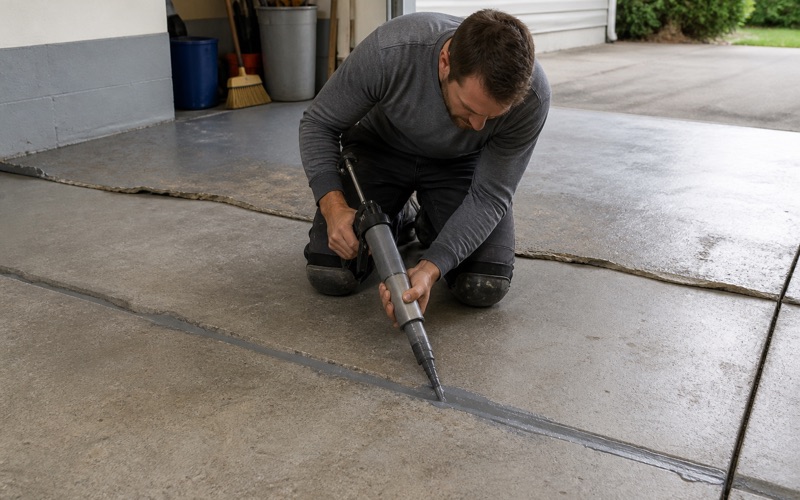
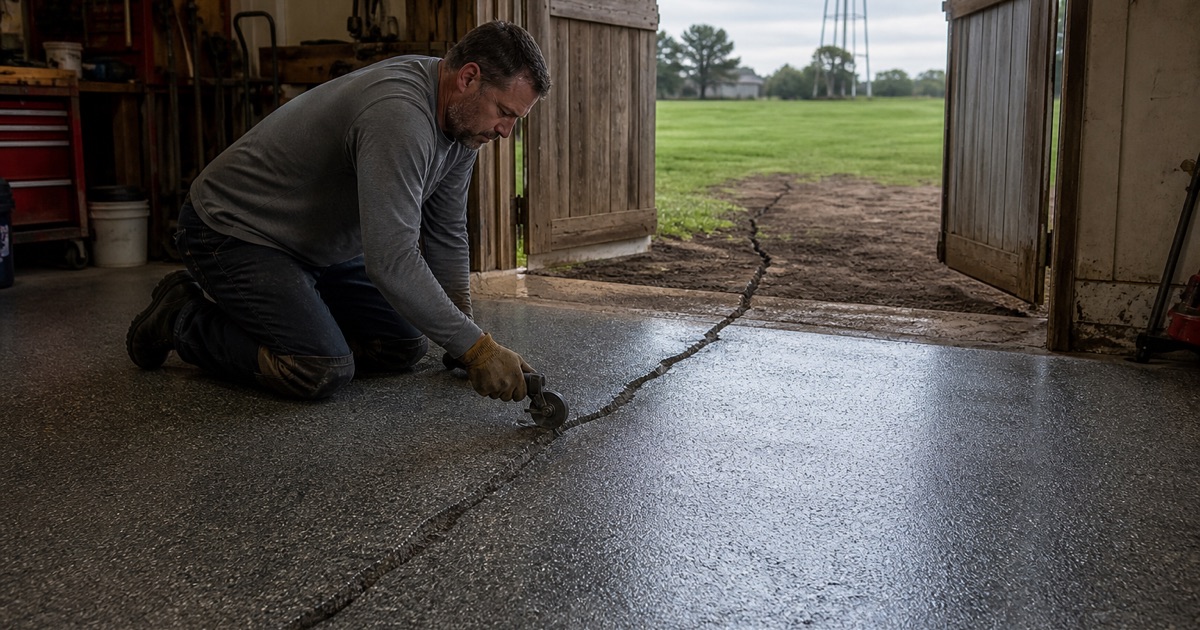
Where a slab has cracks over ground like this, we do not fill them rigid and skim a coating over the top. A crack over moving ground is treated as a live joint: routed out, filled with a flexible sealant such as a semi-rigid polyurea joint filler where the loading suits it, and honored through the coating rather than hidden under it.
We tell an owner before the work starts that a detailed joint may telegraph again, because on 12.0 percent linear extensibility it very likely will. Existing control joints get the same respect. That honesty costs us the occasional job against someone promising a permanent repair, and we would still rather lose it than argue about it in eighteen months.
The stock is old, and so are the slabs
83.0 percent of this city’s housing was built before 1980, 20.9 percent predates 1950 and 14.3 percent predates 1940, with the 1970s the largest single decade at 30.7 percent and the 1950s next at 22.6 percent. Post-tension slabs only became common in Texas after about 1980, so the typical slab here is conventionally reinforced and ground-supported on the most expansive soil in the area.
A garage or shop floor of that vintage may be an original thin unreinforced pour, a slab poured over an earlier surface, or a floor that was never engineered as a slab at all. Mid-century construction also predates most modern under-slab vapor-retarder practice, which is exactly why the moisture numbers matter more here than they would on newer concrete.
Old buildings and floors with a century of history on them
The mineral-water era left large buildings behind
Hot mineral water was found here accidentally in 1891, the first bathhouse opened in 1895, and the Arlington Hotel opened that same year, burned in January 1899 and was replaced by more elaborate structures in 1901. Conrad Hilton opened a hotel here on May 27, 1930 at a cost of $375,000. The resort industry declined after World War II and left the buildings standing.
Renovating one of those is a floor job with a hundred years of substrate history under it. Terrazzo beds, quarry tile, thinset, cutback adhesive, mastic, sheet goods and two or three generations of sealer can all sit on the same slab, and what is underneath them is often several different pours at slightly different elevations. We survey that before we specify anything.
Every slab is ground or shot blasted
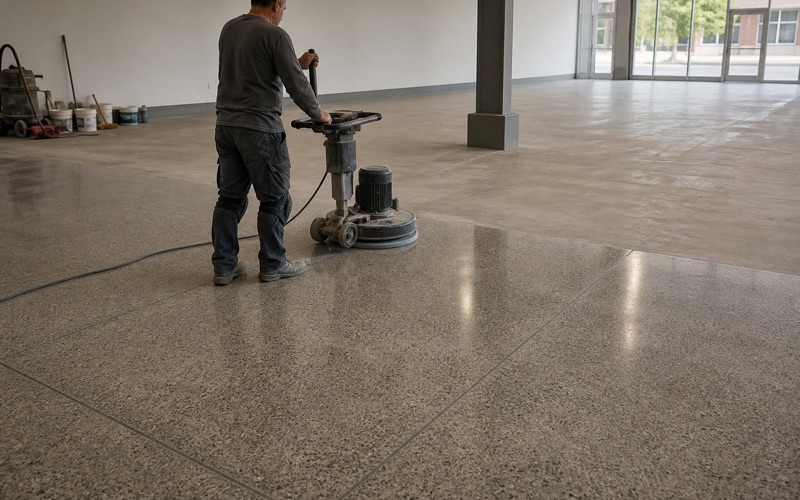
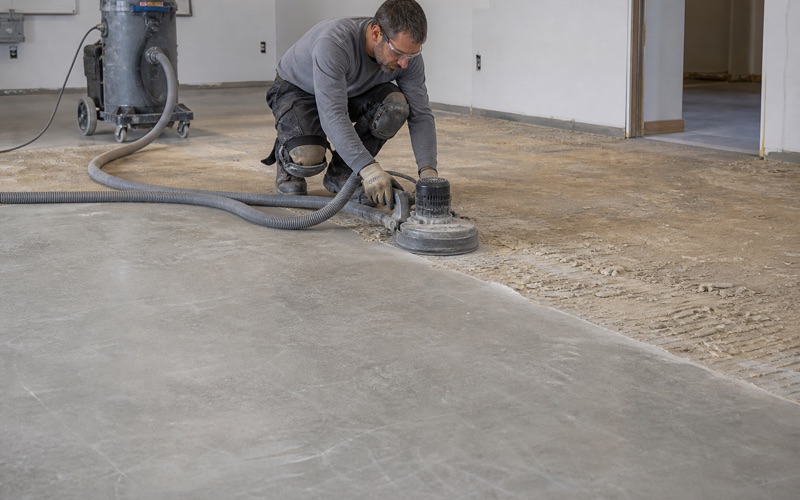
We do not acid etch and we do not coat over an existing sealer. Every slab is mechanically profiled with diamond grinding or shot blasting to an ICRI CSP surface profile suited to the system going down, with diamond segment bond hardness matched to how hard or soft the concrete turns out to be once we start cutting.
Where a coating or adhesive has to come off, PCD tooling handles removal that an ordinary grinding segment would only smear and glaze. Reclaiming a floor that has already had a failed system on it is a genuinely bigger job than coating bare concrete, and we price it that way rather than discovering it on the first morning.
A smaller market, priced honestly
Vacancy here runs about 17.9 percent, roughly 451 empty units out of 2,524, in a city whose population fell 8.5 percent between 2010 and 2020 to 5,462. Nearly one home in five stands empty, and the owner of a vacant house is usually deciding whether to reinvest at all rather than which flake blend to pick.
What remains as steady institutional demand is the county seat function, Marlin Independent School District, Falls Community Hospital and two Texas Department of Criminal Justice units — the Marlin Unit, a transfer facility opened in June 1992, and the William P. Hobby Unit. Work inside a TDCJ perimeter is authorized by the agency rather than by a city permit, which changes the paperwork and the site access rules entirely.
Scheduling, water and the working window
Potable water on site is not something we assume
A boil water notice for the city was rescinded on May 13, 2026, and the city has posted a public awareness notice for the Drinking Water State Revolving Fund. There is documented history behind that: in December 2015 the system manager cut wires when alarms sounded rather than fixing the problems. This is a matter of record, not rumor.
Our trade needs potable water for mixing, cleanup and equipment, so we confirm supply before mobilizing and carry our own when the answer is uncertain. A notice landing mid-job is a scheduling risk here that simply does not exist in most towns, and building it into the plan is cheaper than reacting to it.
The dew point at the slab decides the start time
We schedule against the dew point measured at the slab surface, not the air temperature on a phone. Manufacturer data sheets commonly require the surface to stay at least 5 degrees above the dew point through application and cure, and the NWS gridpoint forecast for this grid issued August 17, 2026 carried dew points from 60 to 75 degrees with relative humidity from 25 to 87 percent.
At a 75 degree dew point, most of the working day closes unless the slab is genuinely warm. That is why we start mid-morning in summer rather than at dawn, when a cool slab under humid air produces amine blush and a hazy, poorly bonded first coat instead of a finished floor.
Heat, freeze and what goes in writing
The same forecast carried temperatures from 74 to 102 degrees. On a published product, pot life runs roughly 60 minutes at 55 degrees, about 40 minutes at 72 degrees and about 20 minutes at 95 degrees, while the recoat minimum collapses from 24 hours to 6 hours and an uninsulated slab can approach the 160 degrees maximum surface temperature a data sheet allows. We size batches and crews to that, not to a spring pace.
Winter carries the opposite risk. Winter Storm Uri ran February 11 to 21, 2021 across all 254 Texas counties, with six to nine consecutive days of freezing weather in Central Texas — the longest such streak on state record. Permits for building, remodeling, additions and demolition come from the City of Marlin Permit Department, and because Texas does not license flooring contractors we show general liability cover, workers’ compensation and a Texas sales and use tax permit instead of a number that does not exist.
- 20+ Years in Central Texas
- Fully Insured
- Free Written Proposal