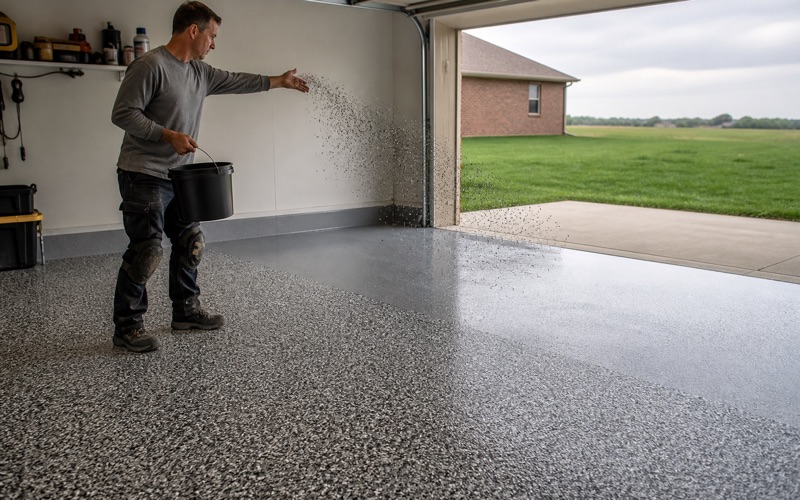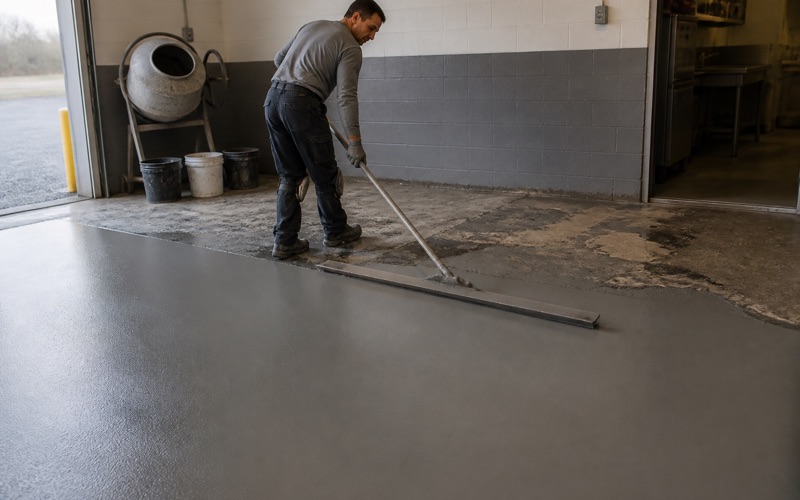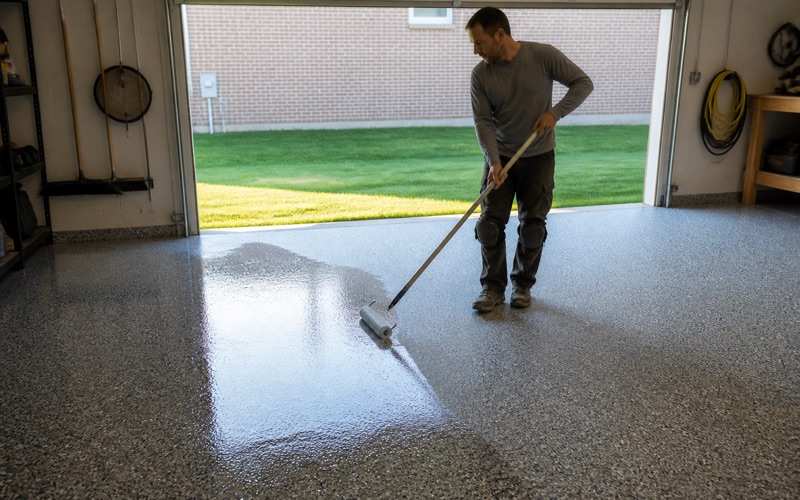
Temple Epoxy Flooring installs garage floor coating in Killeen, and we have spent more than 20 years putting resin systems down on Central Texas concrete. A large share of the calls we take in this city come from someone who will never park a car on the floor. The owner is one person, the occupant is another, and the two want different things out of the same slab.
Before we quote, we check what the slab is actually sitting on. About a third of the ground we work over is true shrink-swell clay and roughly half of it is not, and those two conditions call for different conversations, different crack details and sometimes a different product entirely. Guessing at that stage is what produces a callback eighteen months later.
We also say plainly what a coating cannot do. It is a film. It follows the slab it is bonded to, and it will not stop, bridge or hide seasonal ground movement. Almost everything else on this page follows from that one limit.
Ten thousand rented houses and who signs for the floor
The floor is a decision made at turnover
10,115 single-family detached houses in Killeen are renter-occupied. That is 26.4 percent of every occupied detached house in the city, and it is the specific pool where a garage floor stops being a home improvement and becomes a turnover item. The person choosing the coating is an owner, an investor or a property manager, and they are usually choosing it in the gap between one lease and the next.
We handle those jobs differently from the ground up. The brief is not what would look good in this garage, it is what will still be intact after the next two tenancies and can be cleaned by a turn crew in an afternoon. Durability and turnaround set the specification. Color and flake blend get picked last, and usually in about ninety seconds.
Renters are the majority household here
Killeen is 50.5 percent renter-occupied, with 30,211 renter households against 29,558 owner households out of 59,769 occupied units. That balance is unusual, and it means the buyer on any given garage floor here is as likely to hold the property as an asset as to live in it. We never assume which one is on the phone.
The turnover is measurable rather than anecdotal. 56.5 percent of renter households moved into their current unit in 2020 or later, and 12.4 percent moved in during 2023 or later, against 23.1 percent of owner households over the same window. Beyond that we do not speculate about causes; the movement is documented, the reason for it is not something we are going to invent for you.
What the owner is actually buying
On a rental turnover the owner is buying a date as much as a floor. A lease starting on the first of the month is a hard constraint, and a coating with a long recoat window or a slow return to service can be the wrong choice for that job even where it is the better coating on paper. We say which product fits the calendar and which one does not.
The proposal names the product, the system build and the mil thickness, so what was quoted can be checked against what was installed. That matters more, not less, when the person paying is not standing in the garage while the work happens. We also walk the warranty exclusions before the job is sold, substrate movement and moisture first among them.
Looking for epoxy flooring closer to McGregor? See Epoxy Flooring Services in McGregor.
San Saba clay under a tract slab
Killeen was platted in 1881 by the Gulf, Colorado and Santa Fe Railway on 360 acres and named for Frank P. Killeen, the railroad’s assistant general manager, but the town of 1,263 people recorded in 1940 has almost nothing to do with the 153,095 counted in 2020. Nearly every garage slab in this city was poured during that growth, onto one particular soil.
What the soil survey maps under this city
The soil survey at the Killeen city centroid maps San Saba clay on 1 to 3 percent slopes, with San Saba making up about 90 percent of the map unit. Formally it is a fine smectitic thermic Leptic Udic Haplustert, which is to say a Vertisol, the soil order defined by the fact that it shrinks and swells.
The numbers are what matter on a job. That profile runs roughly 50 percent clay through the upper 28 centimeters, carries a plasticity index near 40 and shows about 10 percent linear extensibility. Linear extensibility at that level is a very high shrink-swell rating. The ground takes on water and expands, dries out and contracts, and the slab poured on top of it moves seasonally right along with it.
A moving crack is a joint, not a defect to fill
Expansive clay of this class produces hairline slab cracking that opens through a dry summer and closes again after a wet spell. A rigid coating carried straight across a crack like that either telegraphs the line through the finish or splits along it, which is a slower and considerably uglier failure than simply leaving the crack visible would have been.
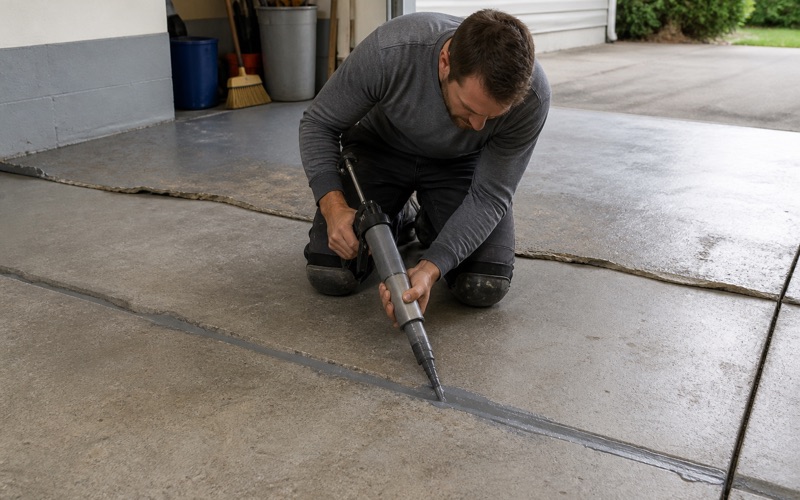
So we treat a crack over moving ground as a live joint. That means a semi-rigid polyurea joint filler detailed to keep moving rather than a hard fill troweled flush and coated over, and it means telling you before the job starts that the line may show itself again. A floor that was explained honestly does not turn into an argument two seasons later.
Post-1980 slabs and what is inside them
75.4 percent of Killeen’s housing stock was built in 1980 or later and 42.9 percent went up in 2000 or later. Texas residential construction is overwhelmingly slab-on-grade with basements effectively absent, and post-tension slabs became common in this state after roughly 1980. The modal garage slab here is therefore a post-1980 pour, and a meaningful share of those are post-tension.
That governs what we will and will not do to the concrete. Cutting, coring or driving an anchor into a post-tension slab risks a tendon, and nobody should be doing it without knowing where the cables run. Diamond grinding and shot blasting take the top off the surface without going anywhere near them, which is one more reason we prepare a floor that way.
What the floor has to survive between tenancies
Preparation decides how long the coating lasts
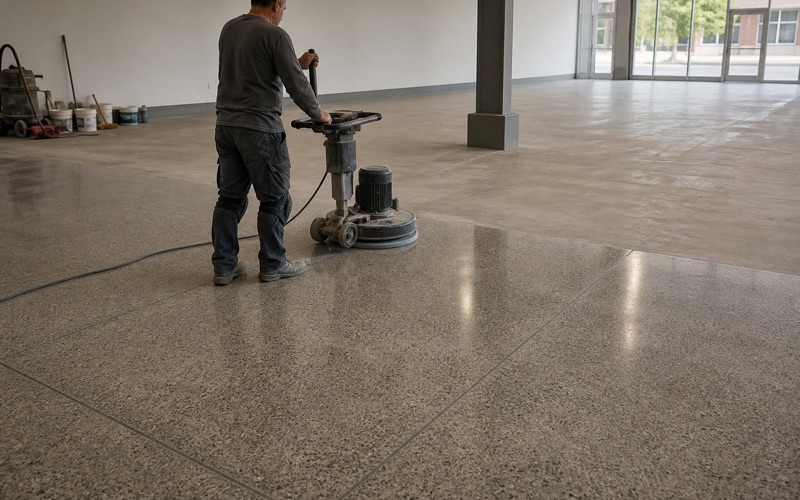
Every slab we coat is mechanically ground or shot blasted to an ICRI CSP profile matched to the system going over it. We do not acid etch, and we do not coat over an existing sealer. A resin film bonded to somebody else’s sealer is only ever as good as that sealer’s grip on the concrete, which is usually not good at all.
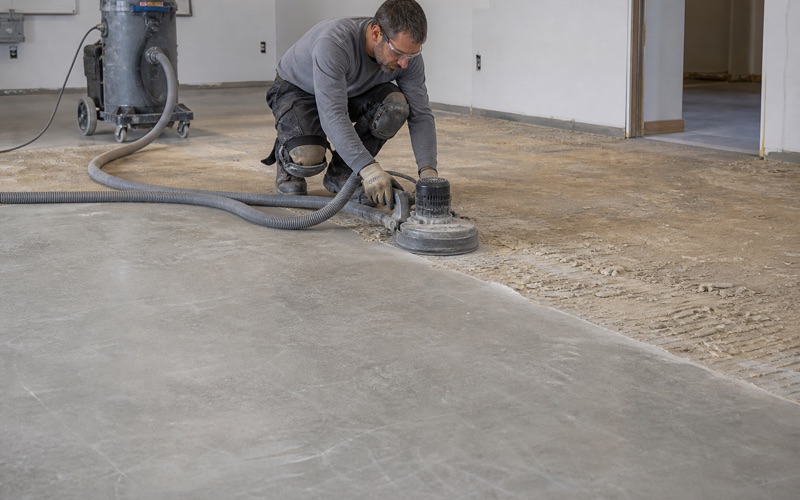
Taking off an old coating is its own line item and we say so up front rather than discovering it on the morning. PCD tooling strips a failed film, diamond segments of the right bond hardness open the concrete underneath, and the vacuum runs the whole time. On a rental with a hard handover date, this stage is what decides whether the schedule holds.
Moisture testing written into the scope
On an older slab, moisture testing goes into the scope from the start rather than being sold as an add-on after a floor blisters. Depending on the slab that means ASTM F1869 calcium chloride vapor emission testing, ASTM F2170 in-situ relative humidity probes, or an ASTM D4263 plastic sheet test as a fast screen, all read against the ASTM F710 thresholds.
If the readings come back high, the answer is a moisture-mitigation primer under the build, priced before the work starts instead of halfway through it. 24.6 percent of this city’s housing stock predates 1980, and slabs of that age frequently went down over a vapor retarder that is thin, torn or simply not there.
Hot tire pickup and the two-car bay
Hot tire pickup is what kills a cheap garage floor, and it is a live risk on a vehicle that has been sitting on a dark driveway through a Central Texas afternoon. A hot tire softens a thin or under-cured film and lifts it when the car moves. A 100 percent solids epoxy carried to the specified mil build and topped with a polyaspartic or polyurea handles that; a one-day roll-on out of a box does not.
Build era also decides how the job runs. Post-2000 tract houses here carry an attached two-car bay off a short front driveway, which means predictable area, predictable slab and predictable access. Pre-1980 stock is likelier to have a single bay, a carport or a detached garage down a long driveway run, and getting a grinder and vacuum back there is the part that costs money.
Scheduling against a vacancy window
Dew point at the slab surface, not air temperature
We schedule against the dew point at the slab surface rather than the air temperature, which is why we tend to start mid-morning in summer instead of at dawn. A published requirement that the surface sit at least 5 degrees above the dew point is easy to miss on a cool slab on a humid morning, and missing it produces amine blush or an outright bond failure.
The margins here are tighter than a specification written for a dry climate assumes. A recent National Weather Service gridpoint forecast for the Killeen grid carried dew points from 58 to 72 degrees and relative humidity from 24 to 85 percent. Against a 72 degree dew point, a slab that has been sitting overnight at 74 degrees is not a floor anybody should be coating.
Pot life in a Killeen summer
Heat governs the other half of the working day. That same forecast period ran from 74 to 102 degrees, and an uninsulated garage slab does not shed all of its heat overnight when the low sits in the mid-seventies. On one published product, pot life falls from roughly 60 minutes at 55 degrees to about 40 minutes at 72 degrees and about 20 minutes at 95 degrees.
A twenty-minute pot life changes crew size and batch size, not just the start time. It also cuts our way: the same heat collapses the minimum recoat window from 24 hours down to about 6, which is exactly what an owner with a lease starting on Saturday needs. We quote the return to service honestly, because on a turnover the schedule is the deliverable.
Freeze risk, permits and who you are dealing with
Winter here is not a formality. Winter Storm Uri ran February 11 to 21, 2021, affected all 254 Texas counties and gave Central Texas six to nine consecutive days of freezing temperatures, the longest such streak in the state’s recorded history. An unheated garage in a hard freeze sits below the minimum application temperature on every product data sheet worth reading, so a February booking carries real multi-day shutdown risk and we say so when we take it.
Work in this city goes through the City of Killeen, a home-rule city on the council-manager form adopted by charter in 1949, with its own development services and building inspections. A coating inside an existing garage is normally a finish rather than a structural alteration, but any panel work, added circuit or mechanical ventilation put in for our crew is a city permit item pulled at the city. Nothing about a residential job here runs through the adjacent federal installation, and treating the two as one market is a scheduling error that costs somebody a morning.
Texas does not license flooring or coatings contractors, so there is no license number for anyone in this trade to show you. What we can show is general liability cover, workers’ compensation, a Texas sales and use tax permit and city contractor registration. We would rather hand those over than let a number nobody actually issues stand in for them.
- 20+ Years in Central Texas
- Fully Insured
- Free Written Proposal