Temple Epoxy Flooring installs epoxy flooring in Jarrell, and in more than 20 years of coating Central Texas concrete we have rarely worked a market where the slabs are this new. That single fact reverses most of the assumptions a flooring contractor brings to this part of the state, starting with what is inside the concrete and ending with what is underneath it.
Before we quote, we establish what the slab is and what it sits on. Across this region roughly a third of the ground we work over is true shrink-swell clay and about half is not, and the difference decides the crack detail and sometimes the product. Reading it for a specific address takes very little time and saves an argument later.
We also say plainly what a coating cannot do. It is a film. It bonds to the slab, follows the slab, and will not stop or bridge ground movement, and it will not hold onto concrete that is still giving off moisture. Everything below follows from those two limits.
A town where nearly every slab is newer than 2010
The stock here runs the opposite way to the rest of the region
87.9 percent of Jarrell’s housing was built in 1980 or later, and 67.4 percent went up in 2010 or later. This is not an old town with a few new subdivisions on the edge; it is a new town with a small older core. The city was founded in 1909 and only incorporated in 2001, and the growth since then has been steep enough that any five-year housing estimate describes the composition better than the count.
For our trade the practical result is uniformity. The garage we walk into here is usually a modern attached two-car or three-car front-facing bay off a tract driveway, with predictable dimensions, predictable finish quality and predictable access. Narrow single bays and detached rear garages down a long driveway are largely absent, which takes a whole category of cost out of the quote.
Assume post-tension until the plans say otherwise
Post-tension slabs became common in Texas construction after roughly 1980, and with the overwhelming majority of this city built after that line, the default assumption here runs opposite to almost every other town in the region. We treat a Jarrell garage slab as potentially post-tensioned until somebody establishes that it is not.
That is not caution for its own sake. Cutting, coring or drilling an anchor into a post-tension slab risks severing a tendon, and a severed tendon turns a floor job into a structural repair. Any drain, dowel, bolted rack leg or core sample has to wait until the slab type is known, and in a stock this new that is a live question on most jobs rather than a rare one.
Young concrete carries a moisture history of its own
34.8 percent of the housing here was built in 2020 or later, which puts a meaningful share of these garages on concrete young enough that residual construction moisture is still a real variable. A slab that has not finished drying will lift a coating regardless of how well the surface was prepared.
Builder-applied curing compounds are the companion problem. A membrane-forming cure left on the surface is exactly the sort of thing a resin system will not bond through, and it is invisible to anyone who does not look for it. Testing and grinding rather than assuming is a different discipline from the one an old-stock market teaches, and it is the one this city needs.
Looking for epoxy flooring closer to Hewitt? See Epoxy Flooring Services in Hewitt.
Shallow soil over rock, not deep reactive clay
What the survey actually maps under this city
The soil survey at the Jarrell city centroid maps Castephen silty clay on 3 to 5 percent slopes, with Castephen at 100 percent of the map unit. It is a loamy, carbonatic, thermic, shallow Entic Haplustoll, well drained. The word shallow sits in the taxonomic family name, and it is the operative word on the whole page.
That is not a single-point curiosity either. A second query several miles away in the newer development area east of the original townsite returned the identical map unit with the same horizon values, so the shallow carbonatic condition holds across the area where the town is actually growing rather than at one spot on a map.
Bedrock at roughly sixteen to twenty-two inches
The profile runs from the surface to 41 centimeters at 33.5 percent clay, plasticity index 27 and linear extensibility 4.5 percent, and then it stops. The horizon from 41 to 56 centimeters carries no clay, plasticity or extensibility values at all, which is the signature of a bedrock contact. In round numbers there is something like sixteen to twenty-two inches of soil over rock.
A slab here therefore bears on a thin carbonatic layer over limestone rather than on many feet of moving material. That is a fundamentally different foundation condition from the one most regional advice about Central Texas slabs is written for, and it changes what we look for when a homeowner points at a crack.
Movement that is rock-limited rather than clay-driven
Linear extensibility of 4.5 percent is a genuine shrink-swell load and we do not dismiss it, but it is a fraction of what a deep smectitic soil delivers, and the shallow contact physically limits how much material there is to move in the first place. The honest description is moderate and rock-limited seasonal movement.
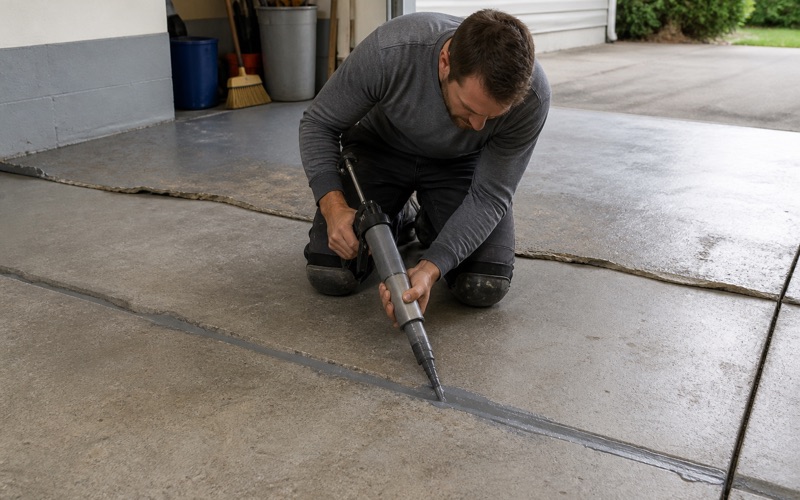
Where a crack is genuinely still working, we treat it as a live joint rather than filling it rigid and coating over it, using a semi-rigid polyurea filler and telling you before the job that the line may telegraph again. Where a crack is not moving, saying so is worth more than selling a detail for a problem the ground here does not produce.
Water over a shallow contact
Drainage that has to move sideways
Shallow rock removes one problem and creates another. Water arriving at a well-drained soil that ends at limestone at less than two feet does not keep percolating; it moves laterally along the contact instead, and it concentrates where the grade sends it. Around a slab edge that means water with fewer places to go.
Moisture arriving at the underside of a slab is what lifts a coating, so on this ground we pay attention to where the grade puts water before we talk about finishes. Downspout discharge, driveway pitch and the approach into a bay opening all matter more here than the soil report on its own would suggest.
Moisture testing written into the scope
Moisture testing is in the scope from the start rather than sold as an add-on after a floor blisters. Depending on the slab that means ASTM F1869 calcium chloride vapor emission testing, ASTM F2170 in-situ relative humidity probes, or an ASTM D4263 plastic sheet test as a fast screen, read against the ASTM F710 thresholds.
Probe testing on a possible post-tension slab is one of those places where the two halves of this page meet, since an in-situ probe requires drilling into the concrete. That is a conversation we have before scheduling, not a decision a technician makes on the morning with a hammer drill in hand.
Preparation on a slab nobody has coated before
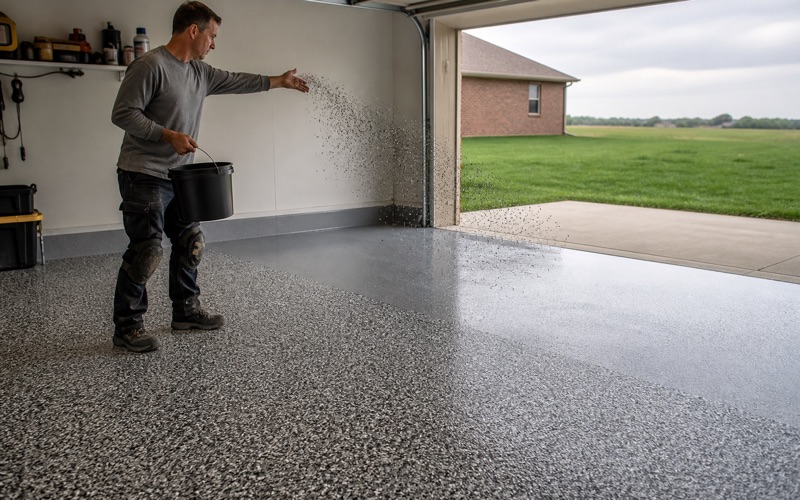
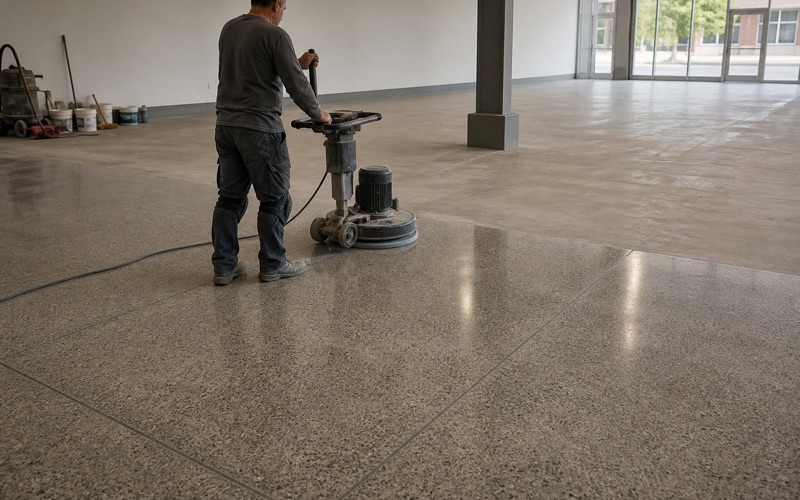
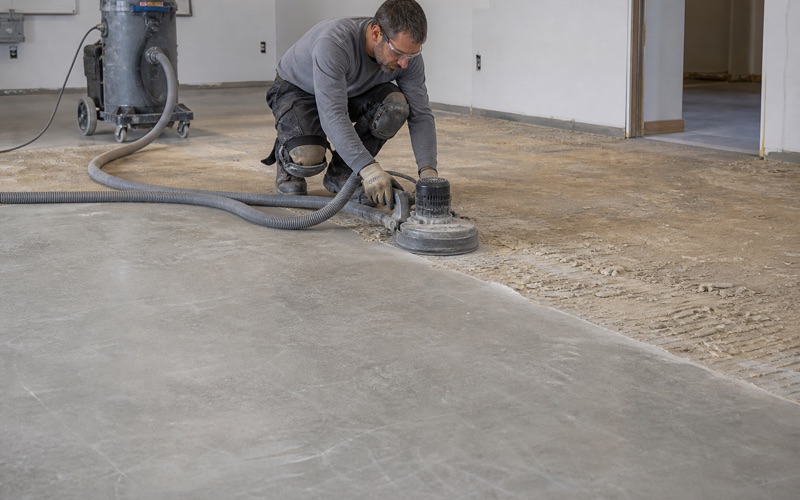
Every slab we coat is mechanically ground or shot blasted to the ICRI CSP profile the chosen system needs. We do not acid etch, and we do not coat over an existing sealer. On new construction that second rule bites more often than people expect, because a slab that looks bare frequently is not.
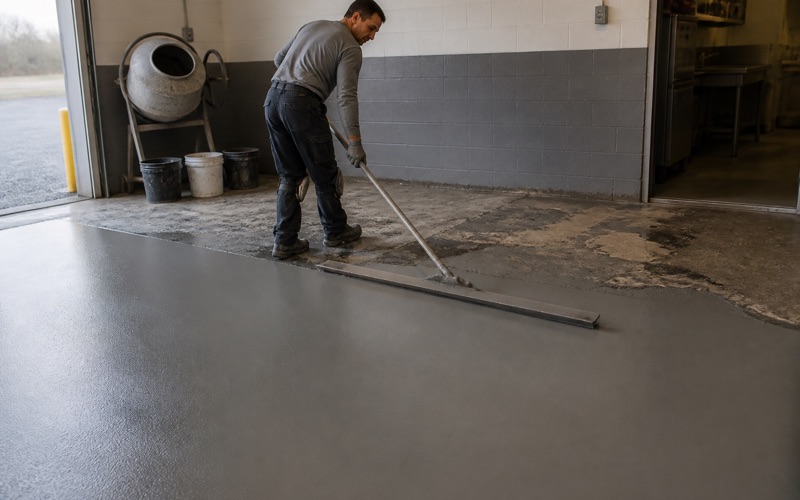
If a previous coating has to come off, PCD tooling and the right diamond segment bond hardness handle it, and it is priced as its own line rather than absorbed into a square-foot rate. The proposal names the product, the system build and the mil thickness, so what was quoted can be checked against what was installed.
Building the schedule around the weather and the paperwork
Dew point at the slab surface, not air temperature
We schedule against the dew point at the slab surface rather than the air temperature, which is why summer work here starts mid-morning rather than at dawn. A published requirement that the surface stay at least 5 degrees above the dew point is easy to miss on a cool slab on a humid morning, and missing it produces amine blush or a bond failure that shows up weeks later.
This city also falls under a different National Weather Service forecast office from the counties to the north, so a forecast written for one of them does not describe conditions here. A recent gridpoint forecast for this grid carried dew points from 59 to 74 degrees and relative humidity from 25 to 85 percent, and at the top of that range there is no early start worth taking.
Heat, pot life and surface temperature
The same forecast period ran from 76 to 102 degrees. On one published product, pot life falls from roughly 60 minutes at 55 degrees to about 40 minutes at 72 degrees and about 20 minutes at 95 degrees, while the minimum recoat window collapses from 24 hours to about 6.
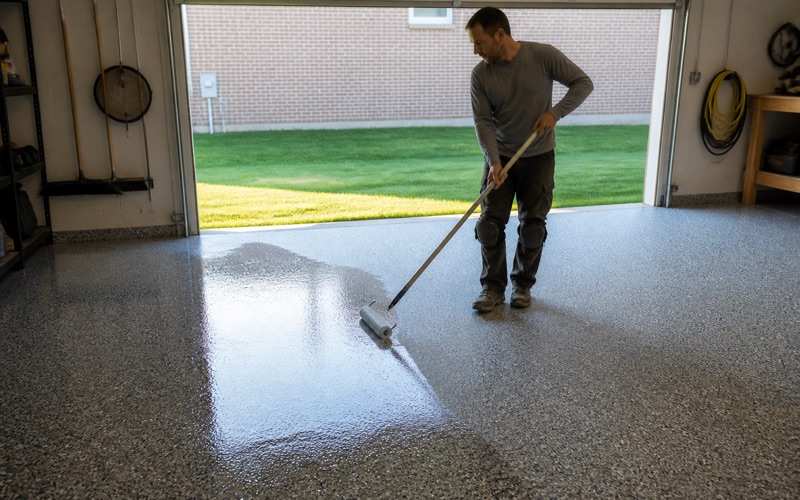
A new tract garage with a west-facing door and no insulation is exactly the enclosure where a slab climbs toward the 160 degrees maximum surface temperature a data sheet allows. A twenty-minute pot life changes crew size and batch size, not just the start time, and a 100 percent solids epoxy laid at the specified spread rate and topped with a polyaspartic or polyurea is what stands up to hot tire pickup afterward.
Two authorities, a winter risk, and what we can show you
Winter is the opposite constraint. Winter Storm Uri ran February 11 to 21, 2021, affected all 254 Texas counties and brought Central Texas six to nine consecutive days of freezing temperatures. An unheated garage in a hard freeze sits below the minimum application temperature on every product data sheet worth reading, so we flag the shutdown risk when a February date goes on the calendar.
Permits run through City of Jarrell Permits and Development at City Hall on Town Center Boulevard. This is a general-law city governed by a Mayor and a Board of Aldermen, incorporated only in 2001, so the code history is short and we confirm the current adopted edition with the city rather than assuming it. Fire protection is a separate matter entirely: it comes from Williamson County Emergency Services District No. 5, not a city department, so a commercial occupancy or hot-work question is answered by a different organization from the one issuing the building permit.
Texas licenses no flooring or coatings contractor, so instead of a license number nobody issues, we show general liability cover, workers’ compensation, a Texas sales and use tax permit and city contractor registration. We also go through the warranty exclusions before the job is sold, moisture and substrate movement first among them.
The growth behind all of this is recent and steep. The 2020 census counted 1,753 residents and the 2025 estimate put the city at 5,870, while the school district’s enrollment more than doubled between 2012 and 2019. Much of the housing on the north side dates from after May 27, 1997, when an F5 tornado destroyed the Double Creek Estates subdivision entirely and twenty-seven people were killed — the single most consequential day in this city’s history, and the reason a stretch of it was rebuilt from nothing.
- 20+ Years in Central Texas
- Fully Insured
- Free Written Proposal