Temple Epoxy Flooring installs epoxy flooring in Hewitt, and we have spent more than 20 years putting coatings on Central Texas concrete. The useful part of that is not the number of years but the number of return visits: we have seen which of our own floors held and which ones moved with the ground under them.
Before we quote, we want to know what the slab sits on. Across this trade area roughly a third of the ground is true shrink-swell clay and about half of it is not, so the site determines the conversation. In this particular city the answer comes back the same wherever we look, which is unusual and worth explaining.
We also say plainly what a coating cannot do. Epoxy is a film bonded to the top of concrete. It follows the slab, and it will not stop, bridge or hide seasonal ground movement. Everything below is written from that limit rather than around it.
A young stock on consistently reactive ground
Two map units across the city, one shrink-swell rating
SSURGO at the Hewitt city centroid maps the Austin-Urban land complex, 1 to 3 percent slopes, with Austin at 60 percent of the map unit and urban land at 40 percent. The Austin soil series is a fine-silty, carbonatic, thermic Udorthentic Haplustoll, well drained, running to 45 percent clay with a plasticity index of 35 and linear extensibility of 7.5 percent.
About a mile west the survey changes to Fairlie clay, 1 to 3 percent slopes, Fairlie at 85 percent of the unit. Fairlie is a fine, montmorillonitic, thermic Udic Haplustert, a true Vertisol, at 50 percent clay with a plasticity index of 41 and the same 7.5 percent linear extensibility.
There is no low-movement pocket here
Two different map units, two different soil orders, and the same high shrink-swell rating. That matters because in much of this region a site visit is genuinely a coin toss between reactive and quiet ground, and a quote can swing on the answer.
In this city it does not swing. We plan every job here on the assumption that the ground under the slab gains and loses volume with the seasons, and we price the joint treatment accordingly rather than discovering the problem after the first dry summer.
Reading a crack before anything gets filled
Existing cracks get read as active or dormant before we choose how to treat them, because a joint detail chosen for a static slab fails on a moving one inside a single season. Width, edge condition and whether the two sides sit at the same height all say something.
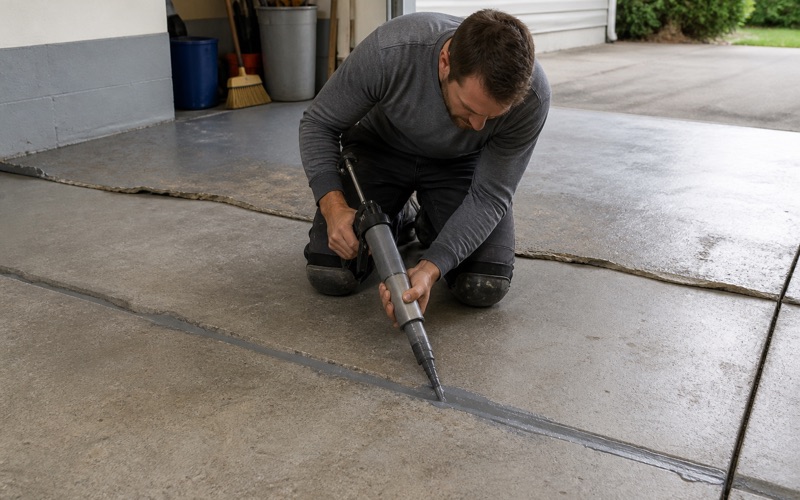
A crack over ground like this is carried as a live joint in semi-rigid polyurea filler rather than packed rigid and coated flat. We tell you before the job that it may telegraph again, and warranty exclusions get explained at that point too, with substrate movement and moisture named first.
Looking for epoxy flooring closer to Woodway? See Woodway Epoxy Flooring.
Post-tension as the working assumption
The slab era here runs the opposite way
74.4 percent of this city’s housing was built in 1980 or later, and only 25.6 percent before it. That is backwards from most of Central Texas, where the older stock dominates, and it is the single most useful construction fact about a Hewitt address.
Post-tension slabs became standard Texas practice in exactly that era, and on ground with a plasticity index in the 30s and 40s they were adopted for precisely this reason. So our default assumption on a house here is a tensioned slab until the drawings or a scan say otherwise.
Tendons decide which tools come out
Nothing gets cut, cored, drilled or anchored on a slab we believe is tensioned until tendon locations are established. That is not a cosmetic caution. A severed tendon is a structural repair, and it happens to contractors who assumed a conventional reinforced pour because the house looked ordinary.
In practice this changes small things all through the job: how a threshold transition gets fixed, how a drain or a floor-mounted fixture is handled, and whether a saw cut is on the table at all. We would rather redesign a detail than take the risk.
An even growth curve, not one repeated house
The decade shares here are remarkably flat. The 1970s hold 21.2 percent of the stock, the 1980s 17.9 percent, the 1990s another 17.9 percent and the 2000s 21.6 percent, with the 2010s at 16.1 percent behind them. Four decades each carrying roughly a fifth.
The practical effect is that we see the whole 1970 to 2010 range of tract construction rather than one house type over and over. Slab finish, control joint spacing and garage dimensions all shift across that span, and so does what the concrete does under a grinder.
Preparation on a slab that is not old
Mechanical profile, every time
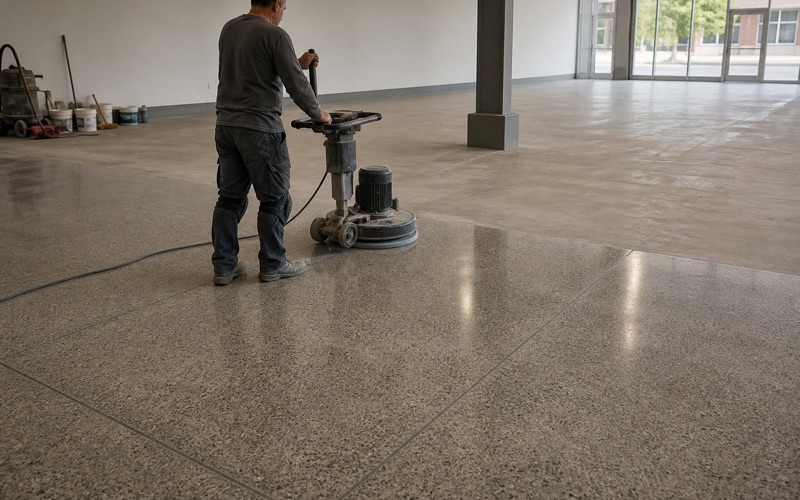
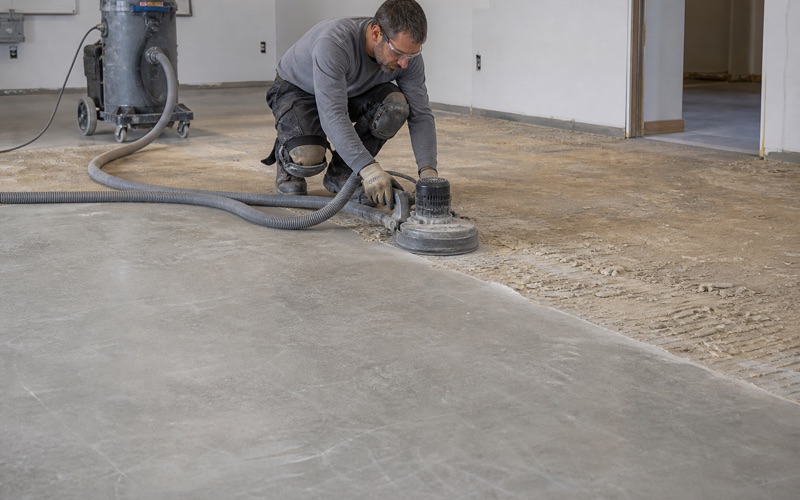
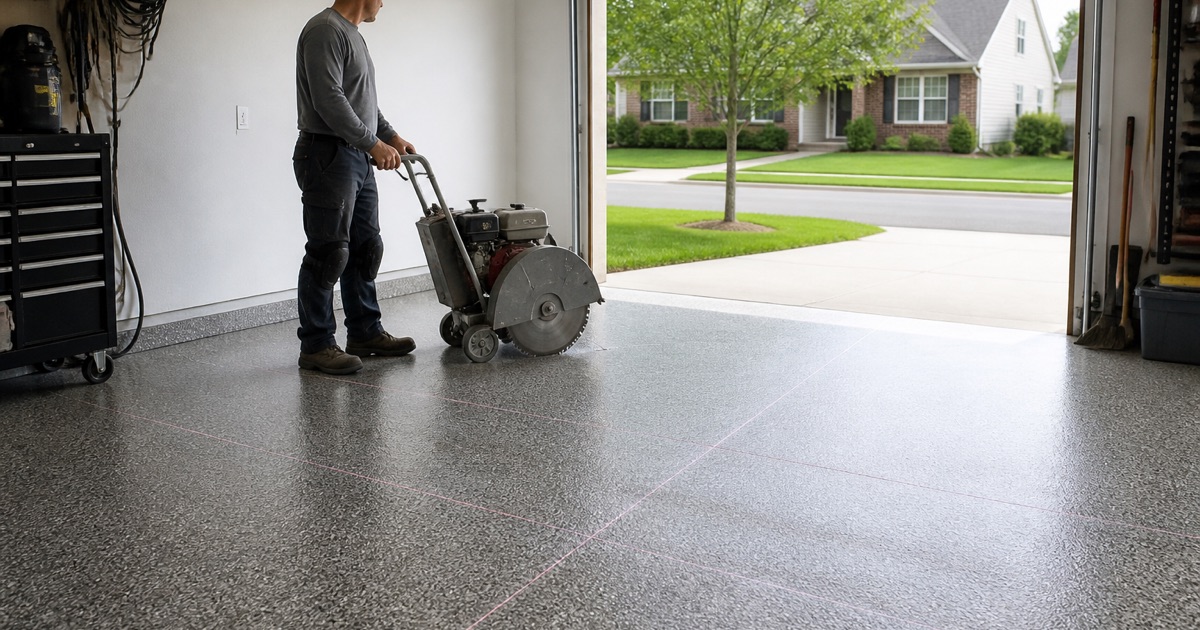
Every slab is mechanically ground or shot blasted to an ICRI CSP profile matched to the system going down. We do not acid etch and we do not coat over an existing sealer, because both leave the film sitting on something other than sound concrete.
Newer concrete in good condition can be harder and denser than an old, weathered pour, so we pick diamond segment bond hardness for the slab in front of us. Where a previous coating has to come off, PCD tooling does that work before any profiling begins.
Moisture is not only an old-slab problem
Moisture testing goes into the scope in writing rather than being sold as an add-on after a floor blisters. We screen with the ASTM D4263 plastic sheet test, then run ASTM F1869 calcium chloride vapor emission testing or ASTM F2170 in-situ relative humidity probes and read the results against the ASTM F710 thresholds.
A slab poured after 1980 is likelier to have a vapor retarder beneath it than a 1950s pour, but that is a probability rather than a guarantee, and a retarder that was punctured during construction performs like one that was never there. Where the numbers come back high, a moisture-mitigation primer is priced in before the job is sold.
What the proposal actually says
The proposal names the product, the system build and the mil thickness, so what was quoted can be checked against what was installed. Spread rate is stated alongside it, because mil build is only as real as the coverage the crew actually achieved.
Solids content and VOC in grams per liter are listed as well. The federal architectural coatings rule at 40 CFR 59 Subpart D constrains what may legally be applied, and a data sheet is the honest place to settle that question rather than a conversation on the driveway.
One hundred and forty-seven empty units
Scheduling around people who never left
Vacancy in this city runs about 2.4 percent, which is roughly 147 unoccupied units out of 6,157. That is about as tight as a housing market gets, and it has a direct operational consequence for us: there is almost never an empty house to work in.
So a garage floor here comes with a household living around it, a car that has to go somewhere for the cure window and someone counting days. Cure time is a customer-experience constraint in this city rather than a purely technical one, and we plan the sequence to give the shortest honest displacement.
Attached homes and the wall you do not own
This city carries an attached-home layer its neighbors do not: 492 single-family attached units, 367 of them renter-occupied against only 26 owner-occupied. Those garages tend to be a single or tandem bay off a shared drive.
That means tighter working room, less space to stage material, and a shared wall that limits cross-ventilation while a coating cures. There is also a household on the other side of that wall who did not order the work, which shapes when we run a grinder and how we handle dust extraction.
Turnover on a landlord’s timeline
Of the 1,907 renter households here, 461 rent a freestanding detached house. That is a landlord’s decision at turnover rather than an occupant’s, and it is a different brief entirely: durability against cost, and turnaround against a vacancy that is expensive by the day in a market this tight.
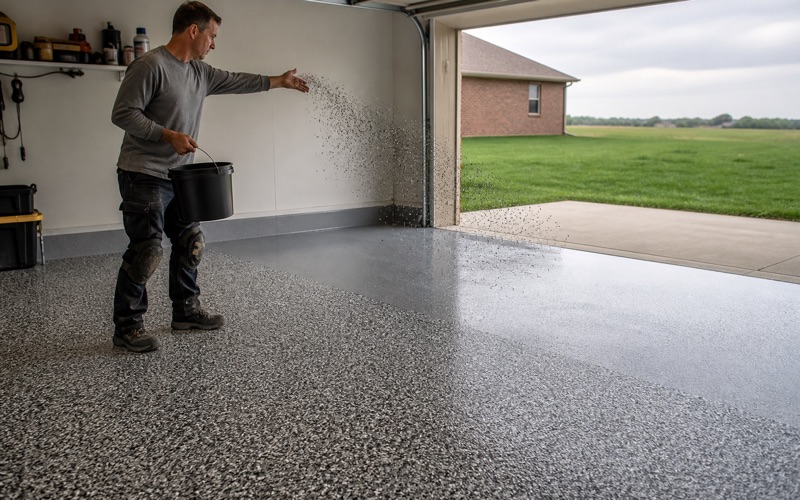
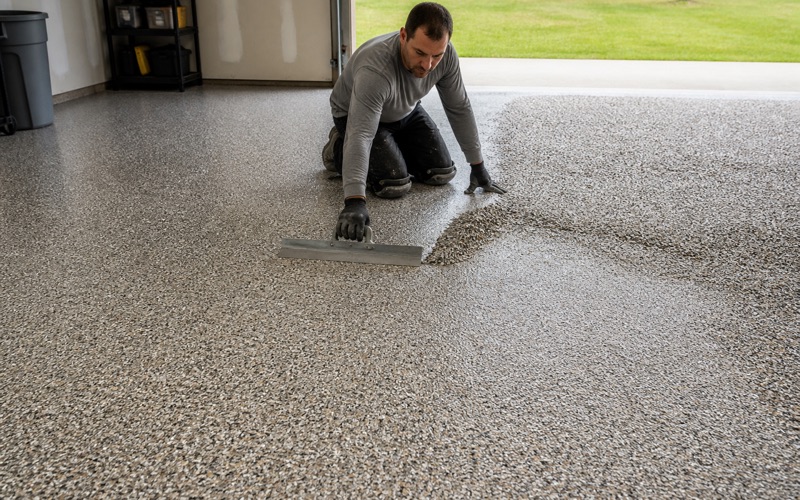
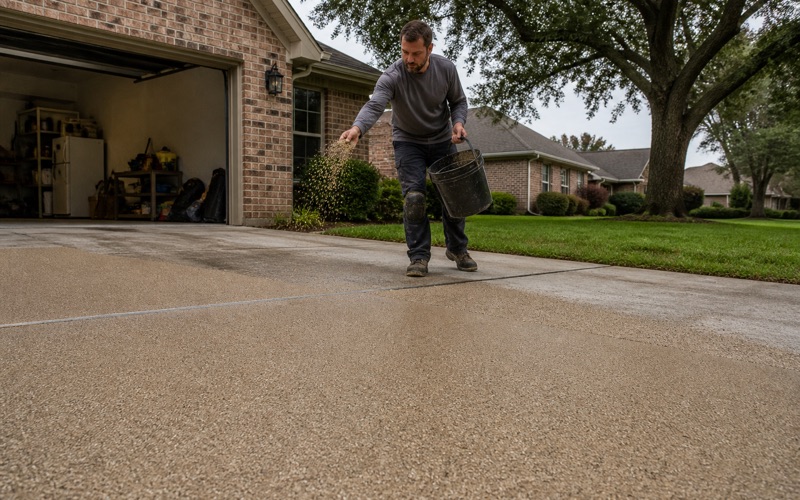
We take those jobs on the owner’s schedule and specify for wear rather than for appearance. A vinyl flake broadcast under a polyaspartic topcoat hides scuffing and cleans easily, which is usually the right trade for a floor that will change tenants again.
Dew point at the slab, not the temperature on the porch
We schedule against the dew point at the slab surface rather than the air temperature, which is why summer work starts mid-morning instead of at dawn. The National Weather Service gridpoint forecast for this grid, FWD 74,46, inside zone TXZ159, carried dew points from 57 to 73 degrees and relative humidity from 23 to 82 percent.
Against a manufacturer floor requiring the surface to stay at least 5 degrees above the dew point, a 73 degree dew point decides whether an early start is workable at all. In an attached garage with one open door and no cross-draft, it decides more than the start time.
The same forecast ran from 75 to 103 degrees, with overnight lows near 75 meaning an uninsulated slab never fully sheds its heat. Pot life on a published product falls from about 60 minutes at 55 degrees to 40 at 72 degrees and near 20 at 95 degrees, while the recoat minimum collapses from 24 hours to 6.
Winter is the opposite risk and the reference event is Winter Storm Uri, whose incident period ran February 11 to 21, 2021 across all 254 Texas counties. Central Texas saw six to nine consecutive days of freezing temperatures. A February window in an unheated garage carries real shutdown risk, and we say so before it is booked.
Industrial land along the rail line
Warehouse slab is a different specification
The Union Railroad runs through the center of this city and industrial land use sits along the tracks in the northern portion, with Burlington Northern Santa Fe serving the wider area and Interstate 35 running past. Those buildings hold warehouse slab, dock apron and truck-court floor.
None of that is a residential bay scaled up. Forklift wheels, pallet drag and point loads at rack feet drive the mil build, and hot tire pickup on a coating too thin or poorly bonded shows up first in the staging lane rather than out on the floor.
Freight volumes and what they do to a floor
More than 20 common motor carriers serve this city, with single-carrier service reaching 32 southwestern metropolitan areas and a 400-mile overnight radius. A dock that turns that much freight is running traffic across the same twenty feet of slab all day.
For that band we generally build a 100% solids epoxy body coat with a polyaspartic or polyurea topcoat, and step up to urethane cement where thermal shock or heavy wash-down is in play. On a bare slab that only needs dust control, a lithium silicate densifier is sometimes the honest answer instead.
Permits, and what we carry instead of a license
Hewitt is a home rule city. It adopted its charter on April 3, 1982 once the population passed 5,000, and it runs under the council-manager form with a seven-member council elected at large across three wards plus one at-large place, and a mayor chosen annually by the council. City Hall is at 200 Patriot Court.
Permits and inspections are municipal here rather than county. Texas does not license flooring or coatings contractors, so instead of a license number we produce general liability cover, workers’ compensation, a Texas sales and use tax permit and city contractor registration before work starts.
- 20+ Years in Central Texas
- Fully Insured
- Free Written Proposal