Temple Epoxy Flooring installs epoxy flooring in Harker Heights, and after more than 20 years on Central Texas concrete we have learned not to assume what is under a slab here. The subsurface in this city is the opposite of what the surrounding area would lead a contractor to expect, and getting that wrong shows up in the floor a year later.
We check what a slab actually sits on before we quote, because the ground across our service area splits roughly in half between true shrink-swell clay and something else entirely, and the two need different conversations. This city belongs to the something else. That single fact changes the crack assessment, the joint detailing and what we are willing to put in a warranty.
Every proposal we write names the product, the system build and the mil thickness, so what was quoted can be checked against what was installed. Warranty exclusions get explained before the job is sold, with substrate movement and moisture named first, and moisture testing is written into the scope on an older slab rather than sold as an add-on after a floor blisters.
Nineteen inches of soil, then solid rock
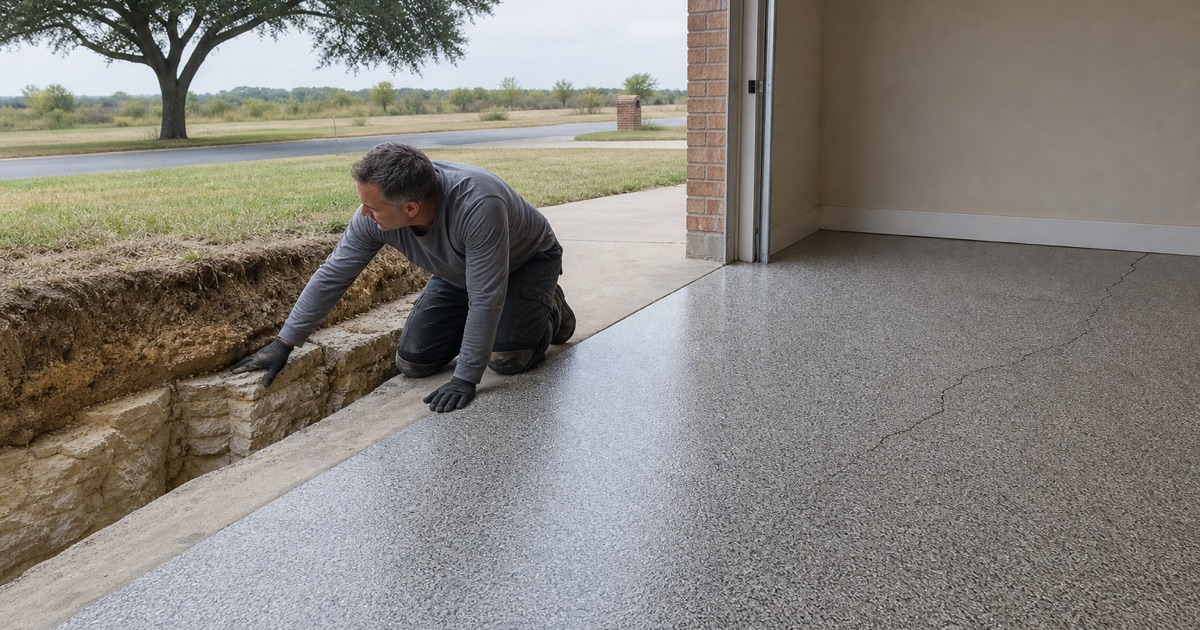
Indurated limestone at 48 centimeters
SSURGO at the city centroid maps the Speck association on 1 to 8 percent slopes, with Speck at 82 percent of the map unit — a clayey, mixed, superactive, thermic Lithic Argiustoll, well drained. The component carries a lithic bedrock restriction with a hardness class of indurated at a representative depth of 48 centimeters. That is roughly nineteen inches of soil sitting on solid rock.
This is not deep reactive clay and we will not describe it as such. A shallow profile over indurated limestone has far less soil available to swell, so the seasonal vertical movement a slab can experience is limited by how little material there is to move. Anyone quoting this city on a boilerplate expansive-clay narrative has not looked at the ground.
Moderate movement, in two layers that do not agree
The soil that is there is still clayey, and the two horizons behave differently. The top 20 centimeters run 29.5 percent clay with a plasticity index of 23 and linear extensibility of 4.5 percent. From 20 to 48 centimeters that rises to 47.5 percent clay, plasticity index 33 and linear extensibility of 7.5 percent, and then it stops at rock.
So the honest description is moderate movement rather than none, in a profile whose upper and lower layers do not respond to a wet or dry season at the same rate. That is a different mechanical problem from a uniformly swelling column of clay, and it produces a different crack signature on the slab above it.
One garage footprint, two different bearing conditions
The consequence that matters most on a residential job is this: on ground sloping 1 to 8 percent over a bedrock surface only nineteen inches down, a single slab can bear partly on rock and partly on soil within the footprint of one garage. The rock does not settle. The soil does, seasonally and unevenly.
Differential support like that produces cracking that is not uniform across the floor — often a crack that runs a fairly consistent line rather than a random map pattern, sometimes with a small elevation difference across it. A coating specification written for an evenly supported slab does not describe that substrate honestly, and we would rather explain the difference than paper over it.
Looking for garage floor coating closer to Killeen? See Garage Floor Coating in Killeen.
Reading a slab before writing a specification
What we look at on the walk-through
We map the crack pattern before we price anything, because on this ground the pattern is diagnostic. A crack that tracks a straight line across a bay, with different behavior on either side, reads very differently from shrinkage cracking radiating out of a re-entrant corner. We check for elevation change across a crack, hollow-sounding areas, curled edges and any spalling at the existing control joints.
We also look at the slope of the site and the drainage against the slab, because well drained shallow soil over rock moves water sideways along the rock surface rather than down through it. Where water is being delivered under one end of a floor and not the other, that is worth knowing before a coating goes on top.
A crack over a bearing change is treated as a live joint
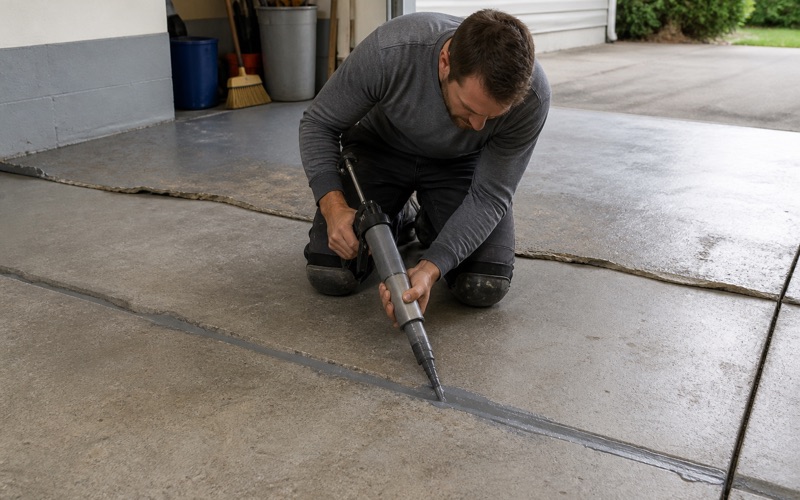
Where a crack sits over a change in what the slab is bearing on, we do not fill it rigid and coat over it. It gets routed out, filled with a flexible sealant such as a semi-rigid polyurea joint filler where the loading allows, and honored through the coating as a joint rather than hidden under it. Existing control joints get the same treatment.
We tell an owner before the work starts that a detailed joint may telegraph again. That is a maintenance item rather than a permanent repair, and saying so up front is the difference between a floor that meets expectations and an argument about a hairline in eighteen months.
What the coating itself is actually doing
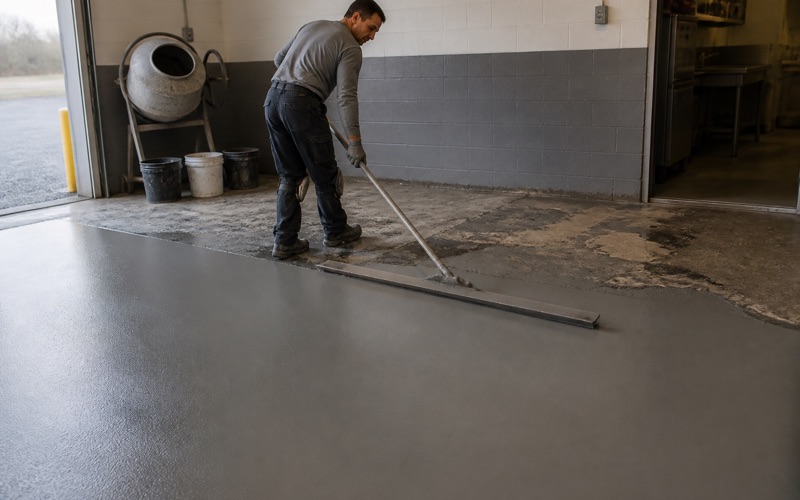
An epoxy coating is a film. It is thin, high in modulus and bonded tightly to the concrete, which means it follows the concrete wherever the concrete goes. It will not stiffen a slab, it will not stop ground movement and it will not bridge a crack that is still working through the year.
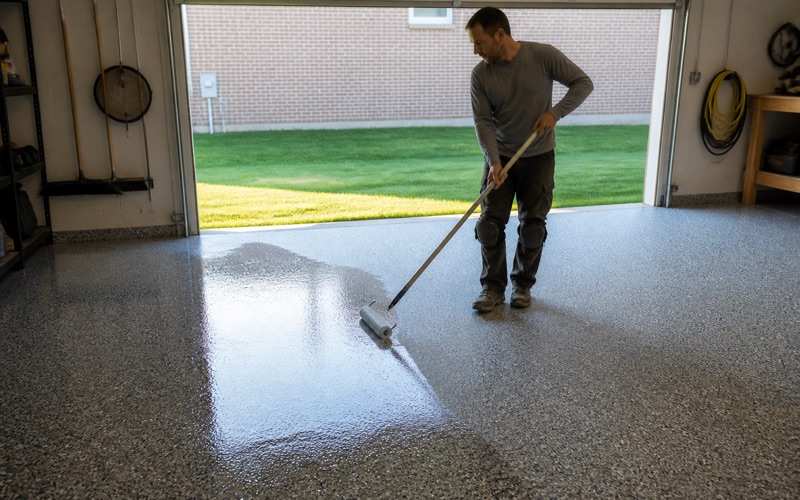
What it does deliver is worth buying: a sealed, cleanable, chemically resistant and abrasion-resistant surface that resists hot tire pickup, oil and brake fluid, and stops a bare slab dusting into the house every time a car pulls in. That is a maintenance and appearance decision on a sound floor, not a structural repair, and we sell it as exactly that.
A young housing stock and the slabs that came with it
There is essentially nothing here older than 1957
This community was founded when Pinckney R. Cox and Harley Kern began subdividing their land and selling lots in 1957, and it incorporated on September 24, 1960, taking its name in honor of Harley Kern. The housing data reflects that precisely: of 13,168 total units, exactly one dates to the 1940s and none predates 1940.
That means the entire pre-war repertoire of this trade is simply absent. There are no 1920s slabs to reclaim, no pre-code garage floors and no century-old commercial substrate to excavate through. It is a fundamentally different starting condition, and it is generally a cheaper and more predictable one.
Post-tension slabs and locating tendons first
53.4 percent of the housing here was built in 2000 or later and 79.2 percent in 1980 or later, with the 2000s the largest single decade at 26.9 percent and the 2010s next at 22.7 percent. Post-tension slabs became common in Texas after about 1980, so a substantial share of the garage slabs in this city are post-tension.
That changes the pre-step, not the coating. A post-tension slab cannot be cored, drilled or saw-cut without locating tendons first, so anchoring a threshold, doweling a transition or cutting a new control joint is a different operation here than on a conventionally reinforced floor. We establish which kind of slab we are on before anyone brings a saw into a bay.
The older layer and what it did not get
20.8 percent of the stock predates 1980, with the 1970s alone accounting for 17.9 percent, and under-slab vapor retarders were not standard practice on Texas residential slabs of that era. Moisture vapor emission through a slab remains the most common cause of epoxy adhesion failure on residential concrete.
So on that layer we measure rather than assume. Calcium chloride vapor emission testing to ASTM F1869, in-situ relative humidity probes to ASTM F2170 and a plastic sheet test to ASTM D4263 as a screen, read against ASTM F710 thresholds and the product’s own limits. Where the results run high, a moisture-mitigation primer goes into the specification and the price before installation.
Systems, surface prep and the working window
Two very different buyers in one city
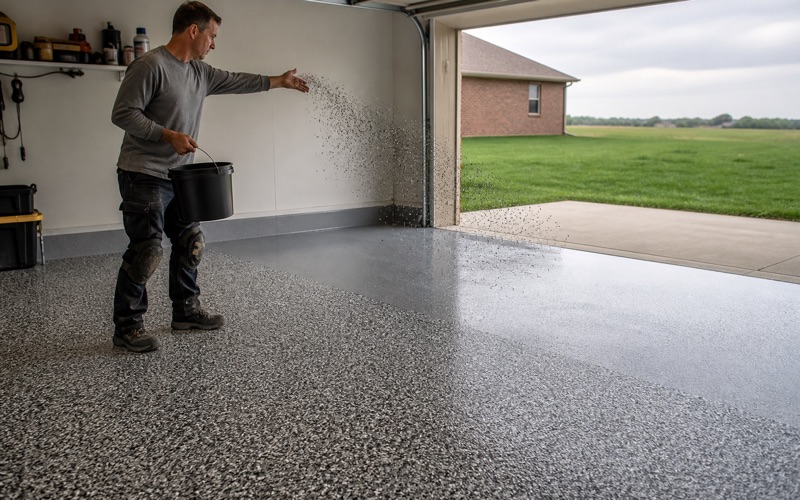
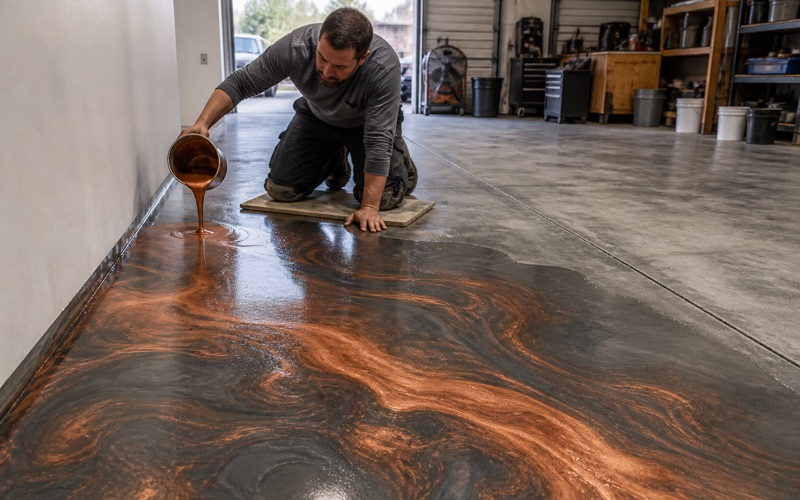
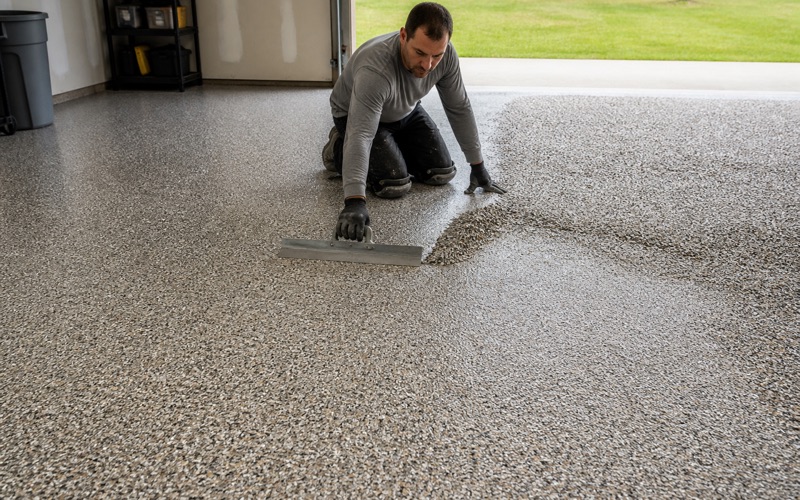
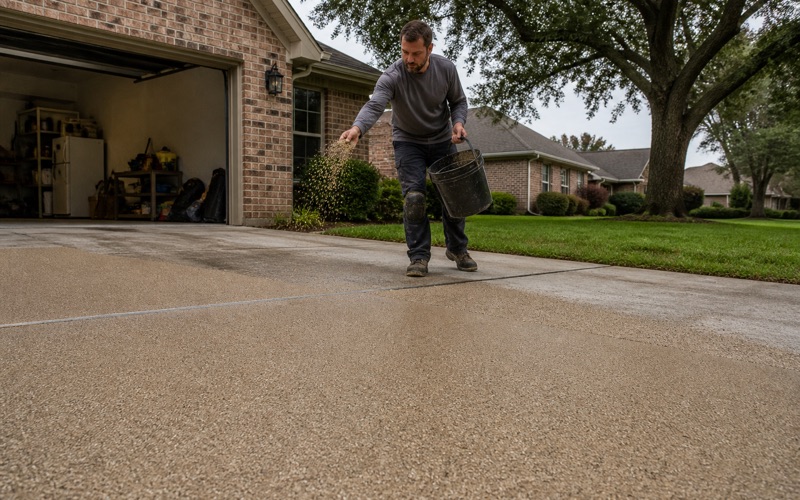
At 61.7 percent owner-occupied against 38.3 percent renter-occupied, this is a homeowner’s city, and a homeowner is buying an improvement they will look at every day. That sale is about the flake or quartz aggregate broadcast, the gloss level of the polyaspartic or polyurea topcoat, and how the finished floor reads against the rest of the house.
The rental side is real and it is a different specification. 1,532 single-family detached houses here are rented, and 48.4 percent of renter households moved in during 2020 or later. On a turnover we work to the landlord’s timeline, where durability and a handover date decide the build rather than appearance, and we say which of the two conversations we are having.
Every slab is ground or shot blasted
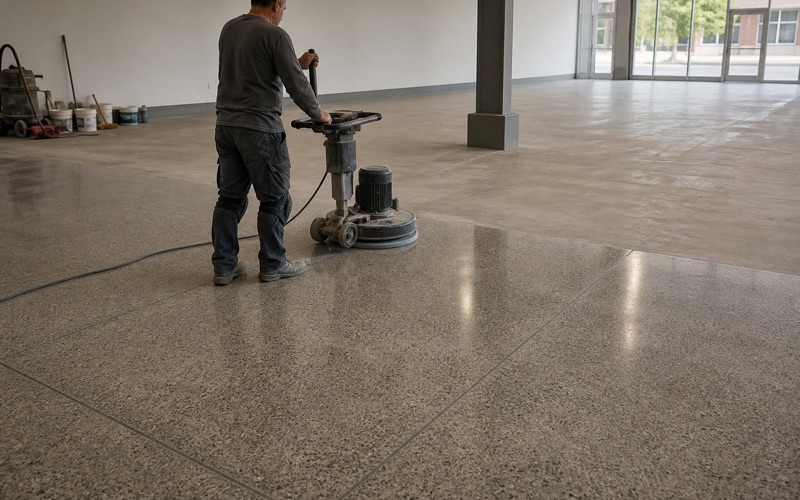
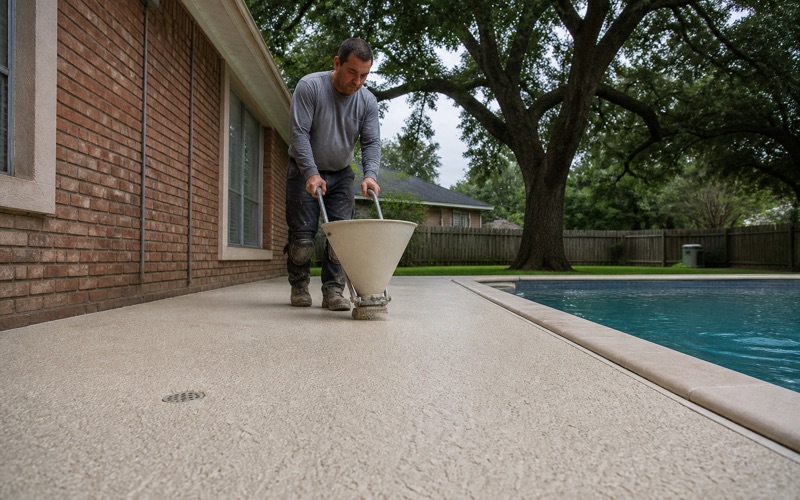
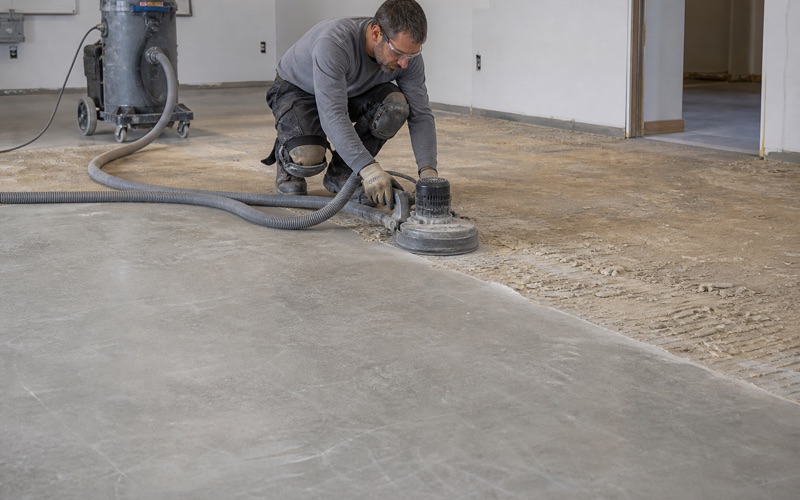
We do not acid etch and we do not coat over an existing sealer. Every slab is mechanically profiled by diamond grinding or shot blasting to an ICRI CSP surface profile appropriate to the system going down, with diamond segment bond hardness matched to the hardness of the concrete once we start cutting into it.
On newer slabs that often means dealing with a curing compound or a lithium silicate densifier already on the floor, and PCD tooling handles removal that a standard grinding segment would only glaze. A 100 percent solids epoxy base with a polyaspartic topcoat is the common build here; product selection also accounts for the architectural coatings rule at 40 CFR 59 Subpart D, which caps VOC content by category.
Dew point, heat and the days we will not start
We schedule against the dew point measured at the slab surface rather than the air temperature. Data sheets commonly require the surface to stay at least 5 degrees above the dew point through application and cure, and the NWS gridpoint forecast for this grid issued August 17, 2026 carried dew points from 57 to 72 degrees with relative humidity from 24 to 84 percent. At a 72 degree dew point a cool morning slab is ruled out, which is why we start mid-morning in summer.
The same forecast carried temperatures from 74 to 102 degrees, and an uninsulated garage slab does not shed that heat overnight. Pot life on a published product runs roughly 60 minutes at 55 degrees, 40 minutes at 72 degrees and about 20 minutes at 95 degrees, with recoat minimum collapsing from 24 hours to 6 hours. Winter Storm Uri, February 11 to 21, 2021, brought six to nine consecutive freezing days to Central Texas, and a February booking in an unheated garage carries real shutdown risk. Texas does not license flooring contractors, so we show general liability cover, workers’ compensation and a Texas sales and use tax permit instead.
- 20+ Years in Central Texas
- Fully Insured
- Free Written Proposal