Temple Epoxy Flooring installs epoxy flooring in Gatesville, and we have been coating concrete across Central Texas for more than 20 years. That span matters less as a credential than as a record: we have gone back to floors we put down a decade ago and seen what held and what moved.
Before we quote anything, we want to know what your slab actually sits on. About a third of this trade area is true shrink-swell clay and roughly half of it is not, and those two situations call for different joint details and sometimes a different answer about whether coating is right at all.
We also say plainly what a coating cannot do. An epoxy floor is a film bonded to the top of concrete. It follows the slab beneath it, and it will not stop, bridge or hide seasonal ground movement. Nearly everything else on this page follows from that one honest limit.
Six units in one town
An institutional presence in a town of about 16,000
Gatesville’s population was 16,135 at the 2020 census, and six Texas Department of Criminal Justice units operate in or adjacent to the city: the Christina Melton Crain Unit, the Hilltop Unit, the Dr. Lane Murray Unit, the Patrick O’Daniel Unit, the Linda Woodman State Jail and the Alfred D. Hughes Unit. Five of the nine women’s prisons in the entire Texas system sit here.
The O’Daniel Unit houses the state’s women’s death row. As of 2012 the prisons employed 2,600 people, so the household economy tracks a state agency payroll rather than a private employment base.
What that concentration means for coated floors
Correctional facilities concentrate exactly the floor categories that get coated rather than tiled or sealed: food-service kitchens, institutional laundries, infirmary and medical wings, shower and wet-process rooms, and industrial shop space. Those are cleanability and chemical-resistance specifications carrying a documented service life.
That is a very different brief from a homeowner’s appearance upgrade, and the proposal reads differently for it. It names the product, the system build and the mil thickness, so what was quoted can be checked against what was installed.
Work behind a perimeter is not a city permit question
An ordinary commercial job here runs through the City of Gatesville Development Services Department. Work inside a Texas Department of Criminal Justice perimeter is authorized by the state agency instead, and the contracting route and access rules belong to that agency to state rather than to us to describe. We ask the facility what its rules are and build the crew-day around the answer.
Looking for epoxy flooring closer to Marlin? See Epoxy Flooring in Marlin.
Institutional floors and what they have to take
Kitchens and food-service floors
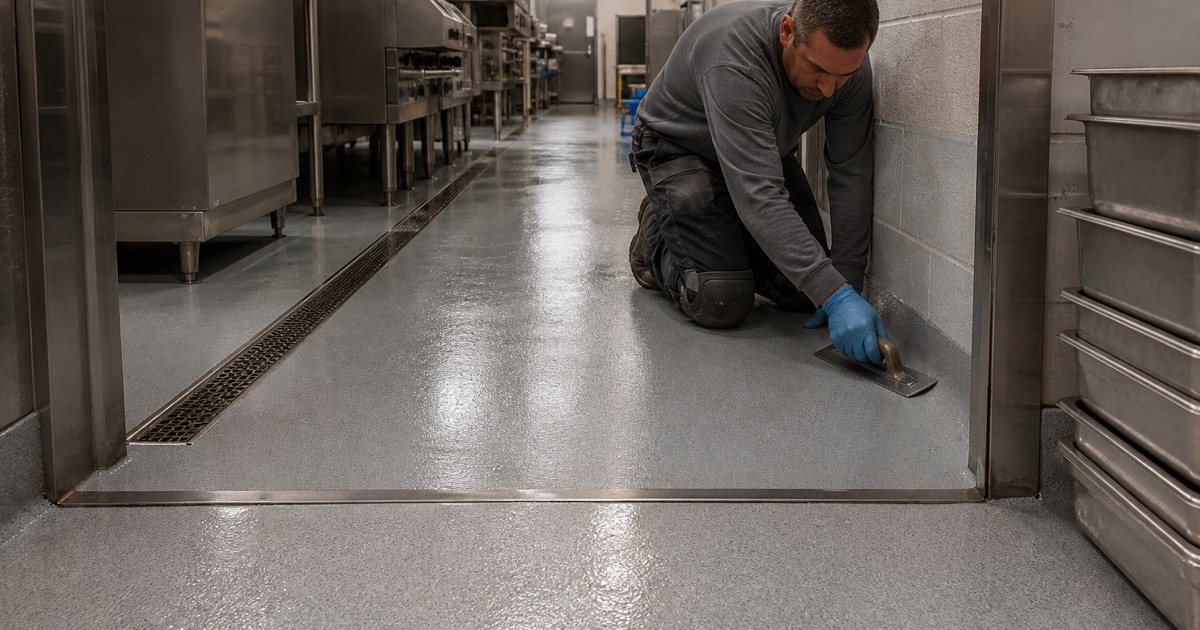
A kitchen feeding thousands of meals a day is a hot-water, grease and thermal-shock environment. The Texas Food Establishment Rules at 25 TAC Chapter 228 adopt the FDA Food Code, and section 6-101.11 sets the standard a floor has to meet: smooth, durable and easily cleanable.
That pushes us toward urethane cement rather than a straight 100% solids epoxy wherever boiling water reaches the slab daily, with an integral coved base at the wall junctures under section 6-201.13. Section 6-201.11 carries the antislip exception permitting a broadcast texture where a smooth surface would be unsafe.
Laundries, showers and wet-process rooms
Institutional laundries and shower rooms are constant-moisture spaces, and the failure there is rarely wear. It is a coating losing bond to a slab passing vapor from underneath, and drains, slopes and cove details decide whether water leaves the room or stands in it.
We specify slip resistance for the wet condition rather than the dry one, because a coefficient of friction measured on a dry sample says little about a shower floor at shift change. Aggregate choice and topcoat both move that number, and both get named.
Medical wings and cleanability
Infirmary and medical wings are a chemical-resistance problem more than an abrasion problem. Repeated disinfectant exposure, seamless transitions and a surface that will not hold a stain are what the specification is buying, and a quartz aggregate broadcast usually beats vinyl flake for it.
Amine blush is the quiet enemy here: a hazy, waxy film that forms on curing epoxy in humid conditions and ruins the bond of the next coat if it is not removed. We plan the recoat window around that risk.
Shop floors and hot tire pickup
Hot tire pickup, where warm tires soften a film and lift it as a vehicle sits, is the classic failure in industrial shop space. It is a bond and thickness problem rather than a product-brand problem, which is why prep and mil build get more attention from us than the label on the pail.
A polyaspartic or polyurea topcoat over a 100% solids epoxy body coat buys abrasion resistance and color stability at a mil build we state up front. Solids content and VOC in grams per liter appear on the proposal too, because the architectural coatings rule at 40 CFR 59 Subpart D limits what can legally go down.
A sandy surface over heavy clay
What the top foot says, and why it misleads
Central Texas is generally described as sitting on Blackland Prairie clay, and in this city that description is simply wrong. SSURGO at the city centroid maps Minwells fine sandy loam, warm, 1 to 3 percent slopes, with Minwells at 90 percent of the map unit, a fine, mixed, active, thermic Udic Paleustalf, well drained. It is not a Vertisol.
The surface horizon, the top 23 centimeters, is genuinely sandy: 13 percent clay, a plasticity index of 8 and linear extensibility of 1.0 percent. A hand auger in the top foot comes up sand, and a quote written off that reading is a quote written off half the story.
The argillic horizon underneath
Directly beneath that sand, from 23 to 51 centimeters, sits the argillic horizon at 42 percent clay, a plasticity index of 30 and linear extensibility of 4.8 percent. From 51 to 117 centimeters it still runs 40 percent clay. The layer a slab actually bears against is clay.
That is why we ask what a slab sits on before quoting rather than after a crack telegraphs through a new floor. The soil report flatters this site if you read only the top line, and that is how a coating gets sold into a movement conversation nobody had.
The west end of the city reads differently again
Out near the correctional complex the map unit changes. SSURGO there maps Lewisville clay loam, 1 to 3 percent slopes, a fine-silty, mixed, active, thermic Udic Calciustoll running 31 to 35 percent clay, a plasticity index of 23 to 29 and linear extensibility between 2.7 and 3.2 percent. That is a calcareous clay rather than a smectitic one, and two sites a few miles apart can sit on two different soil orders.
What moderate movement means for the coating
Linear extensibility of roughly 3 to 5 percent in the horizons carrying a slab is a shrink-swell load a coating has to tolerate, not one that dominates the job. That is a real difference from the deep smectitic clays farther east, and it is good news worth stating plainly.
It is not a guarantee for every lot. Slidell, a true Vertisol, is a 3 percent minor component of the centroid map unit, so an individual property can still sit on high-movement ground where the dominant soil does not.
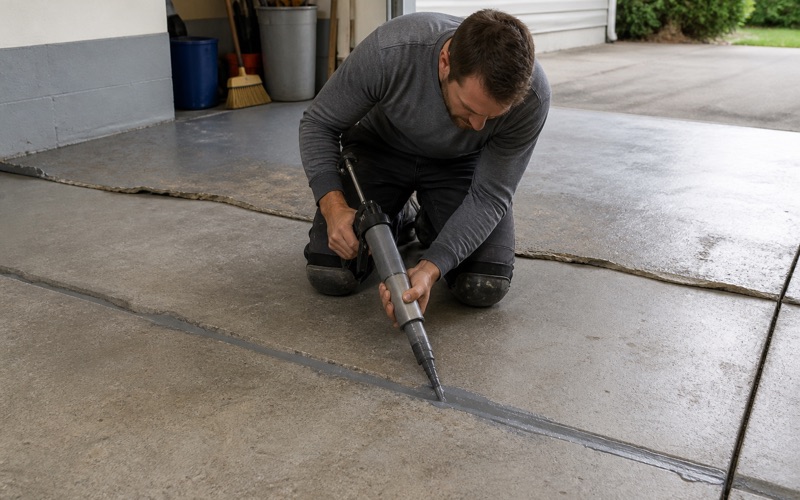
A crack over ground like that is treated as a live joint and carried in semi-rigid polyurea filler, not packed rigid and coated over. We tell you before the job that it may telegraph again, and we explain the warranty exclusions then rather than after, with substrate movement and moisture first among them.
County seat civic and commercial buildings
An ordinary permit path, which is worth saying out loud
Gatesville is an incorporated municipality with a Mayor, a City Council and a City Manager, and City Hall stands at 803 Main Street. Development Services handles permits and inspections, code enforcement, and planning, and there is a Planning and Zoning Commission plus a separate Building Standards Commission.
The adopted building code edition is not published on the city’s public pages, so we call Development Services rather than assume a state default. Fire service is a volunteer department, which matters when a plan review turns on a solvent or a hot-work question.
Civic, county and commercial floors
As the county seat of Coryell County, the courthouse, the county offices, the county jail and the county’s own facility maintenance all sit inside the city. Coryell Health is headquartered here and runs a hospital with surgery, oncology, dialysis and laboratory services, a wound center and a walk-in clinic.
Two manufacturers add production and shop floors to that mix: Kalyn Siebert, building heavy-haul trailers, and Laerdal Medical Corporation, making medical teaching supplies. Texas does not license flooring or coatings contractors, so instead of a license number we show general liability cover, workers’ compensation, a Texas sales and use tax permit and city contractor registration.
Older garages and the landlord’s timeline
The city has 3,288 housing units and 51.6 percent were built before 1980, the 1960s being the largest single decade at 18.8 percent. There are 1,870 owner-occupied single-family detached units here, which makes this a real homeowner market and not only an institutional one.
Texas building is slab-on-grade with basements effectively absent, and post-tension slabs only became common after about 1980, so the modal garage slab in this city is conventionally reinforced ground-supported concrete. That decides whether anchoring, coring or cutting into it is even on the table.
Around 513 detached units are renter-occupied, and a turnover is a different job from an owner’s. Durability and turnaround set the specification there instead of appearance, and we work to the vacancy window a landlord gives us.
Preparation, moisture and the calendar
Mechanical prep, every time
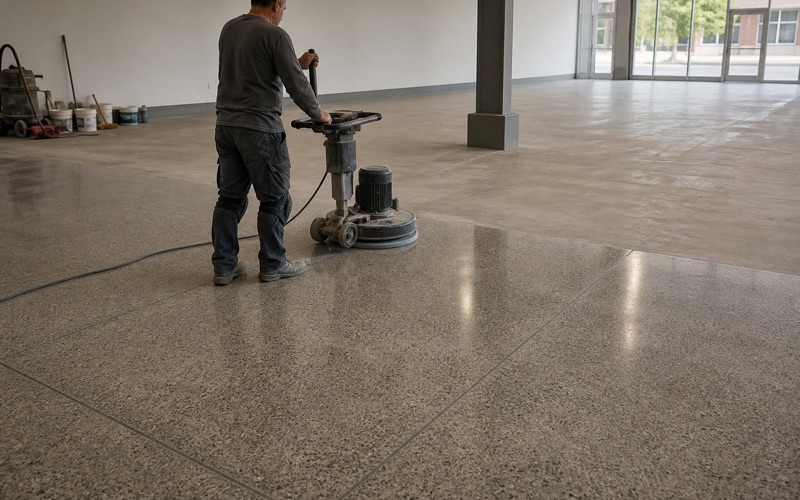
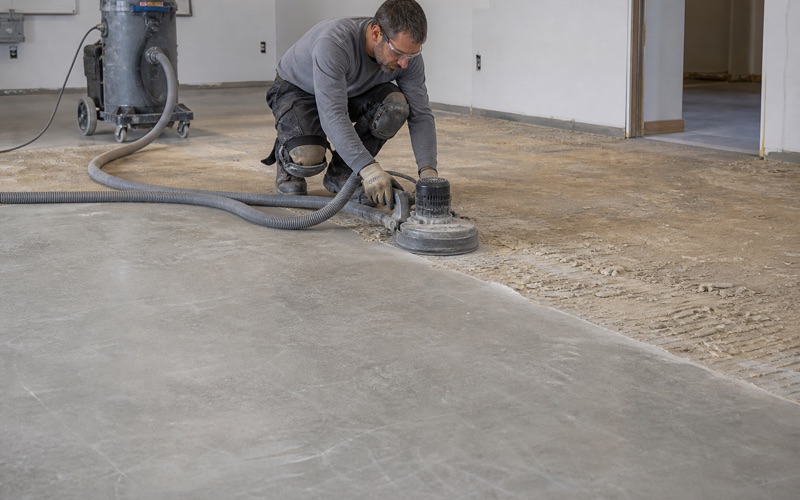
Every slab we coat is mechanically ground or shot blasted to an ICRI CSP profile matched to the system going down. We do not acid etch, and we do not coat over an existing sealer, because both leave the film sitting on something other than sound concrete.
Where an old coating has to come off first, we run PCD tooling and pick diamond segment bond hardness to suit the concrete in front of us. A lithium silicate densifier has its place on a bare slab, but it is not a substitute for profile.
Moisture testing written into the scope
On an older slab, moisture testing goes into the scope rather than being sold as an add-on after a floor blisters. We use ASTM D4263 as a fast screen, then ASTM F1869 calcium chloride vapor emission testing or ASTM F2170 in-situ relative humidity probes read against the ASTM F710 thresholds.
Where those numbers come back high, a moisture-mitigation primer is priced into the proposal before the job is sold, not raised afterward as a change order. On a slab poured in the 1960s that is a likely outcome, and we would rather say so early.
Scheduling against the dew point at the slab
We schedule against the dew point at the slab surface rather than the air temperature, which is why we start mid-morning in summer instead of at dawn. The National Weather Service gridpoint forecast for this grid, FWD 53,45, inside zone TXZ157, carried dew points from 55 to 72 degrees.
Against a manufacturer floor requiring the surface to stay at least 5 degrees above the dew point, a 72 degree dew point decides whether an early start is workable at all. The same forecast ran 74 to 103 degrees, and pot life on a published product falls from roughly 60 minutes at 55 degrees to about 40 at 72 degrees and near 20 at 95 degrees.
Winter carries the opposite risk. Winter Storm Uri ran February 11 to 21, 2021 and touched all 254 Texas counties, with Central Texas seeing six to nine consecutive days of freezing temperatures. A February window here carries real multi-day shutdown risk, and we say so when we quote it.
- 20+ Years in Central Texas
- Fully Insured
- Free Written Proposal