
Temple Epoxy Flooring installs epoxy garage floor systems across Temple, TX, serving surrounding cities including Belton, Nolanville, Harker Heights, Killeen and McGregor. We have been coating concrete in this part of Central Texas for more than twenty years, which mostly means we have been called back to fix other people’s garage floors often enough to know exactly where they go wrong.
Almost none of those failures are about the resin. They are about the slab: a surface that was never ground open, moisture nobody measured, or a crack that was filled solid when it was still moving. The color and the flake blend are the part everyone wants to talk about, and they are the last decision that actually matters.
So our garage floor work starts underneath. We establish what your slab sits on, how sound the surface is, and whether vapor is coming up through it, and we put that in writing before we quote a system. What you get back names the product, the build and the mil thickness, so the finished floor can be checked against the thing you agreed to buy.
What Goes Into an Epoxy Garage Floor
The Slab Assessment
We walk the floor before quoting: mapping cracks, sounding for hollow or delaminated areas, checking whether the surface has been sealed, and looking at the existing coating if there is one. Ground conditions vary considerably across Temple, so we establish which soil your address sits over as part of this. That single fact changes how we treat cracks and what we are willing to promise about them.
Moisture Testing
On any older slab we test before ordering material, using calcium chloride testing to ASTM F1869 or in-situ relative humidity probes to ASTM F2170, read against the thresholds in ASTM F710. Vapor driven up from below is the most common cause of blistering in a garage. Where the readings are high we specify a moisture-mitigation primer rather than proceeding and hoping.
Surface Preparation
Every slab is opened mechanically with diamond grinding or shot blasting to a measurable ICRI CSP profile. This removes the closed, power-troweled skin and any previous sealer so the primer can key into sound concrete. We do not acid etch: it leaves salts and a weakened layer behind, and a coating over that releases in sheets rather than failing gradually.
Choosing the Right System
Full Flake Broadcast
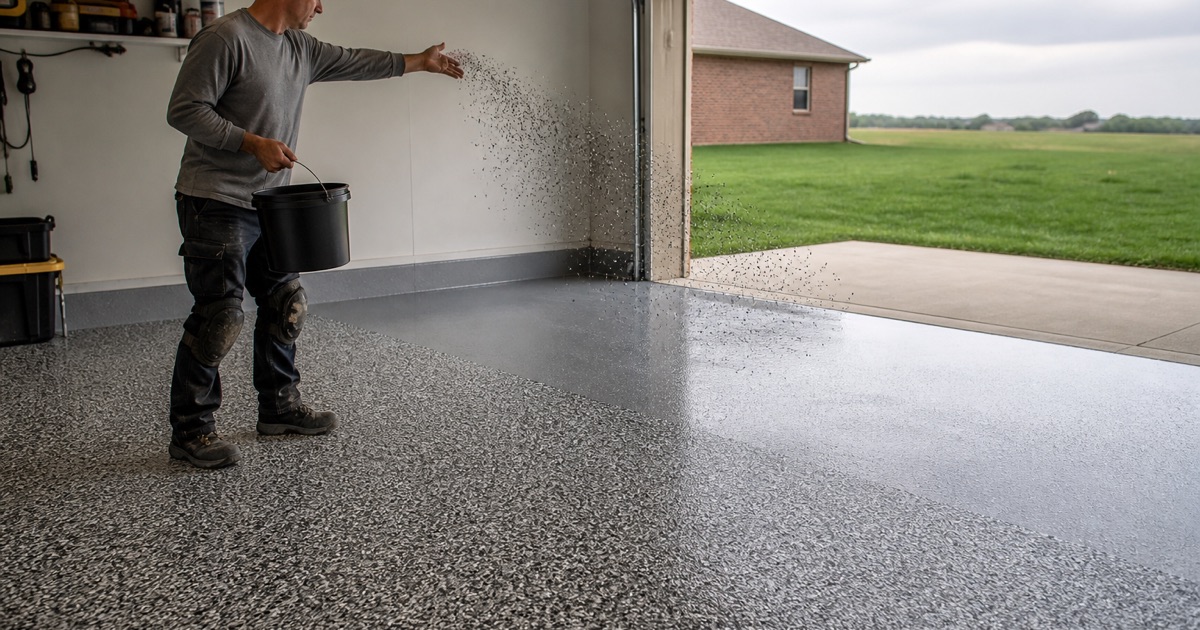
Vinyl flake broadcast to refusal, then locked in with clear topcoats, is the most popular garage system we install and the one we recommend most often. The flake adds texture underfoot, disguises dust and tire marks, and hides minor slab imperfections that a solid color would highlight. It also gives a finished thickness with real abrasion resistance rather than a thin decorative film.
Solid Color and Partial Broadcast
A solid pigmented finish gives the cleanest, most uniform look and suits display garages and showrooms. A partial broadcast sits between the two, adding some texture and visual break-up without the density of a full flake floor. Both show wear more readily than full flake, which is a genuine trade-off rather than a matter of taste alone.
Quartz Aggregate
Where grip matters more than appearance — a workshop bay, a space that gets hosed out, a garage that doubles as a wet work area — a quartz aggregate broadcast gives a harder-wearing and more slip-resistant surface than vinyl flake. It is coarser underfoot and heavier to clean, so we specify it where the work happening on the floor justifies it.
Topcoat Selection
Most of our garage systems use an epoxy build coat with a polyaspartic or polyurea wear layer over it. The epoxy provides body and adhesion; the topcoat provides fast cure, better color stability under sunlight through an open garage door, and much stronger resistance to hot tire pickup. Using a single product for both roles usually means giving something up at one end.
Cracks, Joints and Central Texas Ground
Telling a Live Crack from a Settled One
We judge whether a crack has stopped moving by looking at edge condition, whether the width varies along its length, and whether the two sides still sit level. A dormant crack can be filled, faired and forgotten. A live one cannot, and treating the second like the first is the reason a brand new floor develops a matching line through it within a season.
Detailing a Live Crack as a Joint
Where movement is ongoing we treat the crack as a control joint rather than a defect to be erased, filling it with a semi-rigid polyurea chosen to accept movement instead of a rigid paste that transfers it straight into the coating. We tell you in advance that it may telegraph again. That is an honest maintenance item and naming it now is better than arguing about it later.
Post-Tensioned Slabs
A good deal of newer construction around Temple is post-tensioned, with steel tendons running under tension through the slab. That changes what can be cut, cored or mechanically anchored, and it makes joint cutting a decision rather than a default. We establish slab type before a saw comes out, because a severed tendon is a structural problem rather than a flooring one.
What a Coating Cannot Do
A coating is a film bonded directly to concrete, so it goes wherever the concrete goes. It will not stop, bridge or resist ground movement, and no product on the market does. What it does is seal the surface, make it cleanable and give it abrasion and chemical resistance. Any company telling you a garage coating protects against foundation movement is describing something that does not exist.
Our Step-by-Step Garage Floor Process
1. Assessment and Written Proposal
We inspect the slab, test moisture where the age of the concrete warrants it, and issue a written proposal naming the system, the build and the mil thickness. Anything we have found that affects the outcome — a live crack, a previous coating, a damp reading — is written down at this stage rather than raised as a surprise mid-job.
2. Clearing and Protection
The floor has to be completely empty, including shelving and anything stored along the walls. We agree in advance who moves what, then mask and protect walls, doors and thresholds. Dust extraction is set up before grinding starts, because containment is far easier to establish at the beginning than to chase afterwards.
3. Grinding and Repair
We grind the slab to profile, selecting the diamond bond against the concrete’s own hardness — hard concrete takes a soft bond so the matrix wears at the right rate. Spalls, pits and dormant cracks are then repaired, and live cracks and existing joints are detailed to move.
4. Prime, Build and Broadcast
The primer goes down first, followed by the build coat, with flake or aggregate broadcast into it while it is still wet. Batch sizes and crew positions are set to the working time the day’s slab temperature actually allows, which in a Central Texas summer can be a fraction of the figure on the data sheet.
5. Scrape, Topcoat and Handover
Excess broadcast is scraped and vacuumed back to a consistent texture, then the clear topcoats go on. We hand over with two dates in writing: when you can walk on the floor and when you can park on it. Those are different figures, and the gap between them is where most new floors get marked.
Timing the Work
Summer Mornings
We schedule against the temperature of the slab rather than the time on the clock. On a humid Central Texas morning the concrete runs colder than the air, which can put the surface at or below the dew point and leave a film of condensation on it that nobody can see. Starting mid-morning, once the slab has warmed, prevents an adhesion failure that would surface weeks later.
Heat and Working Time
Resin chemistry accelerates sharply with temperature, and a product with roughly an hour of pot life on a mild day can drop to about twenty minutes on a hot slab. Temple sees around twenty days a year at or above a hundred degrees. On those days we mix smaller, move faster, and open less floor at a time rather than pretending the data sheet figure still applies.
Cold Weather
Temple averages about thirty-three freezing nights a year, enough to matter for scheduling. A cold slab slows cure sharply and some products stop cross-linking altogether below their minimum temperature. Where a genuine cold snap is coming we move the date, because a rescheduled install costs a few days and a floor that never reaches full hardness costs the whole job.
- 20+ Years in Central Texas
- Fully Insured
- Free Written Proposal