Temple Epoxy Flooring has been installing epoxy flooring in Fort Hood and across Central Texas for more than 20 years, and this page is written differently from the others on this site. Fort Hood is a United States Army post rather than a town, and nearly everything a coatings contractor takes for granted works differently inside the fence.
Before we quote anything we want to know what the slab sits on. Here we also have to know who controls the building and how a crew and a trailer full of equipment get through the gate, because those two questions settle more about a job on this installation than any product choice does.
We also say plainly what a coating cannot do. Epoxy is a film bonded to the top of concrete. It follows the slab, and it will not stop, bridge or hide seasonal ground movement. The rest of this page is written from that limit rather than around it.
Nine owner-occupied houses in the whole place
What the tenure figures actually say
The Fort Hood census place records 5,259 occupied housing units, and nine of them are owner-occupied. That is 0.2 percent. The other 5,250 are rented, and the figure comes from a published cross-tabulation of tenure by structure type rather than from two tables pushed together.
That finding has to be stated rather than worked around. There is no retail garage-floor market on this installation, because residents do not own the homes they live in and are in no position to commission a permanent alteration to one. A page here promising local homeowners a weekend garage makeover would be describing a market that does not exist.
Privatized family housing, and who actually decides
On-post family housing is privatized. Lendlease Communities closed on the portfolio in October 2001 as the Army’s first privatized military housing community, under the Residential Communities Initiative and the Department of Defense Military Housing Privatization Initiative, with the Army granting a 50-year ground lease for the land.
Lendlease carries responsibility for maintenance, property management and all new construction and renovation of those residences, and the portfolio was renamed Cavalry Family Housing in May 2023 after the 1st Cavalry Division. A floor in one of those units changes when that program says it changes and through that procurement, not because an occupant would like it to.
The property form is not suburban
Two thirds of the stock here, 66.1 percent, is single-family attached and only 19.2 percent detached, which is the reverse of an ordinary Texas city. Attached and duplex-form military family housing commonly carries a single bay or a carport off a shared drive rather than the two-car attached garage a suburban template assumes. Vacancy near 20.7 percent reflects a population cycling on permanent-change-of-station orders, not a soft market.
Looking for epoxy flooring closer to Jarrell? See Epoxy Flooring in Jarrell.
No permit counter, and a gate instead
There is no municipal building department
This is a federal military installation, and the census place is a boundary drawn around the residential cantonment rather than a municipality. There is no mayor, no council and no municipal building department, so there is no adopted code edition to look up locally and no counter at which to pull a residential permit.
Facility work runs through U.S. Army Garrison Fort Hood and its Directorate of Public Works instead, whose Engineering Division handles renovation on post. Authorization comes through the garrison and its contracting channel, and a contractor who arrives expecting the ordinary municipal sequence has misunderstood the job before starting it.
One detail worth stating because stale sources get it wrong: the post was named Fort Hood in 1942, redesignated Fort Cavazos on May 9, 2023, and redesignated Fort Hood again by an order signed June 11, 2025 with the ceremony held July 28, 2025, this time honoring Col. Robert B. Hood. The housing portfolio kept the Cavalry name it took in 2023.
Passes, vetting and the REAL ID requirement
Every vehicle occupant aged 18 and over needs a valid DoD ID card or an Installation Access Pass. Non-DoD applicants are vetted against FBI criminal and terrorist authoritative databases before a pass is issued, and the Marvin Leath Visitors Welcome Center at Building 69012, T.J. Mills Blvd handles that process.
Implementation of the REAL ID Act began May 7, 2025, so each crew member needs a REAL ID-compliant license, a U.S. passport, a military ID or an Enhanced Driver’s License. Long-term passes valid up to 90 days are what make a multi-week floor job practical, and applications can be started online well before mobilization.
Vehicles and crews are screened separately
Passenger gates are not where our equipment enters. All commercial vehicles must use the North Clarke Road Access Control Point Truck Inspection Facility for inspection and vetting, so a grinder trailer, a shot blaster or a materials truck takes the truck route and absorbs that inspection at the front of every mobilization day.
Crew composition is constrained here as it is nowhere off post. Foreign nationals without official business need sponsorship by a DoD ID cardholder and cannot enter unescorted, holders of limited-term licenses need a sponsor present, and anyone who fails vetting may apply through an Access Denial Waiver Application decided by the installation commander.
Where the heavy floor work actually sits
Barracks renovation
The Directorate of Public Works Engineering Division has renovated 59 of the 99 barracks on post across roughly twelve years. One award ran $59 million for three buildings as a complete gut and rebuild including all new electric, plumbing, fire protection and HVAC, and a $74 million barracks modernization project began with demolition in July 2026.
Those are the floors that get coated at scale here: corridors, latrines, laundry rooms, mechanical spaces and stairwells inside buildings stripped back to the frame. The brief is a cleanability standard and a documented service life, which is a different document from a residential quote and gets written differently.
Motor pools and vehicle bays
Motor pool renovation runs roughly $10 million per motor pool. Recently renovated 1st Cavalry Division motor pools had building height raised to take larger vehicles, and 13 motor pools used by the 1st Cavalry Division and the 3rd Cavalry Regiment have been assessed as needing demolition and rebuild rather than renovation.
A motor pool floor is close to the hardest thing this trade coats: tracked and wheeled traffic, hydraulic fluid and diesel, point loads from jacks and stands, and hot tire pickup wherever a warm tire meets a film that is too thin or poorly bonded. That is a 100% solids epoxy body coat under a polyurea or polyaspartic topcoat at a stated mil build, or urethane cement where wash-down and thermal shock justify it.
Reaching that work is procurement, not marketing
None of that volume arrives from a phone call. A coatings contractor reaches it as a subcontractor to a federal prime, with the access requirements above attached to every person on the crew and every vehicle carrying equipment. Alongside it sits a steadier stream of institutional floors on post, including the food-service and back-of-house spaces at Carl R. Darnall Army Medical Center, the Clear Creek Exchange and the two commissaries.
Two soils on one installation
Topsey at the cantonment
SSURGO at the cantonment maps Topsey clay loam, 3 to 8 percent slopes, severely eroded, with Topsey at 85 percent of the map unit. It is a fine-loamy, carbonatic, thermic Udic Calciustept, well drained, running 25 to 37 percent clay with a plasticity index of 18 to 20 and linear extensibility of 1.9 to 3.1 percent.
That is low to moderate shrink-swell, and it is genuinely good news for a coating. Seasonal movement on ground like that is a load the film has to tolerate rather than the factor that governs the entire specification.
Slidell a few miles away
A few miles off, the same survey maps Slidell silty clay, 0 to 2 percent slopes, Slidell at 85 percent of the unit. It is a fine, smectitic, thermic Udic Haplustert, a true Vertisol, at 45 to 50 percent clay with a plasticity index of 33 to 40 and linear extensibility of 7.5 to 9.7 percent.
That is high to very high shrink-swell, roughly three times the seasonal movement of the cantonment map unit. Two buildings on one installation can sit on ground that behaves completely differently, which is why we ask what a given slab bears on rather than treating the address as the answer.
Old slabs, and what that permits
63.9 percent of the stock here was built before 1980, with the 1970s alone accounting for 34.9 percent, the largest decade by a wide margin. Post-tension slabs became common in Texas after about 1980, so the modal slab on this post is conventionally reinforced ground-supported concrete rather than tensioned.
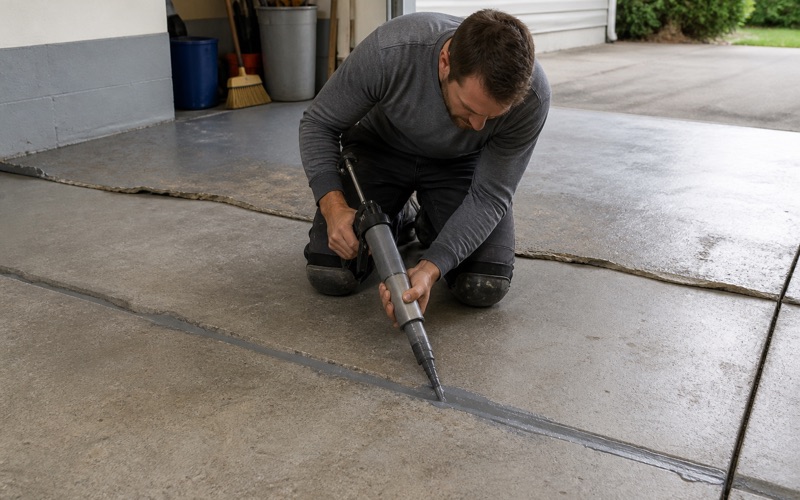
That decides whether cutting, coring or anchoring is on the table at all. Over high-movement ground, a crack is carried as a live joint in semi-rigid polyurea filler rather than packed rigid and coated flat, and we say before the job that it may telegraph again.
Preparation, moisture and the calendar
Mechanical prep and a proposal that can be checked
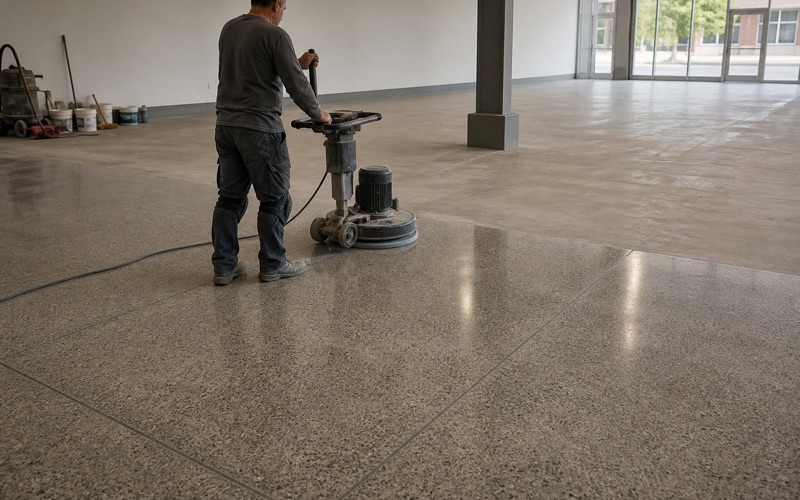
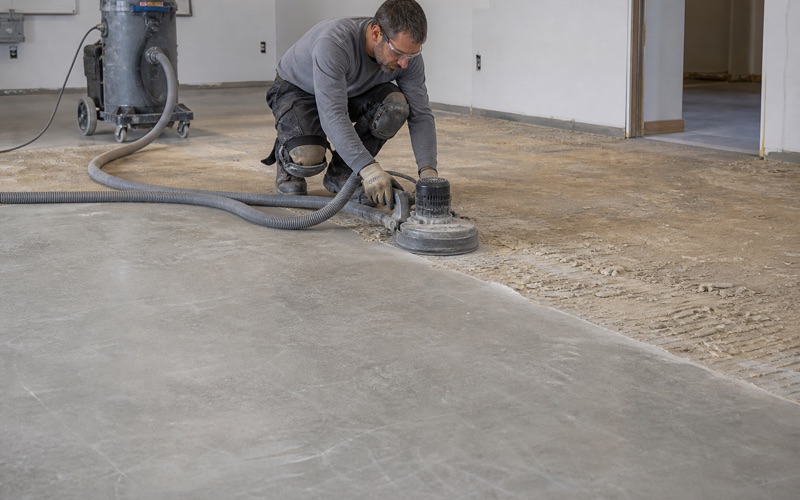
Every slab is mechanically ground or shot blasted to an ICRI CSP profile matched to the system going down. We do not acid etch and we do not coat over an existing sealer, and where an old coating has to come off, PCD tooling with a diamond segment bond hardness chosen for that concrete does the removal.
The proposal names the product, the system build and the mil thickness, with spread rate, solids content and VOC in grams per liter stated alongside, since the federal architectural coatings rule at 40 CFR 59 Subpart D constrains what may legally be applied. Warranty exclusions are explained before the job is sold, substrate movement and moisture first among them.
Texas does not license flooring or coatings contractors. Instead of a license number we show general liability cover, workers’ compensation and a Texas sales and use tax permit, and on a federal enclave those documents go to the garrison or the prime rather than to a municipal office.
Moisture testing on a slab from the 1970s
On concrete of that age, moisture testing goes into the scope in writing rather than being sold as an add-on after a floor blisters. We screen with the ASTM D4263 plastic sheet test, then run ASTM F1869 calcium chloride vapor emission testing or ASTM F2170 in-situ relative humidity probes and read the results against the ASTM F710 thresholds.
A vapor retarder beneath a slab poured in the 1970s is far from certain, and where the numbers come back high a moisture-mitigation primer is priced in before the job is sold. Inside a building stripped for renovation with limited climate control, those readings can move week to week.
Dew point, heat, and a gate that closes
We schedule against the dew point at the slab surface rather than the air temperature, which is why summer work starts mid-morning instead of at dawn. The National Weather Service gridpoint forecast for this grid, in zone TXZ157, carried dew points from 57 to 72 degrees and relative humidity from 24 to 82 percent.
Against a manufacturer floor requiring the surface to stay at least 5 degrees above the dew point, a 72 degree dew point decides whether an early start is workable at all. The same forecast ran 74 to 102 degrees with overnight lows near 74, so an uninsulated slab never fully sheds its heat, and pot life falls from roughly 60 minutes at 55 degrees to about 40 at 72 and near 20 at 95.
Winter is the sharper risk on a federal installation. Winter Storm Uri ran February 11 to 21, 2021 across all 254 Texas counties, with six to nine consecutive days of freezing temperatures in this part of the state. The installation has closed for freezing temperatures and poor road conditions more than once since, and here a weather closure is a gate closure rather than only a cold slab.
- 20+ Years in Central Texas
- Fully Insured
- Free Written Proposal