Temple Epoxy Flooring installs flake epoxy floor systems across Temple, TX, serving surrounding cities including Belton, Nolanville, Harker Heights, Copperas Cove and Killeen. Vinyl chip broadcast is the most common finish we put into residential garages and light commercial spaces, and it is the one we recommend most often for floors that have to work rather than just look good.
The appeal is practical rather than decorative. A flake floor is thicker than a plain color coat, it has texture built into it, and the visual variety of the chip disguises dust, tire marks and minor slab imperfection in a way a solid color simply cannot. A garage floor in a single flat color shows every footprint by the end of the first week.
The quality of a flake floor is decided by two steps most people never see: how the slab was ground, and how carefully the broadcast was scraped back before the clear coats went on. Both are labor, and both are where a cheap installation saves its money.
How a Flake System Is Built
Base Coat and Broadcast
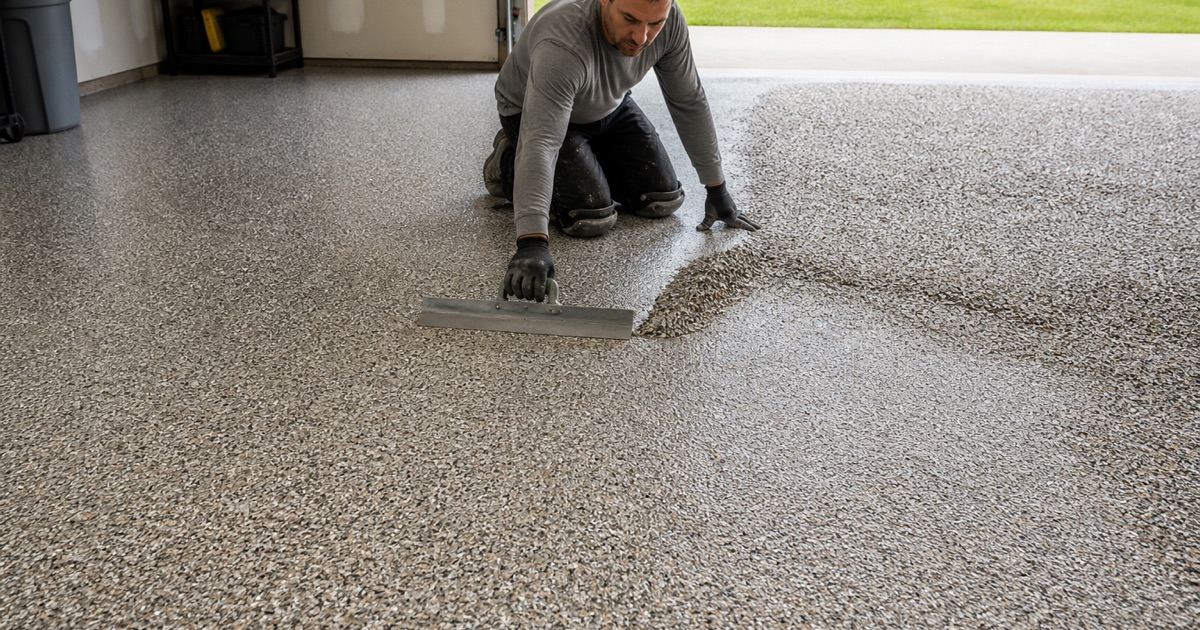
A pigmented epoxy base coat goes down and the vinyl chip is thrown into it while it is still wet, so the flake keys into the resin rather than sitting on top of it. Broadcasting to refusal means continuing until the surface will not take any more chip, which is what produces an even, fully covered floor with no thin patches showing base color through.
Scraping and Vacuuming
Once the base has cured, the loose and proud chip is scraped off and vacuumed away. This is the step that decides how the floor feels underfoot and how much clear coat it will need. Rushing it leaves sharp edges standing up, which then need burying under extra topcoat or, worse, get left rough for the life of the floor.
Clear Topcoats
One or two clear coats lock the flake in and provide the wear surface. A polyaspartic topcoat gives fast cure, better resistance to hot tire pickup and far better color stability under sunlight than a clear epoxy, which ambers over time. The topcoat is also the layer that can be renewed later without disturbing the flake beneath.
Choosing Coverage and Blend
Full Broadcast
Broadcast to refusal gives the thickest, most durable and most forgiving floor, with the base color completely hidden. It is the standard specification for garages, workshops and light commercial areas, and it is what we quote by default unless there is a reason to do otherwise.
Partial Broadcast
A lighter scatter of chip over a visible base color gives a cleaner, more contemporary look with some texture and some visual break-up. It uses less material and less labor, so it costs less, and it is correspondingly less good at hiding wear. It suits display spaces and floors that stay clean.
Chip Size
Chip is supplied in different sizes, and the size changes the character of the floor as much as the color does. Larger chip reads as bold and terrazzo-like and needs more topcoat to bury; smaller chip gives a finer, more uniform texture. We show both at floor scale, because a sample card misrepresents how a chip size reads across a whole room.
Blend Selection
A blend with tonal variety and some contrast hides everyday soiling far better than one close to a single color. This is the advice people most often push back on and most often thank us for later, because the blend that photographs best in an empty garage is rarely the one that still looks clean after a winter of muddy tires.
Where Flake Systems Work
Residential Garages
This is the core application. A full flake floor takes hot tires, dropped tools, dragged bikes and spilled fluids, cleans with a mop, and hides the marks that a solid color would advertise. It also adds grip in a room where people walk in from the rain, which a smooth coating does not.
Workshops and Hobby Spaces
Workshops benefit from the same durability with rather more attention to chemical resistance and to how easy the floor is to sweep. We specify the topcoat against what actually gets spilled, and we can vary the texture so a standing area is comfortable while a wet zone has more grip.
Light Commercial Floors
Flake suits retail back-of-house, storage rooms, break rooms, veterinary areas and small service spaces where a seamless, cleanable floor matters and a decorative pour would be wasted. The repairability is a genuine advantage in a commercial setting, since a damaged patch can be rebuilt and rebroadcast rather than requiring the whole floor.
Rental Property Turnovers
For a landlord the appeal is durability and speed. A flake floor survives several tenancies, hides the wear it does pick up, and a damaged area can be repaired between tenants rather than replaced. We work to a vacancy window and specify for turnaround rather than for appearance.
Preparation and Slab Condition
Grinding to Profile
Every slab is opened with diamond grinding or shot blasting to a measurable ICRI CSP profile, with the diamond bond matched to the concrete’s hardness. Flake adds thickness and weight to a system, which makes the bond to the slab more important rather than less. A flake floor releasing in sheets takes a great deal of material with it.
Moisture and Older Slabs
On older concrete we test to ASTM F1869 or ASTM F2170 against the thresholds in ASTM F710 before material is ordered, and specify a moisture-mitigation primer where the readings call for one. Vapor from below lifts a flake system just as readily as any other, and the chip does nothing to resist it.
- 20+ Years in Central Texas
- Fully Insured
- Free Written Proposal