
Temple Epoxy Flooring carries out epoxy floor repair across Temple, TX, serving surrounding cities including Belton, Killeen, Harker Heights, Copperas Cove and Waco. We repair failing garage floors, commercial coatings and decorative systems, and a good share of that work is on floors installed by somebody else within the last few years.
Repair starts with diagnosis, not with product. A coating that has blistered, a coating that has peeled in sheets and a coating that has simply worn through are three unrelated problems, and the visible damage is the symptom rather than the cause. Fixing the symptom on a floor whose cause is still active produces the same failure again on roughly the same schedule.
So we read the floor first. That assessment sometimes ends with a modest patch, sometimes with a recoat, and sometimes with the unwelcome recommendation that the whole system needs to come off. We give the honest version even when it costs us the easier job.
Diagnosing the Failure
Reading How It Came Away
How a coating detaches tells you why. Large clean sheets with concrete dust on the underside mean the slab was never opened and the film was only ever stuck to a closed, troweled surface. Small dish-shaped blisters mean vapor pressure from below. Loss confined to tire tracks or walkways is wear or a cure problem rather than a bond problem.
Blistering and Moisture
Blisters are usually osmotic, driven by moisture moving up through the slab and collecting under an impermeable film. We test rather than assume, using calcium chloride testing to ASTM F1869 or in-situ probes to ASTM F2170 read against ASTM F710 thresholds. Where readings are high, any repair has to include a moisture-mitigation primer or it is temporary by design.
Hot Tire Pickup
Patches lifting in the shape of a tread mean warm tires are softening the film and pulling it off as they cool. This is a product and build problem: a thin coating, an unsuitable topcoat, or inadequate bond underneath. Repairing it means rebuilding with a system specified for vehicle traffic, not touching in the missing patches.
Cracks Coming Through
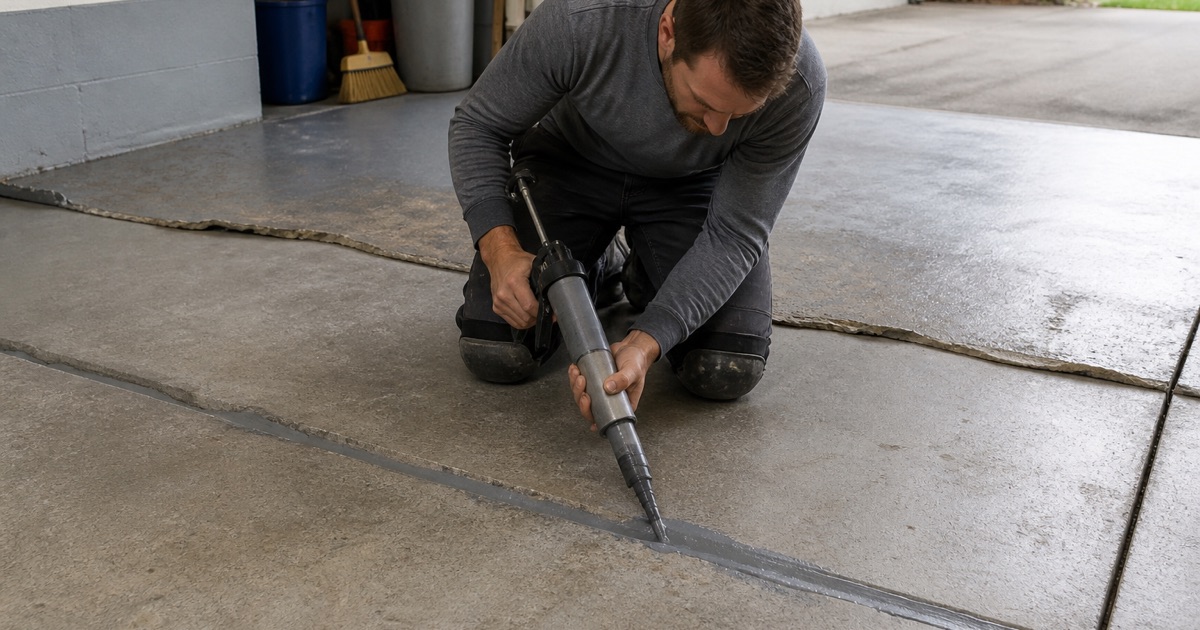
A crack that has reappeared through a finished floor is usually a live crack that was filled rigid and coated over. On the reactive clay soils in parts of this area that ground keeps working seasonally. The repair is to reopen it, detail it as a joint with a semi-rigid filler that accepts movement, and accept it as a visible line rather than trying to erase it again.
What Repair Actually Involves
Spot Repair and Blending
Where the surrounding coating is sound, we cut back to firmly bonded material, grind a feathered edge so there is no ridge, rebuild the system to the original build and blend the finish outward. The success of a spot repair depends heavily on the finish: flake disguises it almost completely, while a solid color or a metallic pour will show it.
Recoating a Worn Floor
A floor that is intact but dull, scratched or thin at the traffic lanes can often be abraded and given a fresh topcoat. This is genuinely economical and takes very little time. It only works where the existing system is properly bonded, so we check adhesion across the floor before recommending it rather than assuming a tired floor is a sound one.
Joint and Edge Repair
Spalled joint edges, damaged thresholds and broken slab arrises are cut back to sound concrete and rebuilt with a repair mortar chosen for compatibility, then re-detailed. In commercial buildings this is often the most valuable repair we do, because unsupported joint edges under hard-wheeled traffic deteriorate quickly once they start.
When It Has to Come Off
Where the original bond has failed, where moisture is untreated, or where more than a modest share of the floor is affected, the honest answer is removal. We shear the old film off with PCD tooling, grind to a fresh ICRI CSP profile and rebuild properly. It costs more than a patch and it is the last time that floor should need doing.
Deciding Between Repair and Replacement
The Extent Question
Localized damage on an otherwise sound floor is straightforward repair work. Once failure is spread across the floor, the economics invert: preparation, mobilization and blending are being paid for repeatedly while the cause remains in place. We map how much of the floor is genuinely affected before recommending either route.
The Cause Question
The more important test is whether the cause is still active. A floor damaged by a one-off event can be repaired with confidence. A floor failing because of untested moisture, an unprepared slab or a moving crack will keep failing, and any money spent on the surface is spent against a problem that lives underneath it.
What We Put in Writing
Our assessment names what failed, why we believe it failed, and what each option costs, including the option we do not recommend. Where a warranty from a previous installer might still apply, we say so. You should be able to see the reasoning rather than being handed a number and an assurance.
- 20+ Years in Central Texas
- Fully Insured
- Free Written Proposal