Temple Epoxy Flooring installs epoxy flooring in Copperas Cove, and we have been coating concrete across Central Texas for more than 20 years. This is one of the few places in the area where we can start a conversation with genuinely good news about the ground, and one of the few where we cannot guess a single thing about the slab from the address.
A coating is a film. It bonds to the concrete, it follows the concrete, and it will not stop or bridge ground movement underneath. We put that on the table before quoting anywhere, and it matters here because the local answer to the movement question is unusually favorable.
What we will not do is price a floor sight unseen. There is no typical house in this town, no dominant build era and no standard bay, so the measurement and the substrate check come first and the finish discussion comes second.
Ground that mostly stays put
Check what a slab actually sits on before quoting it, because in this region a few miles can change the whole answer. Here the check tends to come back the same way, and it is worth explaining why rather than simply asserting that everything will be fine.
Topsey clay loam at the city centroid
The soil survey at the city centroid maps Topsey clay loam on 3 to 8 percent slopes, with Topsey making up 85 percent of the map unit. It is a fine-loamy carbonatic Udic Calciustoll, well drained, carrying about 30 percent clay and a plasticity index of 18.
The number that matters for a floor is linear extensibility, and on this profile it runs 3.0 percent in the top 20 centimeters, 2.6 percent below that, 1.9 percent between 48 and 71 centimeters and 3.1 percent deeper still. At that level the rating is low shrink-swell, and that is not the reading we get everywhere in the region.
What a low shrink-swell rating does to a crack
Low shrink-swell does not mean a slab never cracks. It means the cracking that shows up is more likely to be shrinkage from the original cure or settlement from the fill underneath than the seasonal breathing of reactive ground.
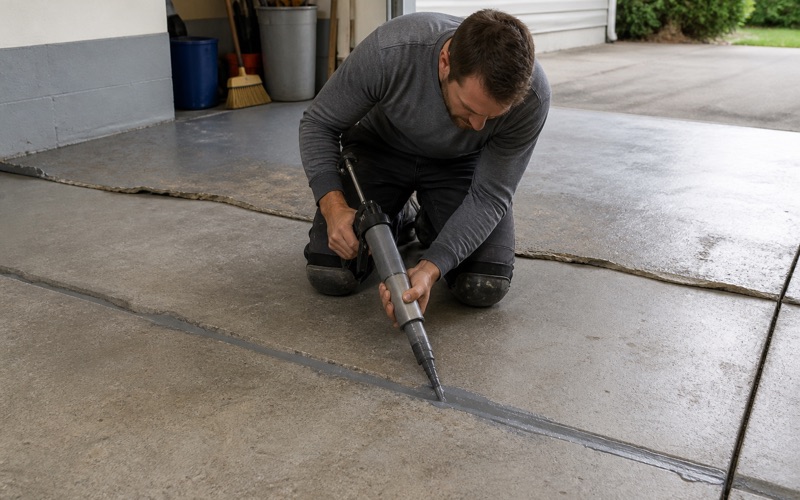
That distinction decides the repair. A crack that has finished moving can be filled, closed and coated over as a permanent repair, while a crack that opens every dry summer has to be treated as a live joint and told about in advance. Here we can far more often say honestly that a crack is done moving.
Well drained, but the slab still gets tested
Saturated hydraulic conductivity on the Topsey profile runs about 9 micrometers per second, a well-drained rating, and it pairs with slopes of 3 to 8 percent. Water tends to move off and through rather than sit against a foundation, which removes one of the more common drivers of coating failure.
It does not remove the need to test. A slab-on-grade poured without a vapor retarder will pass moisture upward no matter how well the surrounding soil drains, so on an older slab moisture testing is written into the scope from the start rather than sold as an extra after a floor blisters.
Depending on the slab that means ASTM F1869 calcium chloride vapor emission testing, ASTM F2170 in-situ relative humidity probes or an ASTM D4263 plastic sheet test, read against ASTM F710 thresholds. Where the numbers come back high, a moisture-mitigation primer goes into the build and into the price before anyone commits to a finish.
Looking for epoxy flooring closer to Gatesville? See Gatesville Epoxy Flooring.
A town with no standard garage
Most Texas towns have one decade that built most of the housing, and a contractor who knows that decade can picture the job before arriving. That shortcut does not exist here, and pretending otherwise produces a quote that has to be corrected on site.
Five decades and no clear winner
Of 16,527 housing units, the 1970s lead at 20.9 percent, the 1990s follow at 16.8 percent, the 1980s at 16.5 percent, the 2000s at 14.5 percent and the 2010s at 13.7 percent. Only about seven percentage points separate the largest decade from the smallest.
That flatness is the operational fact. Bay size, door width, ceiling height, driveway approach and even where the drain sits all shift by era, and none of those eras is dominant enough to be the default assumption on a phone call.
The form of the housing is at least consistent. Roughly 71.3 percent of units are single-family detached and only 2.9 percent are attached, so the work is overwhelmingly one house at a time rather than a shared structure. What varies is the vintage of each one.
The 1970s double bay is the most common single substrate
At 3,448 units the 1970s is still the largest slice, which makes the pre-1980 double-bay garage the most common single substrate in the city. Those slabs have had fifty years to absorb oil, brake fluid, driveway sealer and whatever the last owner decided to pour on them.
On that stock the job is won or lost in surface preparation rather than in product selection. A high-end topcoat over contaminated, unprofiled concrete fails as reliably as a cheap one does.
We measure before we quote
So we measure. Square footage, slab condition, existing coatings, expansion and control joint layout, threshold heights and how the floor meets the apron all get recorded before a number goes on paper, because none of them can be inferred from a street name here.
That also protects the customer from the other direction. A quote built on an assumed 400 square feet and an assumed clean slab is a quote that grows on installation day, and we would rather spend the extra half hour up front than have that conversation later.
Preparing the slab and writing the specification
Once the substrate is understood, the build follows from it. Two slabs of the same size in this city can need genuinely different systems, and the reason is usually age rather than use.
Before and after the post-tension line
About 35.8 percent of housing here predates 1980 and sits on conventionally reinforced ground-supported concrete. The remaining 64.2 percent came later, and post-tension construction became common in Texas after roughly that same point, so this is a city where the cutoff genuinely splits the stock in two.
Which one is underfoot decides what may be cut, cored or anchored, because a tendon in a post-tension slab is not something to find with a saw. We establish that before any mechanical work is scheduled rather than during it.
Mechanical preparation, every time
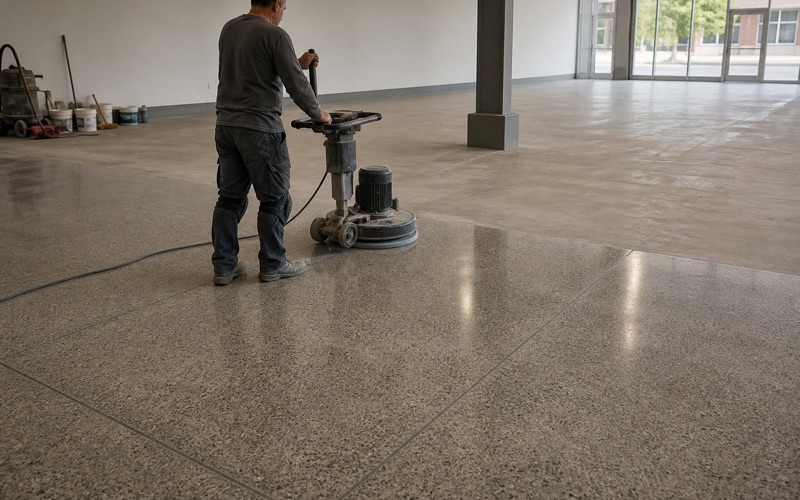
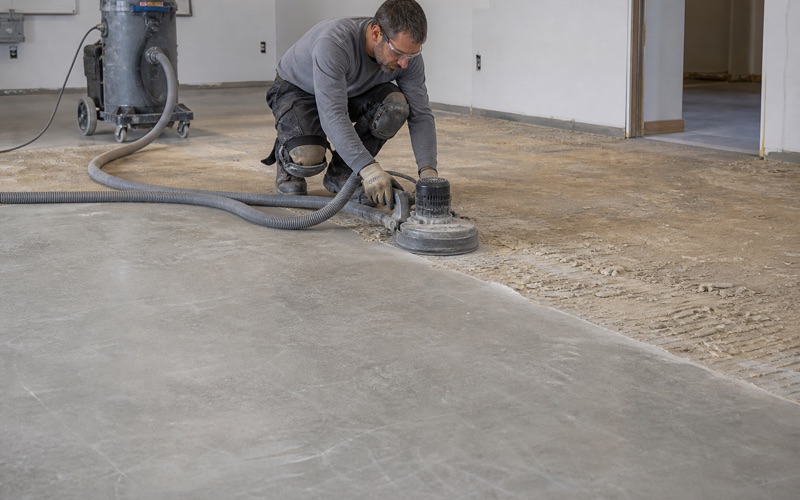
Every slab is diamond ground or shot blasted to an ICRI CSP profile matched to the system going down. We do not acid etch, and we do not coat over an existing sealer.
Where a previous coating has to come off, it comes off with PCD tooling first, and the diamond segment bond hardness is chosen against the hardness of the concrete rather than against whatever tooling happens to be on the truck. On a fifty-year-old garage slab that choice is most of the labor.
A proposal that names what was bought
Our proposals name the product, the system build and the mil thickness, so what was quoted can be checked against what was installed. Warranty exclusions are explained before the work is sold, with substrate movement and moisture first among them.
Texas does not license flooring contractors, so there is no license number for anybody to produce. What we show instead is general liability cover, workers’ compensation, a Texas sales and use tax permit and city contractor registration. Worth noting too that the city has adopted the 2024 ICC codes, including the 2024 International Residential Code, so nobody should assume an older edition here; a coating inside an existing garage is normally a finish, but an added circuit or mechanical ventilation is a permit item pulled at the city.
Timing the work in a Central Texas year
The calendar constrains this work more than most customers expect. Two thirds of the questions we get about how long a floor takes are really questions about weather, and the honest answer changes month to month.
Dew point at the slab surface, not the air temperature
We schedule against the dew point measured at the slab surface. A published application floor of 5 degrees above the dew point is a hard limit, and the local forecast grid has carried dew points from 55 to 72 degrees with relative humidity between 23 and 82 percent.
A 72 degree dew point rules out a cool slab on a humid morning outright. That is why we start mid-morning in summer instead of at dawn: an early start looks efficient right up to the point where amine blush or a failed bond shows up weeks later.
Pot life shortens as the day heats
The same forecast grid has carried temperatures from 74 to 102 degrees. On one published product, pot life runs roughly 60 minutes at 55 degrees, about 40 minutes at 72 degrees and about 20 minutes at 95 degrees, while the recoat minimum collapses from 24 hours to 6 hours.
A twenty-minute pot life is a crew-size and batch-size decision, not just a scheduling note. It is also why a summer install can sometimes finish two coats in a day when a spring install cannot.
Winter is a real constraint, not a formality
Central Texas gets genuine hard freezes, and the reference event is Winter Storm Uri, whose incident period ran February 11 to 21, 2021 and which affected all 254 Texas counties. Central Texas saw six to nine consecutive days of freezing temperatures, the longest such streak in the state’s recorded history.
An unheated garage during a freeze of that length sits below the minimum application temperature on every product data sheet worth reading. We would rather move a winter date than cure a floor at a temperature the manufacturer does not support.
Turnovers come on a short cycle here
About 40.3 percent of households here rent, and 2,337 single-family detached houses are rented out. More than half of renter households, 52.6 percent, moved into their current unit in 2020 or later, against 24.5 percent of owner households over the same window.
That churn has a clear source. Armed Forces members make up 12.6 percent of the labor force, 21.9 percent of residents lived somewhere else a year earlier, and 3,235 people arrived from another state within a single year. When we take a turnover we work to the owner’s timeline, where durability and how fast the floor can be handed back decide the specification rather than how it looks.
- 20+ Years in Central Texas
- Fully Insured
- Free Written Proposal