
Temple Epoxy Flooring provides concrete grinding across Temple, TX, serving surrounding cities including Belton, Nolanville, Harker Heights, Killeen and Hewitt. We remove old coatings, adhesives and sealers, take down high spots and lipped joints, and leave a slab profiled and ready for whatever is going onto it next, whether that is our work or somebody else’s.
Most people arrive at this service through a problem rather than by name. The carpet came up and the glue stayed down, or a painted garage floor is peeling in sheets, or tile was removed and left ridges of thinset behind. Often a previous coating has failed and nobody will quote a new one until the old one is gone.
All of those are the same job: getting back to sound, clean, open concrete. It is unglamorous work and it decides the outcome of everything laid on top of it, which is why we treat it as a service in its own right rather than as a line item hidden inside another quote.
What We Remove
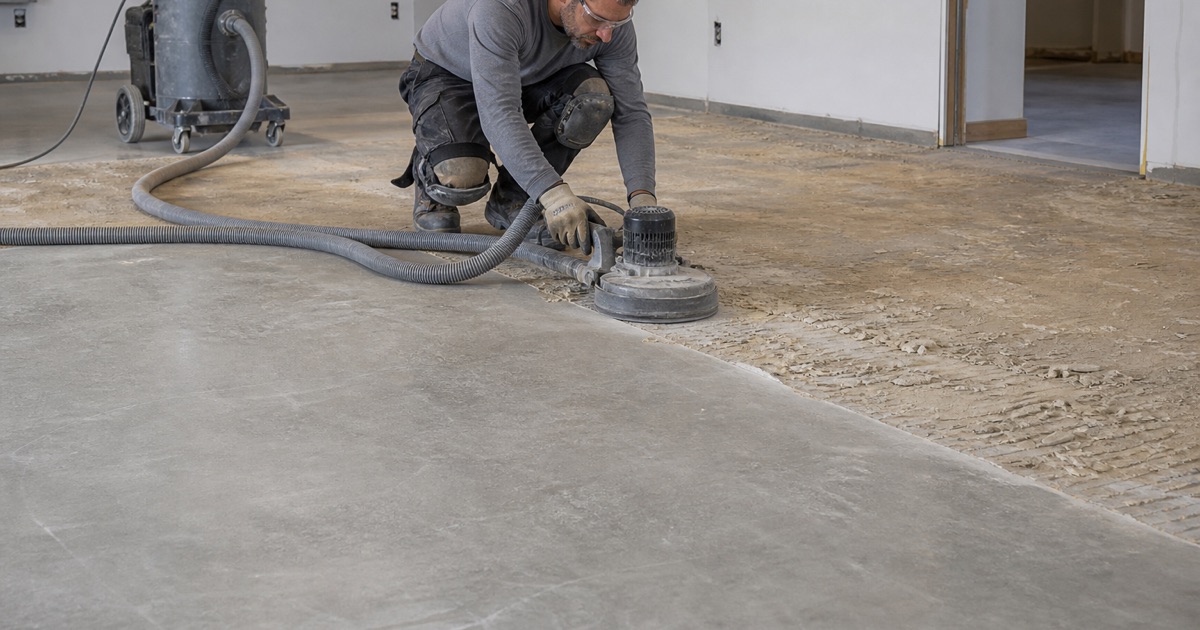
Carpet Adhesive, Mastic and Thinset
Glue left behind after carpet, vinyl or tile is the most common removal we do. Different adhesives behave very differently: some grind away cleanly, others soften under friction and clog tooling immediately. We use PCD attachments to shear the stubborn ones off before switching to diamonds. Some older black mastics warrant testing before they are disturbed, and we will say so rather than start grinding.
Failed and Existing Coatings
Peeling garage paint, consumer epoxy kits, industrial coatings at the end of their life and decorative systems all have to come off before anything new can bond. A coating that is releasing in patches is often harder to remove than one that is fully bonded, because the loose areas flex under the tooling instead of being cut.
Sealers and Curing Compounds
A slab that beads water has something on it, and that something will stop a coating or overlay from bonding. Curing compounds applied when the concrete was poured are frequently invisible and routinely missed. Grinding removes them along with the closed surface layer, which is the only reliable way to be sure they are gone.
Surface Contamination
Oil, grease and chemical spill that has soaked into concrete is a different problem from something sitting on top of it. We assess how deep it has gone, since degreasing a surface does nothing about what is below it. Where contamination runs deep, the honest answer is sometimes that a coating is the wrong choice for that area.
Profiling and Leveling
Grinding to a Stated CSP
Every coating and overlay specifies the surface profile it needs, measured on the ICRI CSP scale from 1 to 10. We prepare to the profile the specified system actually requires and hand over against that number. Preparing to a vague standard of clean is how a bond becomes a matter of luck rather than specification.
Choosing the Diamond Bond
Tooling is selected against the hardness of your concrete, and the rule is counterintuitive: hard concrete needs a soft bond so the matrix wears fast enough to keep exposing fresh diamond, while soft concrete needs a hard one. Getting it backwards either burnishes the floor without cutting it or destroys expensive tooling in an afternoon.
Shot Blasting Large Areas
On large open floors shot blasting profiles concrete faster than grinding and gives a consistently aggressive texture well suited to thicker coatings and overlays. It is less useful at edges and in tight spaces, so most substantial jobs use both: shot blasting for the field and grinding to the perimeter and around obstructions.
High Spots, Lips and Trip Hazards
Grinding takes material away, so it can remove a high point at a doorway, level a lipped joint between slabs, or take down a ridge left by a poor pour. How much can come off is limited by cover over reinforcement, and on a post-tensioned slab there are areas we will not cut into at all.
Dust, Access and Occupied Buildings
Dry Grinding With Extraction
We grind dry with machines connected to HEPA extraction, which contains the dust at source rather than releasing it and chasing it afterwards. This is what makes the work viable inside an occupied house, a trading shop or a running facility, where a wet slurry process would be unacceptable and considerably messier.
Containment and Protection
Working areas are sealed off from live ones, and doorways, fixtures and adjacent finishes are protected before machines start. Containment is far easier to establish at the beginning than to retrofit once fine concrete dust has found its way into a building’s air, so it is part of the setup rather than a response.
Preparing for Another Trade
We are frequently brought in ahead of tile setters, resilient flooring installers and other coating contractors who need a clean, profiled, contaminant-free slab to work onto. We agree the profile and flatness required with whoever is following us and hand over to that standard, which is usually cheaper than a finishing trade improvising preparation with the wrong tools.
- 20+ Years in Central Texas
- Fully Insured
- Free Written Proposal