Temple Epoxy Flooring provides concrete resurfacing across Temple, TX, serving surrounding cities including Belton, Copperas Cove, Gatesville, Cameron and Marlin. We rebuild worn, spalled and unevenly patched concrete indoors and out, using overlays, self-leveling systems and structural repair, and we have been assessing Central Texas slabs for more than twenty years.
Resurfacing is the category people arrive at when the two obvious options have already been ruled out. The slab is too rough and too patched to polish, and too damaged to take a coating directly. Something has to go on top of it, and the question is what, how thick, and whether the concrete underneath will hold still long enough to make it worthwhile.
That last question is the one we answer first. An overlay is bonded to the slab and inherits whatever the slab does, so on ground that moves seasonally the honest conversation about what will and will not come back through has to happen before the material is chosen, not after the first crack reappears.
Deciding What the Slab Needs
Sound Underneath, Finished on Top
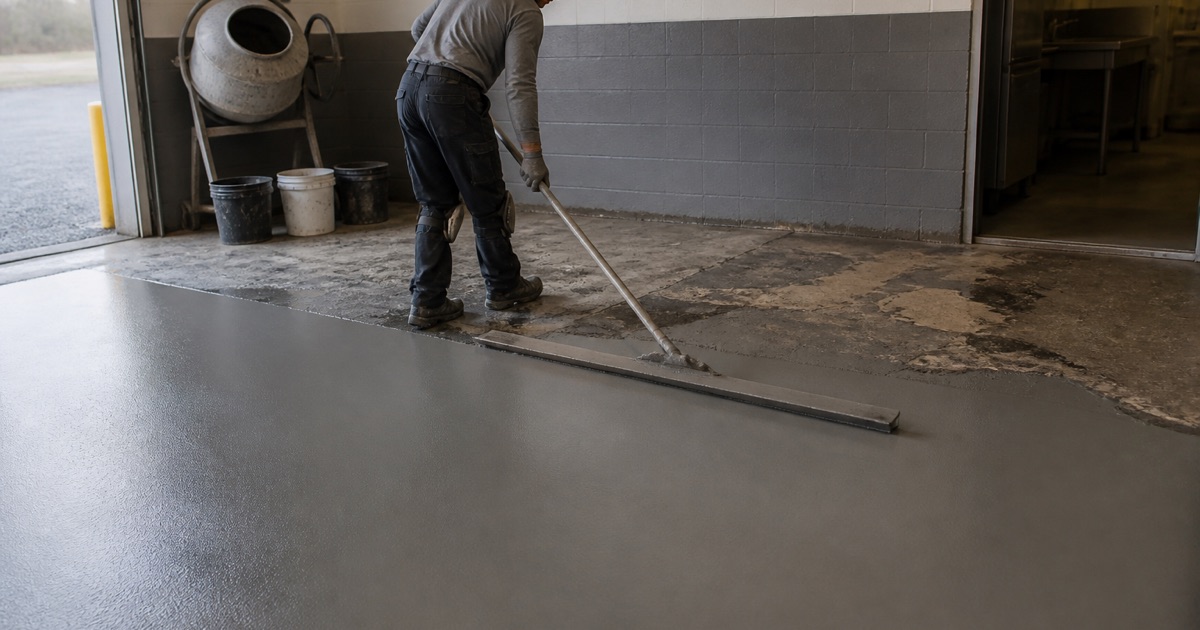
The ideal resurfacing candidate is a slab that has lost its surface but not its structure: pitted, spalled, stained, covered in old patches, worn through in traffic lanes, but still bearing properly and still in one piece. That floor can be rebuilt from the top down at a fraction of the cost and disruption of replacement.
When Replacement Is the Honest Answer
A slab that has broken into sections that move independently, dropped at one edge, or lost the support beneath it is not a resurfacing job. Putting an overlay on it buys a season and wastes the money. We say so plainly when we see it, even though replacement is not work we take on, because the alternative is selling you something we already know will fail.
Live Cracks Versus Dormant Ones
We assess every crack for whether it is still working, looking at edge condition, variation in width along its run and whether the two sides remain level. Dormant cracks are prepared and bridged. Live ones are carried through the new surface as joints, because an overlay cannot restrain movement that a slab several inches thick could not.
Checking for Hollow Areas
Before quoting we sound the floor for delamination — areas where the surface layer has already separated from the concrete below. Those have to be cut out rather than covered, since bonding a new overlay to a layer that is itself loose simply moves the failure plane down a level and hides it.
Overlay Systems We Install
Microtoppings
A microtopping is a thin polymer-modified cementitious skim applied in successive passes to give a fresh, continuous surface over sound concrete. It is a cosmetic system rather than a structural one: it renews appearance and evens out minor surface variation, but it adds almost no thickness and will not correct falls or bridge anything significant.
Polymer-Modified Overlays
A thicker polymer-modified overlay rebuilds a genuinely worn surface and can be finished smooth, textured, stamped or broadcast. The polymer content is what gives it adhesion and flexural strength at thicknesses where a plain sand-cement screed would simply crack. This is the workhorse system for driveways, patios and worn interior floors.
Self-Leveling Underlayment
Where a floor has real dips, falls in the wrong direction, or has to meet a fixed finished height, a self-leveling underlayment is poured and allowed to find its own plane. It corrects geometry rather than just appearance, and it is often the right precursor to a coating or a resilient finish that would otherwise telegraph every low spot.
Repair Mortars for Spalls and Edges
Localized damage — spalled patches, broken slab edges, damaged joint arrises, holes left by removed equipment — is cut back to sound concrete and rebuilt with a repair mortar chosen for compatibility with the substrate. Matching stiffness and shrinkage behavior matters, because a repair that is much harder than what surrounds it becomes the next failure point.
Exterior Resurfacing
Driveways and Aprons
A driveway surface takes hot tires, oil, UV and the full swing of Texas surface temperatures. Resurfacing one means choosing a system that tolerates thermal movement and bonds well to a slab that has usually been weathering for decades. Preparation matters more outdoors, not less, because the bond has to survive conditions an interior floor never sees.
Patios and Walkways
Outdoor living surfaces are usually resurfaced for appearance and for grip, and both are specification decisions. Texture has to be enough to stay safe when wet without being uncomfortable underfoot on a surface people walk on barefoot. Color choice is a temperature decision as well as an aesthetic one, since a dark surface in direct sun gets genuinely hot.
Freeze Damage and Surface Loss
Temple averages around thirty-three freezing nights a year, which is enough to drive freeze-related surface damage where water has been sitting in porous or already-damaged concrete. Resurfacing addresses the result, but where the cause is standing water we look at drainage as part of the job, because a new surface in a wet spot fails the same way the old one did.
Pool Surrounds and Wet Areas
Concrete around water takes constant wetting, chlorine or salt, and bare feet. Resurfacing these areas is as much about traction and surface temperature as about appearance, and the finish is chosen against how the space is actually used rather than how it photographs.
Preparation and Bond
Mechanical Preparation
Every overlay we install goes onto a mechanically prepared surface. Diamond grinding or shot blasting opens the concrete to a measurable ICRI CSP profile so the new material can key into it. Chemical etching is not a substitute: it leaves residues and a weakened layer, and an overlay bonded to that separates as a sheet rather than wearing gradually.
Removing What Is Already There
Old coatings, sealers, adhesives and curing compounds all interfere with bond and all have to come off. PCD tooling shears away the stubborn ones that would otherwise clog diamonds. This step is frequently the largest variable in an exterior quote, because what is on a thirty-year-old driveway is rarely obvious until grinding starts.
Moisture in the Slab
Cementitious overlays are considerably more tolerant of slab moisture than resin coatings, which makes resurfacing a genuine option on floors where moisture testing has ruled out an epoxy system. Where the finished floor is going to be sealed or coated afterwards, we test to ASTM F1869 or ASTM F2170 against ASTM F710 thresholds, because the covering brings the moisture question straight back.
Priming and Bond Coats
Most systems need a bond coat or primer suited to the substrate and the overlay, applied within a working window so the two materials link properly. Applying an overlay to a primer that has been allowed to dry past its window is a common and avoidable cause of hollow, drummy floors that sound wrong the moment you walk on them.
Timing, Temperature and Handover
Slab Temperature
Cementitious materials are as sensitive to conditions as resin ones, just in different ways. A hot slab pulls water out of an overlay too quickly, which weakens the surface and can craze it. On a Central Texas summer afternoon a slab in direct sun runs far above air temperature, so exterior work is scheduled to the surface rather than the forecast.
Cold and Cure
Below about forty degrees most cementitious overlays gain strength very slowly, and freezing before the material has developed strength destroys it. Around thirty-three freezing nights a year is enough that scheduling matters at both shoulders of the season, and we move a date rather than install into a cold snap and hope.
Return to Service
We hand over with the dates that matter written down: when the surface takes foot traffic, when it takes vehicles, and when any sealer or coating over the top has reached its own cure. Those are three different numbers, and the gap between them is where most fresh overlays pick up the damage they carry for the rest of their life.
- 20+ Years in Central Texas
- Fully Insured
- Free Written Proposal