
Temple Epoxy Flooring installs commercial epoxy flooring across Temple, TX, serving surrounding cities including Belton, Killeen, Waco, McGregor and Harker Heights. We coat warehouse and distribution floors, manufacturing areas, clinical and hospital support spaces, service bays, commercial kitchens and retail back-of-house, and we have been working in occupied buildings in this region for more than twenty years.
Temple carries more industrial and institutional floor area than a city of its size usually does, between the hospital systems, the distribution and rail infrastructure, and the manufacturing based here. That mix means commercial work here is rarely one specification repeated. A clinical corridor, a chilled store, a forklift aisle and a dish room are four different problems.
The constraint they share is that the building cannot stop. Almost every commercial floor we install goes in around an operation that has to keep running. Phasing, containment and honest return-to-service times matter as much as the resin does.
Specifying to the Actual Use
Traffic and Build Thickness
Build is specified against the traffic the area really takes rather than uniformly across a building. Forklift aisles, dock aprons and turning areas concentrate load into narrow bands and need considerably more thickness than the open floor around them. Applying one build everywhere either overspends on quiet areas or underbuilds the ones doing the work.
Chemical Exposure
What gets spilled decides the chemistry. Battery-charging areas see acid, kitchens see hot water, grease and food acids, workshops see solvents and brake fluid, and a plant floor may see all of them in different bays. We specify by zone against what is actually handled there, because a general-purpose floor in an aggressive area degrades quietly and then quickly.
Slip Resistance by Zone
Traction is set where it is needed rather than across the whole facility. A wet process area, a walkway beside it and an office corridor want different levels, and over-texturing a floor that gets cleaned by machine makes it harder to keep clean. We agree the zones and the finish for each, and mark them on the specification.
Thermal and Impact Loads
Areas taking steam cleaning, hot discharge or thermal shock need urethane cement rather than a standard epoxy build, because the two materials behave very differently when the temperature swings. Impact from dropped stock or tooling is a separate question again and is answered by build thickness and resilience rather than by hardness alone.
Joints, Moisture and Substrate
Joint Detailing
Joints are where industrial floors fail first. Hard polyurethane wheels hammer any unsupported joint edge until it spalls, and a coating carried rigidly across a working joint cracks along the line of it. We fill joints with a semi-rigid polyurea that supports the edges while still accepting movement, and we carry genuine movement joints through the finish rather than burying them.
Moisture Testing at Scale
On a large slab we test to ASTM F1869 or ASTM F2170 against ASTM F710 thresholds across a grid rather than at one point, because a big floor is rarely uniform and a single reading is not representative. Where results are high we specify a moisture-mitigation primer under the system, priced properly rather than discovered halfway through.
Ground Movement Under a Big Slab
The reactive clay soils in parts of this area move seasonally, and a large slab bridging that ground shows it. A resin floor is a film and follows the concrete exactly, so live cracks are detailed as joints and disclosed rather than filled solid. On a facility floor this is a maintenance conversation to have at specification stage.
Existing Coatings and Contamination
Old coatings, curing compounds, and oil driven into the slab all have to be dealt with before anything new goes down. We grind or shot blast to a measurable ICRI CSP profile and use PCD tooling where an old film would otherwise clog the diamonds. Deep oil contamination sometimes means grinding further or reconsidering the system entirely.
Working Around an Operation
Phasing and Containment
Work is broken into sections sized to what can be prepared, coated and returned to service within the window available. The working area is hoarded and kept under dust extraction so the live side of the building carries on. We agree the sequence with your operations lead rather than presenting one, because they know the flows we would guess at.
Nights, Weekends and Shutdowns
Many commercial floors go in outside operating hours, which is where fast-cure polyaspartic systems earn their cost. Where a genuine shutdown window exists we plan the largest sensible sections into it. Either way the constraint driving the schedule is cure time rather than application time.
Return to Service
We give foot-traffic and full-load dates for each section in writing. These are different figures and the gap matters, because putting racking or a loaded forklift onto a floor that is walkable but not cured marks it permanently. Agreeing the numbers in advance stops a section being reoccupied early on the assumption that it looks finished.
Line Marking and Zoning
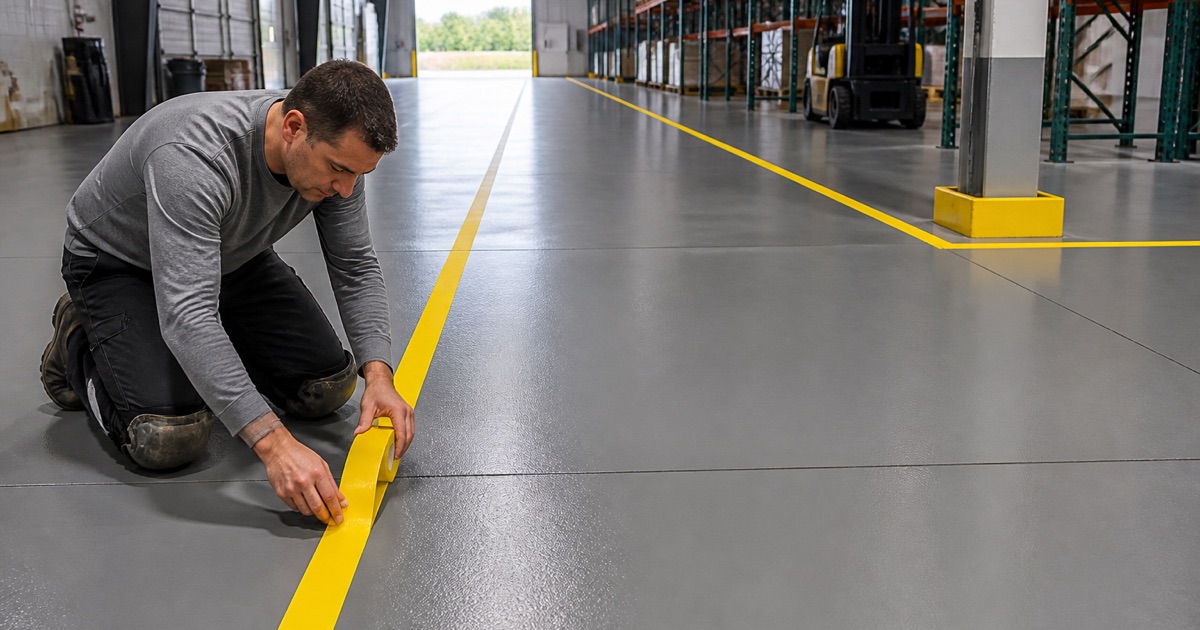
Aisle lines, walkways, racking positions, hazard zones and equipment footprints are laid into the system so they wear with the floor rather than off it. Marking applied on top of a completed floor is scrubbed off by exactly the traffic it exists to organize, so it goes in as part of the build.
- 20+ Years in Central Texas
- Fully Insured
- Free Written Proposal