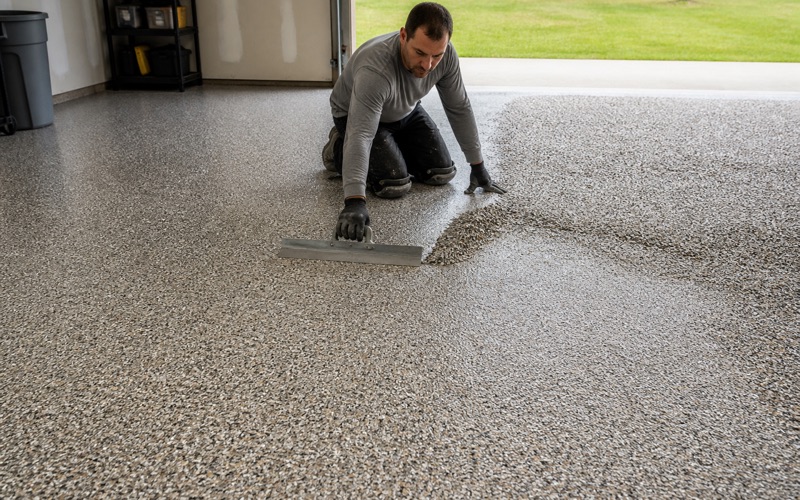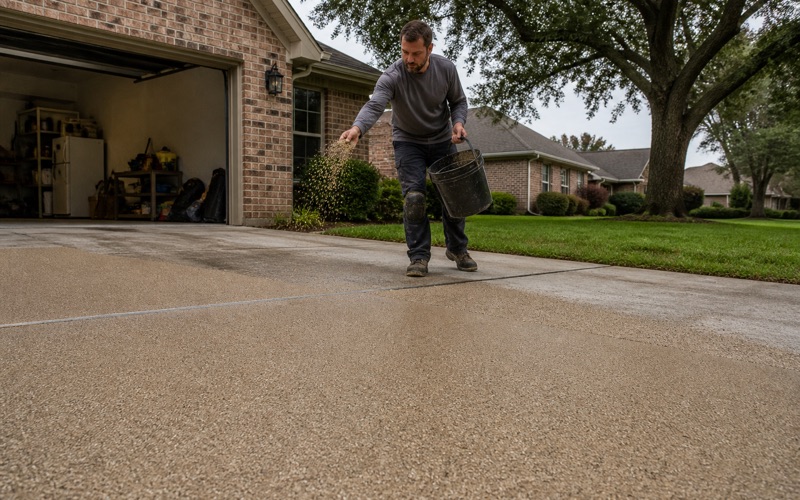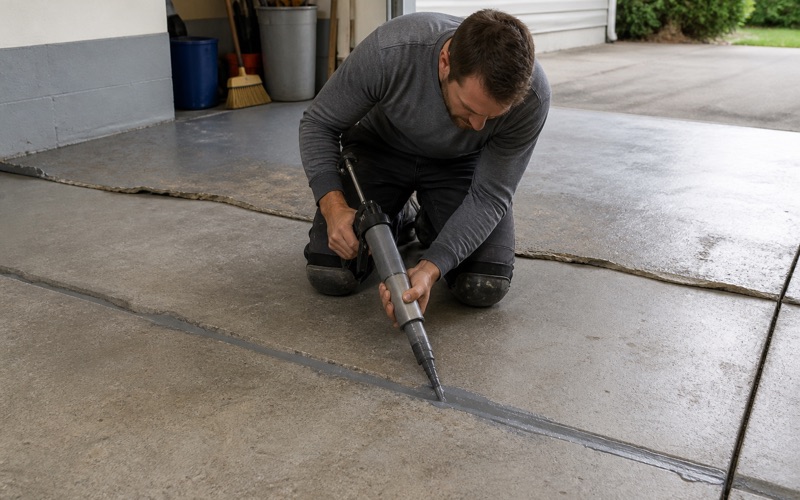
Temple Epoxy Flooring installs epoxy flooring in Cameron, and after more than 20 years on Central Texas concrete we have learned that the interesting question here is not which product goes down but what is already underneath. This is an old town being worked on building by building, and almost every floor we are asked to quote has a history somebody has to uncover first.
So we check what the slab actually sits on before we price anything. A surface that looks like one pour is often three, and a floor that reads as original concrete can turn out to be a topping laid over an earlier finish. That is a survey, not a guess, and it happens before a number goes on paper.
We also say plainly what a coating cannot do. It is a film. It bonds to whatever is directly beneath it and it follows that surface, so it can neither stop ground movement nor rescue a substrate that is coming apart. The rest of this page is about establishing what we are bonding to.
A courthouse square being renovated one storefront at a time
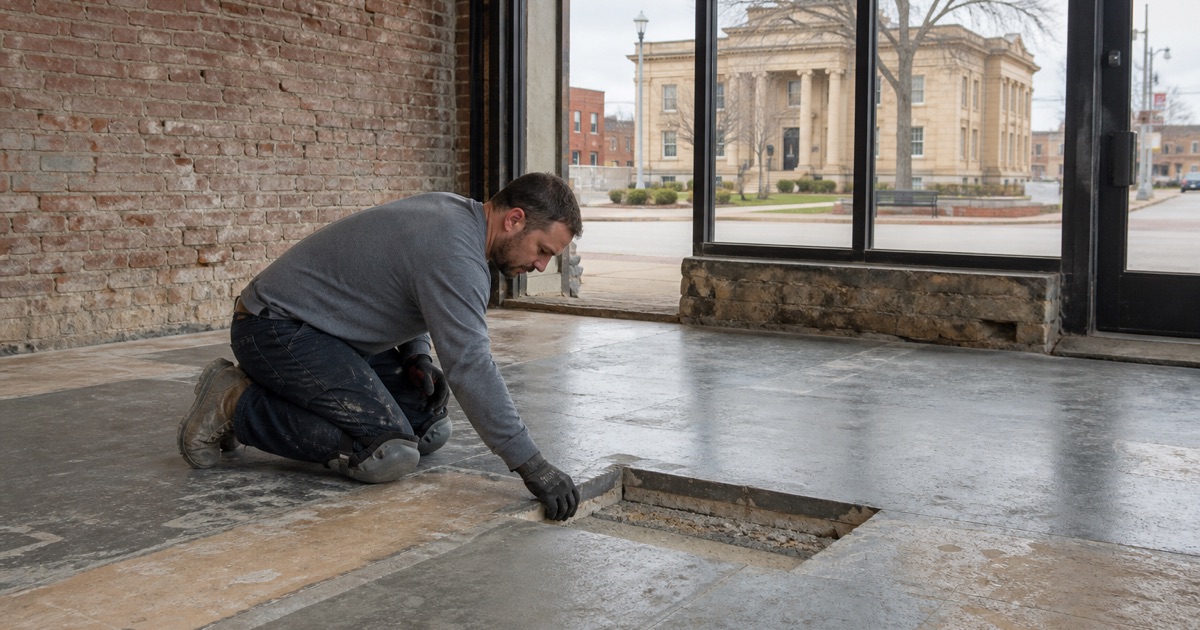
A renovation wave that has been running since October 2021
Since October 2021 the City of Cameron and its downtown square have been in a documented renaissance, with the community renovating the historic buildings one at a time. That is a steady supply of commercial floor work, and it is the most interesting work in this city right now because no two of those floors are the same.
A storefront brought back into use is a floor job before it is anything else. The tenant knows what the space is going to be, the owner knows the budget, and nobody yet knows what is under the tile, the carpet glue or the vinyl that came up last week. We quote that honestly, with the survey and the preparation broken out rather than buried in a square-foot rate.
What is actually under a century-old storefront floor
12.3 percent of this city’s buildings predate 1940, and a slab of that age has usually had a long career. What we typically find is an original slab carrying decades of patching, cutback adhesive, mastic and localized repairs, or else a newer slab poured over an older floor with whatever was between them still in place.
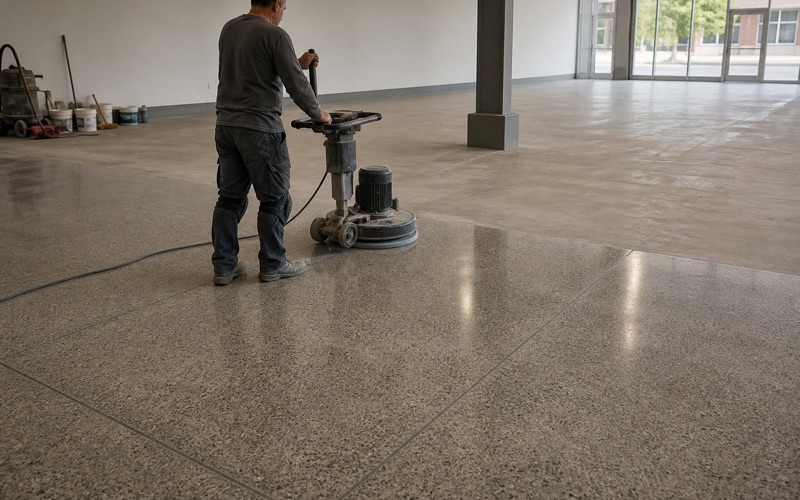
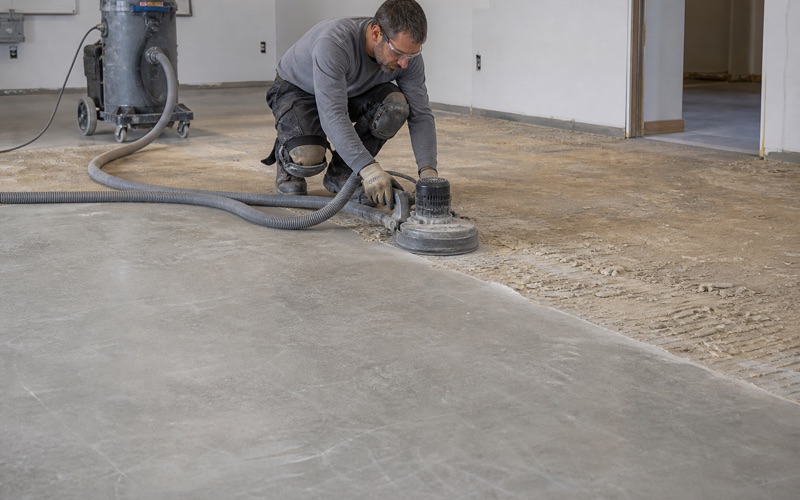
That build-up governs the whole specification. A resin system bonded to old adhesive residue is only as good as that residue’s grip on the concrete, which is why we never coat over an existing sealer and never acid etch. Every slab is mechanically ground or shot blasted to the ICRI CSP profile the system calls for, and if a failed coating has to come off first, PCD tooling and the right diamond segment bond hardness are a separate line in the proposal.
When the storefront is going to serve food
A good share of square renovation ends up as a kitchen, a bar or a service counter, and that changes the rules rather than the color. The Texas Food Establishment Rules and the Food Code provisions on smooth, durable, easily cleanable surfaces, on coved floor and wall junctures and on the antislip exception are what a health inspector reads the floor against.
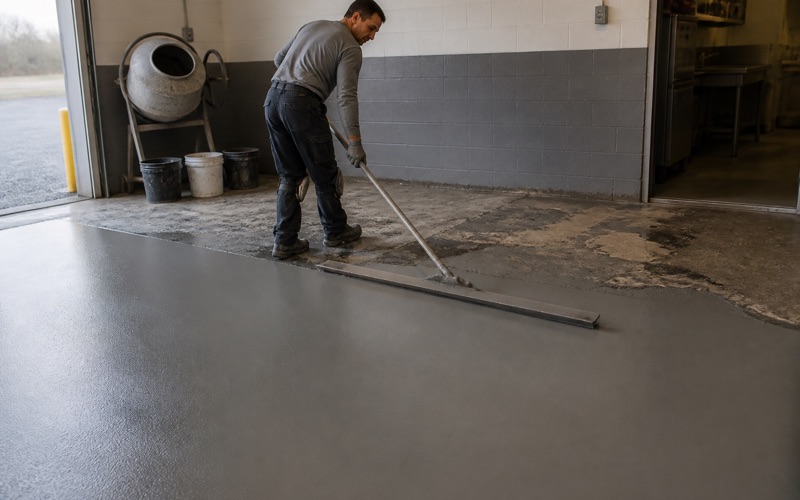
In practice that usually points away from a standard epoxy and toward urethane cement with an integral coved base, finished to a coefficient of friction that stays safe when the floor is wet. Our proposal names the product, the system build and the mil thickness so what was quoted can be checked against what was installed, which matters when an inspection is waiting at the end of it.
Looking for epoxy flooring closer to Copperas Cove? See Epoxy Flooring Services in Copperas Cove.
Reading the ground under this town
Sand on top and clay underneath
The soil survey at the Cameron city centroid maps Minwells fine sandy loam on 1 to 5 percent slopes, with Minwells at 92 percent of the map unit. It is a fine, mixed, active, thermic Udic Paleustalf, well drained, which is to say an Alfisol rather than the shrinking clay this region is generally assumed to sit on.
The profile has to be read horizon by horizon to be useful. The top 23 centimeters carries 13 percent clay, a plasticity index of 8 and linear extensibility of 1.0 percent, which is genuinely sandy. Directly beneath it, from 23 to 51 centimeters, sits an argillic horizon at 42 percent clay, plasticity index 30 and linear extensibility 4.8 percent, and it stays clayey down to 117 centimeters.
Moderate movement, and where the real risk sits
Linear extensibility of 4.8 percent in the layer a slab bears against is a real seasonal load that the coating and its joints have to tolerate, but it is moderate rather than severe. Where we find a crack that is genuinely still working, we treat it as a live joint with a semi-rigid polyurea filler and tell you in advance that the line may telegraph again rather than fill it rigid and coat over it.
The bigger risk here comes from the same profile read the other way. Water moves easily through a sandy surface and then meets a 42 percent clay horizon that it does not move through, which perches moisture at roughly the depth a slab sits. Moisture arriving at the underside of a slab is what lifts a coating, and in this city that is a likelier failure than gross heave.
Moisture testing written into the scope
Because of that, moisture testing goes into the scope on an older slab from the start rather than being sold as an add-on after a floor has blistered. Depending on the slab that means ASTM F1869 calcium chloride vapor emission testing, ASTM F2170 in-situ relative humidity probes, or an ASTM D4263 plastic sheet test as a fast screen, all read against the ASTM F710 thresholds.
If the readings come back high, the answer is a moisture-mitigation primer under the build, priced before the work starts. Walking away from a job that needs one, or coating over it and hoping, is how a contractor ends up back in the same building a year later with nothing good to say.
An old housing stock and what it implies about a garage slab
Nearly three quarters of this town predates 1980
Of 2,119 total housing units, 73.4 percent were built before 1980 and 14.3 percent before 1950, while only 9.7 percent went up in 2000 or later and the estimate records nothing at all built since 2020. Cameron has been the seat of Milam County since it was laid out in 1846 on a sixty-acre tract of Daniel Monroe’s headright along the Little River, and the population has sat below its late-1950s peak of about 7,500 for roughly seventy years.
For this trade the consequence is mechanical. Post-tension slabs became common in Texas only after about 1980, so the modal garage slab in this city is conventionally reinforced ground-supported concrete. That widens what can safely be cut, cored or anchored compared with newer stock, though we still confirm the construction of a specific slab before a saw comes out.
The 1970s cohort is the single biggest job type here
The 1970s alone account for 34.6 percent of the housing stock, more than double any other decade. That is one identifiable population of garage slabs, now around fifty years old, mostly attached single or narrow double bays, carrying five decades of oil staining, hot tire pickup and whatever coatings somebody tried along the way.
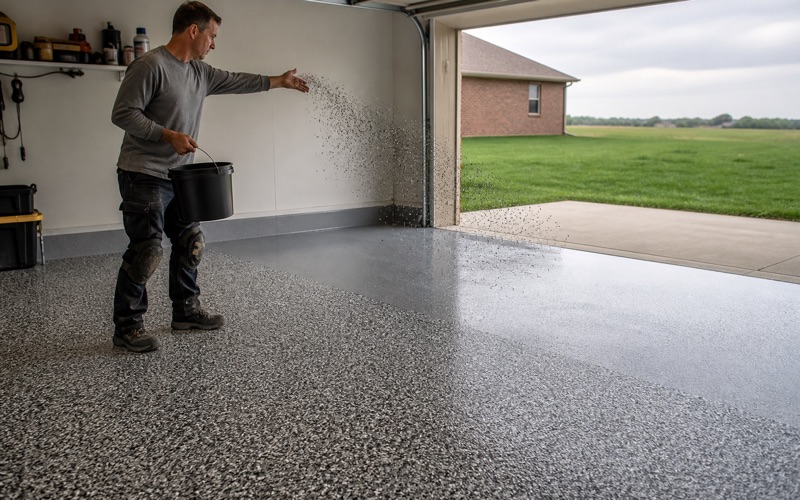
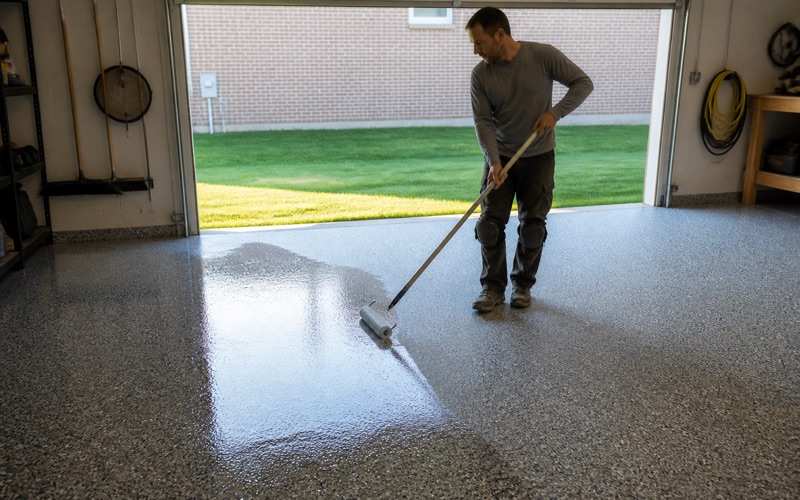
On that stock the work is a preparation and remediation problem before it is a coating problem. Grinding back to sound concrete, dealing with oil that has soaked into the surface, opening and refilling joints, and rebuilding a spalled edge at the door line are where the hours go. A 100 percent solids epoxy body at the specified mil build, topped with a polyaspartic or polyurea, then does the easy part.
Older blocks, rear garages and small multiplex
Around the older blocks near the courthouse square, the garage is often a detached structure reached down a long side driveway, with a narrow opening sized for a one-car household. Getting a grinder, a vacuum and material back there is a real part of the cost, and we would rather look at the access before quoting than discover it on the morning.
This town also carries an unusual amount of small multiplex for its size: 286 units in three- or four-unit structures, every one of them rented, plus 86 in two-unit structures. Those buildings generate common areas, laundry rooms and entry landings where the floor has to be cleanable and slip resistant on a maintenance budget, which is a different specification from a private garage.
The application window in this climate
Dew point at the slab surface is what closes the morning
We schedule against the dew point at the slab surface rather than the air temperature, which is why we usually start mid-morning in summer instead of at dawn. A published requirement that the surface stay at least 5 degrees above the dew point is easy to breach on a cool slab in a humid Central Texas morning, and breaching it produces amine blush or a bond failure nobody sees until later.
The humidity here is as high as anywhere we work. A recent National Weather Service gridpoint forecast for this grid carried dew points from 61 to 75 degrees and relative humidity from 27 to 94 percent. At a 75 degree dew point and 94 percent humidity there is no early start worth taking, and we will move a day rather than force one.
Heat, pot life and surface temperature
The same forecast period ran from 73 to 101 degrees. On one published product, pot life falls from roughly 60 minutes at 55 degrees to about 40 minutes at 72 degrees and about 20 minutes at 95 degrees, while the minimum recoat window collapses from 24 hours down to about 6.
A twenty-minute pot life changes crew size and batch size, not just the start time. An uninsulated fifty-year-old garage slab under a 101 degree afternoon can also approach the 160 degrees maximum surface temperature a technical data sheet allows, which is a genuine reason to stop for the day rather than a cautious one.
Freezes, permits and what we can show you
Winter carries the opposite risk. Winter Storm Uri ran February 11 to 21, 2021, affected all 254 Texas counties and gave Central Texas six to nine consecutive days of freezing temperatures. An unheated building in a freeze sits below the minimum application temperature on every product data sheet worth reading, so a February date carries real multi-day shutdown risk and we say so when we take it.
On permits we confirm rather than assume. A job inside the city limit goes through the City of Cameron and we verify the current permit path and adopted code edition with the city before scheduling, because that is the sort of detail worth a phone call. A commercial job outside the city line picks up the county layer instead, including the Milam County Fire Marshal’s office, which runs its own permitting separate from any city approval.
Texas does not license flooring or coatings contractors, so there is no license number for anyone in this trade to produce. What we can show you is general liability cover, workers’ compensation, a Texas sales and use tax permit and city contractor registration. We also go through the warranty exclusions before the job is sold, moisture and substrate movement first among them.
- 20+ Years in Central Texas
- Fully Insured
- Free Written Proposal