Temple Epoxy Flooring has been installing epoxy flooring in Belton for more than 20 years, and a commercial floor in this city gets scheduled around two dates before it ever gets scheduled around a crew. One of them is a review meeting. The other is a code changeover with a fixed date attached to it. Both belong in the conversation long before anyone talks about color or flake blend.
We work a storefront finish-out the same way we work a small shop bay. We look at what the slab actually is, what is already stuck to it, and what the building owner is required to have approved before a permit is issued. The proposal that comes back names the product, the system build and the mil thickness, so what was quoted can be checked against what was installed.
We also say plainly what a coating cannot do. Epoxy is a film — it bonds to the concrete and it follows the concrete, which means it does not stop seasonal ground movement and it will not bridge a slab that is still working. What it delivers is a sealed, cleanable, chemically resistant and abrasion-resistant surface, and being precise about that up front saves everyone a bad conversation later.
Two dated constraints stacked on one storefront job
A Certificate of Appropriateness comes before the building permit
The City of Belton designates five local historic districts, and its Historic Preservation Commission reviews Certificate of Appropriateness applications. Exterior and storefront work inside a district carries that review ahead of the building permit. The commission meets on its own calendar, so on a downtown job the start date is set by a meeting date rather than by when we have a crew open.
The two district boundaries downtown are routinely confused. The federal Belton Commercial Historic District is on the National Register under reference 90001868, listed December 26, 1990, covering roughly 15 acres over about eight blocks around the courthouse. The city’s own Downtown Belton Commercial Historic District is larger and different, covering 120 properties of which 45 are contributing, and it is the city designation that drives the review.
A code edition that changes on October 1, 2026
Belton currently enforces the 2015 ICC I-Codes together with the 2014 NFPA National Electrical Code. The 2024 ICC codes and the 2026 NEC take effect October 1, 2026. A finish-out permitted before that date and the same finish-out permitted after it are reviewed against editions nine years apart, and that changeover falls squarely inside a normal build season.
For a floor package this is a scoping question rather than a footnote. Slip resistance expectations, occupancy classification, accessible thresholds and the coordination between our work and the mechanical and electrical trades all read off whichever edition the permit is written under. We would rather know which side of the date a project lands on while the scope is still being written than discover it during plan review.
Registration, the portal, and the money attached to a facade
Applications, plan submissions, inspection requests and permit tracking all run through the MGO Connect portal, and contractors register with the city through MGO as part of the application procedure. A contractor who has not registered has not started. The Planning Department sits at 333 Water Street, and the Fire Department publishes its own separate fee schedule.
Texas does not license flooring or coatings contractors, so rather than quote a license number that does not exist, we show general liability cover, workers’ compensation, a Texas sales and use tax permit and our city contractor registration. On the funding side, Belton’s Facade Improvement Grant Program, established in 2006, offers 50/50 matching grants up to $10,000 per facade and up to $20,000 where a building has two street-facing facades — often the reason a downtown project gets built at all.
Looking for epoxy flooring closer to Nolanville? See Epoxy Flooring Services in Nolanville.
What a Belton slab is actually sitting on
Denton silty clay: reactive at the surface, steady underneath
We check what a slab sits on before we quote, because the answer changes the conversation. SSURGO at the Belton city centroid maps Denton silty clay on 1 to 3 percent slopes, with Denton at 85 percent of the map unit — a fine-silty carbonatic thermic Udic Calciustoll, well drained. That is a Mollisol, not a Vertisol, and it does not behave like the deep reactive clay some of this region is known for.
The profile tells the story. The top 33 centimeters run 50 percent clay with a plasticity index of 37 and linear extensibility of 12 percent, which is genuinely active ground. Below 48 centimeters that drops to 25 percent clay, a plasticity index of 20 and linear extensibility of only 3 percent, falling to 2.1 percent deeper still. A slab here rides an active surface layer over a stable subsoil.
Downtown is mapped as urban land, and that is a finding
At the courthouse block, SSURGO returns “Urban land, 0 to 16 percent slopes” at 85 percent of the map unit, with no published clay content, no plasticity index and no linear extensibility. On the oldest and most historically significant blocks in the city, the soil survey simply does not answer the question. That is not a gap we paper over with a guess.
What we do instead is read the slab itself. Crack pattern and width, curled edges, spalled joints, how the floor sounds under a hammer, and how adjacent mapped units behave tell us more than a figure that was never published. On buildings running from 1870 to 1959, that inspection is the only honest basis for a specification.
A film follows the slab, and we say so before the job
An epoxy coating is a thin, high-modulus film bonded to concrete. It does not stop seasonal ground movement, it does not bridge a slab that is still working, and no coating will hold a moving crack closed. What it genuinely delivers is a sealed, cleanable, chemically resistant and abrasion-resistant surface over the concrete that is there.
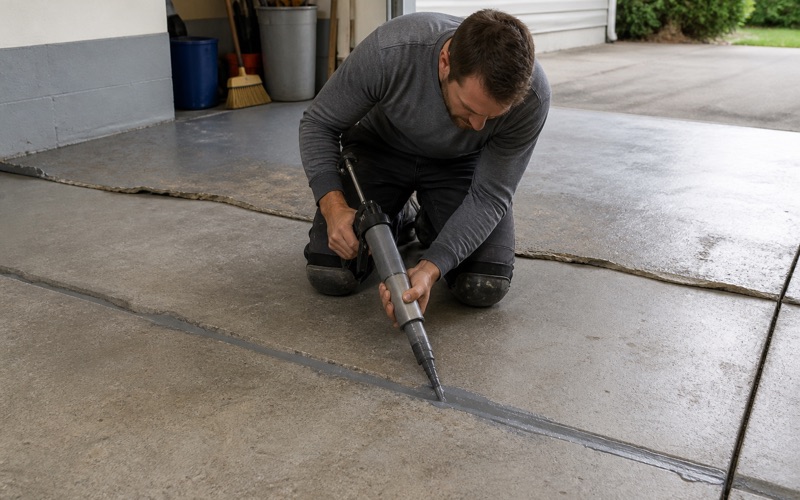
So a crack over moving ground gets treated as a live joint rather than filled rigid and coated over. We route it, fill it with a flexible sealant, and honor it through the coating as a joint, and we tell the owner before the job that it may telegraph again. That detail is a maintenance item, not a permanent repair, and the warranty exclusions — substrate movement and moisture first among them — get explained before anything is sold.
Century-old commercial floors and what is stuck to them
Every slab is ground or shot blasted
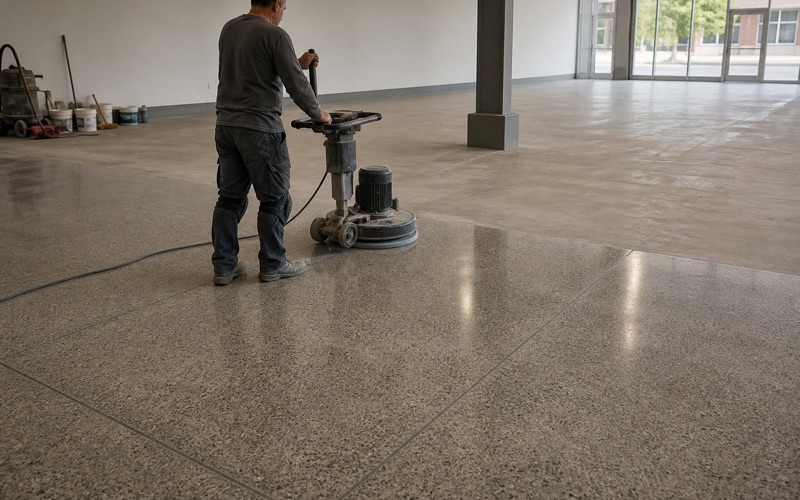
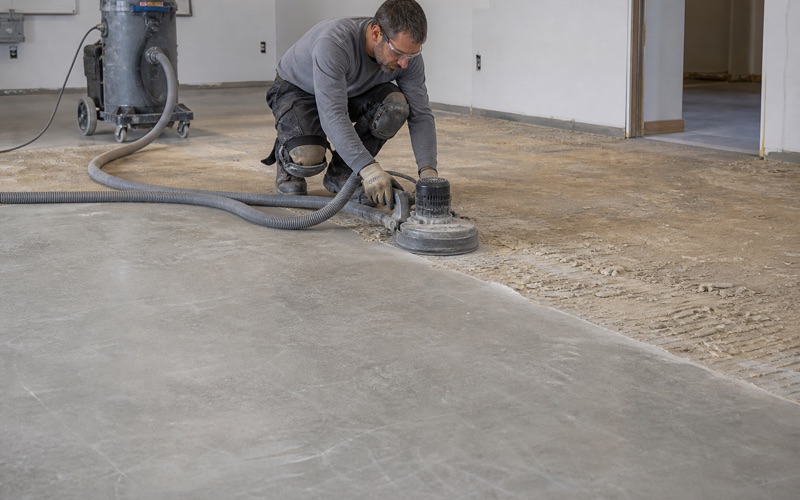
We do not acid etch and we do not coat over an existing sealer. Every slab is mechanically profiled with diamond grinding or shot blasting to an ICRI CSP surface profile appropriate to the system going down, with diamond segment bond hardness matched to how hard or soft the concrete turns out to be. On a soft, old, carbonatic-influenced slab that choice makes the difference between cutting and polishing.
Downtown commercial floors carry layers of history. Cutback adhesive, sheet vinyl, thinset, quarry tile beds and a generation or two of sealer are all common here, and PCD tooling handles removal that a grinding segment would only glaze. We price removal as removal, because a floor that has already had a failed coating on it is a different job from bare concrete.
Moisture testing belongs in the scope, not in the invoice afterward
On an older slab, moisture testing is written into the scope rather than sold as an add-on after a floor blisters. Moisture vapor emission through the slab is the most common cause of epoxy adhesion failure on concrete, and under-slab vapor retarders were not standard practice on older Texas slabs. Downtown Belton has plenty of floors that predate the idea entirely.
We measure it rather than assume it: calcium chloride vapor emission testing to ASTM F1869, in-situ relative humidity probes to ASTM F2170, a plastic sheet test to ASTM D4263 as a quick screen, and the results read against ASTM F710 thresholds and the product’s own limits. Where the numbers come back high, a moisture-mitigation primer goes in the specification and the price before installation, not after.
Matching the system to what the space actually does
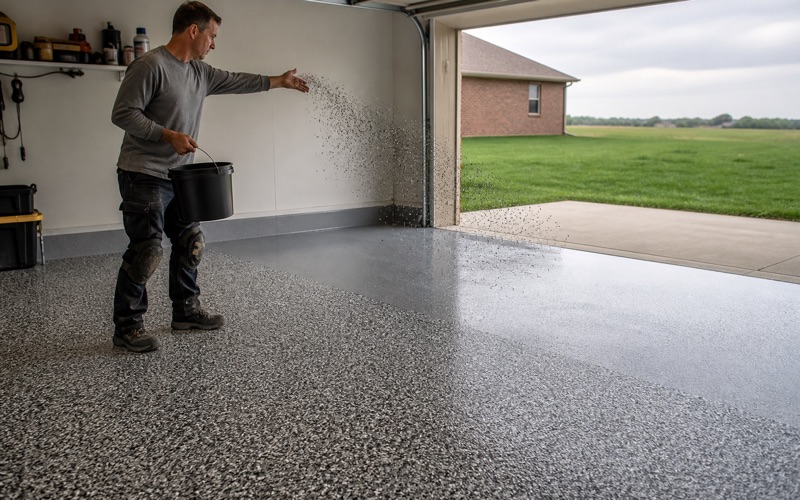
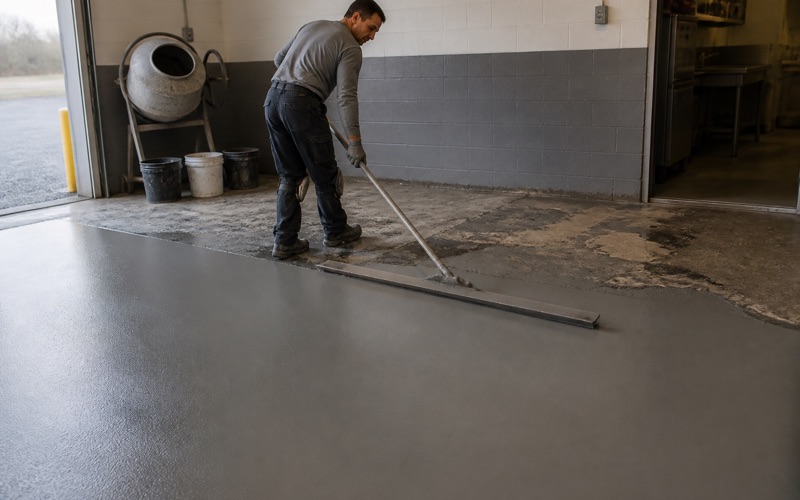
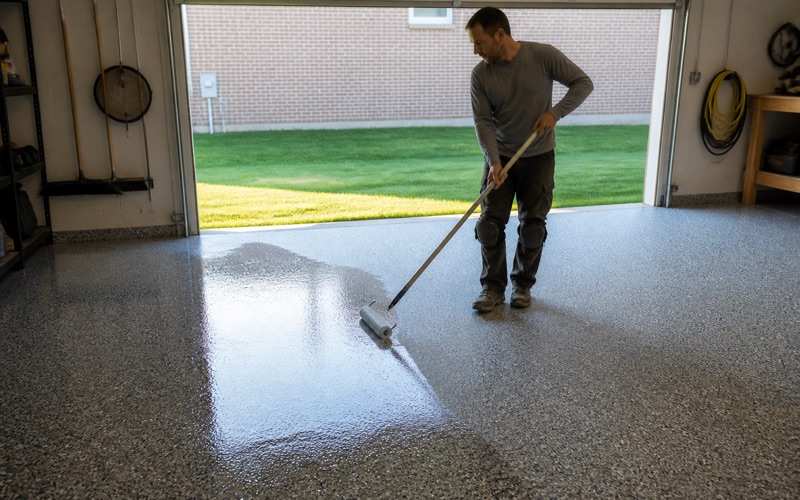
A downtown storefront covers a lot of uses. A retail sales floor wants a decorative vinyl flake or quartz aggregate broadcast with a polyaspartic or polyurea topcoat for fast return to service and good abrasion resistance. A back-of-house prep area is a different animal: urethane cement holds up to thermal shock, hot water washdown and the sanitizers that go with it in a way a standard epoxy build does not.
For a food establishment, the surface has to be smooth, durable, nonabsorbent and easily cleanable under FDA Food Code 2017 section 6-101.11, which is also how the Texas Food Establishment Rules at 25 TAC Chapter 228 read it. Section 6-201.11 makes an antislip exception where safety requires it, and section 6-201.13 covers coved floor and wall junctures, which is why we build an integral coved base into those spaces rather than treating it as trim.
Scheduling a coating installation in Belton
We schedule against the dew point at the slab, not the air temperature
Manufacturer data sheets commonly require the slab surface to sit at least 5 degrees above the dew point during application and cure. The NWS gridpoint forecast for the Belton grid issued August 17, 2026 carried dew points from 58 to 73 degrees Fahrenheit and relative humidity from 24 percent to 85 percent. At a 73 degree dew point, the slab has to be above 78 degrees, and a cool humid morning with a door propped open does not get there.
That is why we start mid-morning in summer rather than at dawn. A slab that is still holding overnight temperature while humid air moves across it is the classic recipe for amine blush and a hazy, poorly bonded first coat. We take a surface reading, not a phone weather app reading, and we will hold a start rather than lay a coat into a condensing surface.
Heat, pot life and how the summer window really works
The same forecast period carried daily maxima of 101 to 103 degrees Fahrenheit with minima only falling to 74 to 78 degrees, so a summer slab never fully sheds its heat overnight. On one published product, pot life runs roughly 60 minutes at 55 degrees Fahrenheit, about 40 minutes at 72 degrees, and about 20 minutes at 95 degrees, while the recoat minimum collapses from 24 hours to 6 hours.
A mix that is comfortable in March is a twenty-minute batch in August, and an uninsulated slab here can approach the 160 degrees Fahrenheit maximum surface temperature a data sheet allows. We plan crew size, batch size and spread rate around that. Product selection also accounts for the architectural coatings rule at 40 CFR 59 Subpart D, which caps VOC content by category.
Winter risk, and the days downtown is not available
February carries a genuine risk of a multi-day shutdown. Winter Storm Uri ran February 11 to 21, 2021 and affected all 254 Texas counties, with six to nine consecutive days of freezing temperatures in Central Texas — the longest freezing streak in the state’s recorded history and the coldest storm here since December 1989. A two-part epoxy that drops below its minimum application temperature mid-cure does not just cure slowly; it can fail to cure at all.
Downtown has its own calendar too. The July 4 parade runs 1.5 miles from 9 a.m., south on Main Street, which is FM 317, from the university to the Bell County Courthouse, then east on Central Avenue and north on Birdwell to the Police Memorial, drawing an estimated 30,000 spectators. Main Street closes, staging is impossible, and a storefront job planned across that date loses the day. We build those dates into the schedule at the proposal stage.
- 20+ Years in Central Texas
- Fully Insured
- Free Written Proposal